


nCa Report
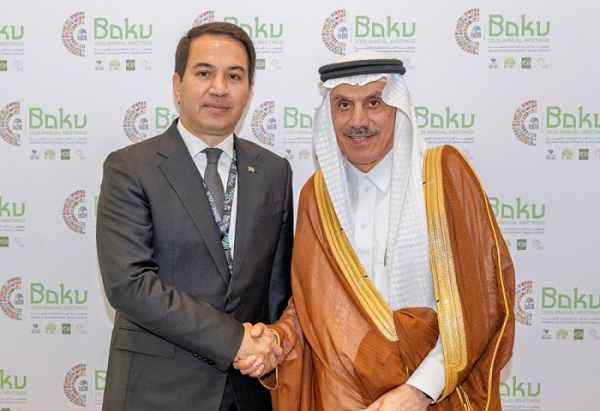
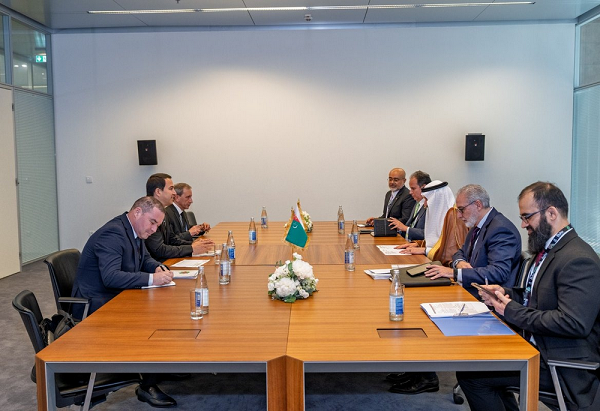
The Islamic Development Bank Group (IsDB) has reaffirmed its growing partnership with Turkmenistan, with the total volume of approved financing for the country reaching $1.38 billion across 30 operations, according to information released following a meeting between Rahimberdi Jepbarov, Chairman of the State Bank for Foreign Economic Affairs of Turkmenistan and IsDB Governor for Turkmenistan, and Dr. Muhammad Al Jasser, President of the IsDB Group.
The meeting took place on the sidelines of the 51st Annual Meetings of the Islamic Development Bank Group, being held in Baku from 16 to 19 June under the theme “Regional Integration for Sustainable Prosperity.” The gathering has brought together ministers, central bank governors, development institutions, private-sector leaders and international organizations from the IsDB’s 57 member countries. More than 2,000 participants are expected to attend the event.
According to the IsDB Group, discussions focused on expanding cooperation in areas that align closely with Turkmenistan’s development priorities, including transport connectivity, trade finance and long-term socio-economic development. The emphasis on connectivity is particularly significant given Turkmenistan’s goal to position itself as a major transit hub linking East and West as well as North and South.
Long-standing partnership
The latest figures underscore a relationship that has steadily expanded over nearly two decades.
One of the earliest landmark projects was the Bank’s involvement in financing the Bereket–Etrek railway line, a key segment of the North–South transport corridor connecting Central Asia with Iran and the Persian Gulf. In 2009, the IsDB and Turkmenistan signed a memorandum of understanding aimed at supporting the project, which was widely viewed as an important component of the revival of historic Silk Road connectivity.
The Bank has also supported the modernization of Turkmenistan’s transport infrastructure. In 2021, the IsDB approved $90.15 million for the Maritime Transport Development Project, which included the construction of three vessels at the Balkan Shipyard in Turkmenbashi. The project was designed to strengthen maritime transport operations through Turkmenbashi International Seaport, a strategic gateway on the Caspian Sea and an important link in transcontinental transport corridors.
According to the IsDB, the maritime project aimed not only to improve transport efficiency but also to develop domestic shipbuilding capabilities, create employment opportunities and introduce environmentally improved technologies.
Connectivity and regional integration
The focus of the Baku discussions mirrors the broader agenda of this year’s IsDB Annual Meetings. Organizers have placed regional integration at the center of deliberations, arguing that stronger transport links, trade facilitation and cross-border investment are becoming increasingly important in an era of geopolitical uncertainty and supply-chain disruptions.
For Turkmenistan, this agenda aligns with national efforts to develop multimodal transport corridors, expand logistics infrastructure and increase participation in regional trade networks. The country has invested heavily in recent years in railways, highways, ports and logistics facilities designed to connect Central Asia with markets in the Caucasus, the Middle East, South Asia and Europe.
Trade finance is another area where cooperation with the IsDB Group could gain greater prominence. Through its affiliated institutions, particularly the International Islamic Trade Finance Corporation (ITFC) and the Islamic Corporation for the Insurance of Investment and Export Credit (ICIEC), the Group has increasingly focused on facilitating trade flows and reducing investment risks across member countries.
A platform for future cooperation
The Baku Annual Meetings are serving not only as a forum for reviewing development finance but also as a venue for forging new partnerships. The programme includes meetings of the Boards of Governors, a private-sector forum, multilateral development bank business opportunities sessions, and discussions on digital transformation, climate resilience, Islamic finance, artificial intelligence, infrastructure development and investment promotion.
Against this backdrop, the Turkmenistan–IsDB dialogue reflects a broader trend: the growing importance of development finance institutions in supporting connectivity and economic diversification across Central Asia. With approved financing now standing at $1.38 billion, the Islamic Development Bank has become one of Turkmenistan’s significant multilateral development partners, particularly in transport and infrastructure projects that support the country’s role as a regional bridge between continents.
Editor’s note: The announced figure of $1.38 billion covers approved financing operations accumulated over the course of the IsDB Group’s cooperation with Turkmenistan. Detailed project-by-project breakdowns for all 30 operations have not yet been publicly released in connection with the Baku meeting. /// nCa, 19 June 2026