


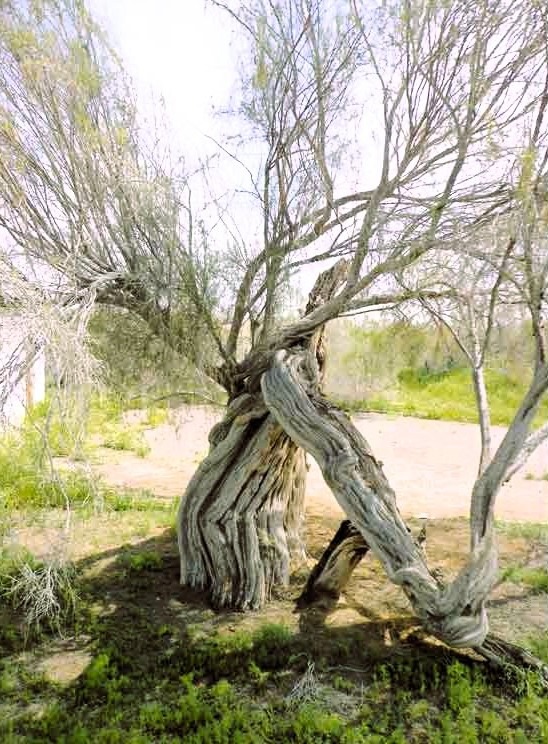
In the heart of the eastern Karakum Desert, on the territory of the Repetek Biosphere Reserve, a tree grows that has become a true natural legend of Turkmenistan. The black saxaul, known as “Sazak-Palvan”, has been withstanding the desert’s extreme climate for over a hundred years, where summer temperatures exceed +50°C and severe frosts are possible in winter.
Saxaul is considered the main tree species of the desert zone. It is the very plant that stabilizes shifting sands, prevents soil erosion, and forms the ecosystems of the Karakum. However, “Sazak-Palvan” stands out even among these exceptionally resilient plants.
Experts note that Turkmenistan’s oldest saxaul predates the Repetek Sand-Desert Research Station, which was established in 1912. The surrounding area was later designated a state nature reserve in 1927. First documented in 1918, the tree is now well over a century old—a remarkable feat considering that black saxauls typically live for about 70 years, while white saxauls have an even shorter lifespan.
Today, “Sazak-Palvan” stands over four meters tall with a massive trunk circumference of 2.85 meters. Its name reflects its impressive stature: “Palwan” translates from Turkmen as “strongman” or “heroic wrestler.” Over the decades, its heavy, sprawling branches have split the trunk to create natural hollows, requiring reserve staff to install supports to prop up its weight.
To protect this botanical treasure, the tree is fenced off and remains under constant scientific monitoring by experts at the Repetek Biosphere Reserve.
Across its century-long life, “Sazak-Palvan” has become an enduring icon of Repetek. It has been studied by generations of prominent naturalists, geographers, and geologists—including Vasilii Dokuchaev, Vladimir Obruchev, Nikolai Vavilov, and Alexander Fersman—as well as long-time reserve director Sergey Veyisov. The majestic tree even featured in documentaries filmed by renowned British naturalist Gerald Durrell and Russian biologist Nikolai Drozdov.
Its remarkable longevity remains a mystery. Scientists are still studying whether “Sazak-Palvan” owes its survival to exceptional genetic vitality or the dedicated care of reserve staff.
Despite its advanced age, the tree remains fertile. Throughout 2023–2025, ecologists harvested its seeds to germinate and cultivate a new generation of saxaul trees carrying the resilient genes of their ancient ancestor.
As the Repetek Biosphere Reserve approaches a dual milestone—celebrating 115 years of scientific research in the Eastern Karakum and 100 years as a protected reserve—this ancient saxaul stands as a living bridge between the desert’s past, present, and future. /// nCa, 5 August 2026 (based on the article “‘Sazak-Palvan’ in Repetek”, published in the newspaper ‘Neutral Turkmenistan’ on 5 August 2026)