


On 4 June 2026, the 9th meeting of the Intergovernmental Turkmen-Turkish Commission on Economic Cooperation (IGC) took place in Ashgabat. During the session, government delegations from both nations held detailed discussions on expanding their strategic partnership and outlined concrete steps to diversify bilateral trade.
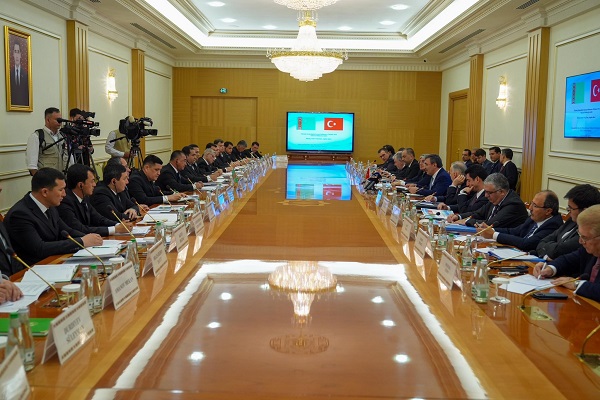
The Turkish delegation was led by Vice President of the Republic of Türkiye Cevdet Yılmaz, while the Turkmen side was headed by Deputy Prime Minister Nökerguli Ataguliyev.
Speaking ahead of the meeting, Cevdet Yılmaz announced that bilateral trade between Türkiye and Turkmenistan reached $2.2 billion last year, adding that the immediate goal is to boost this trade volume to $5 billion as soon as possible, TRT Haber reports.
Underscoring the importance of updating the Bilateral Investment Treaty (Agreement on the Reciprocal Promotion and Protection of Investments), Yılmaz highlighted that Turkish contractors have successfully completed 1,101 projects in Turkmenistan to date, valued at $56 billion.
Turning to transport and logistics cooperation, Yılmaz stated: “Today, global trade and supply chains are undergoing a profound transformation. The Northern Corridor, which has been utilized for years, has become unpredictable due to geopolitical tensions and conflicts in our region. Meanwhile, the Southern route is operating at its limits due to security risks and structural challenges.”
According to the Turkish Vice President, under these circumstances, the Trans-Caspian East-West International Transport Corridor (the Middle Corridor) is no longer just an alternative, but a secure and necessary choice for global trade.
Yılmaz pointed out that the Middle Corridor, which “the two nations will strengthen together, serves as the main backbone that will carry not only the trade of both countries, but also the cargo, energy, and future of the entire Eurasian continent.”
Highlighting that Turkmenistan, with its colossal natural gas reserves and modern infrastructure, is a visionary and pivotal actor in the global energy equation. Yılmaz stressed that Türkiye views energy cooperation between the two nations not merely as a commercial exchange, but as a fundamental pillar of regional stability and global supply security.
He affirmed the readiness and determination of Turkish national energy companies—BOTAŞ, TPAO, and TPIC—to engage in the development of new fields, and emphasized their commitment to engage in all kinds of joint efforts for the shipment of Turkmen gas to Europe via trans-Caspian routes and Türkiye.
“This unwavering partnership in the field of energy will both contribute to the economic integration of the Turkic world and transform the Caspian into the heart of global connectivity,” Cevdet Yılmaz emphasized.
The Main Outcome: A 71-Point Action Plan
The principal outcome of the intergovernmental meeting was the signing of a final Protocol. A key component of the document is an approved 71-point Action Plan. It outlines specific, practical steps to elevate bilateral engagement to a qualitatively new level across a wide spectrum of fields—spanning trade, investment, energy, transport, education, and industry.
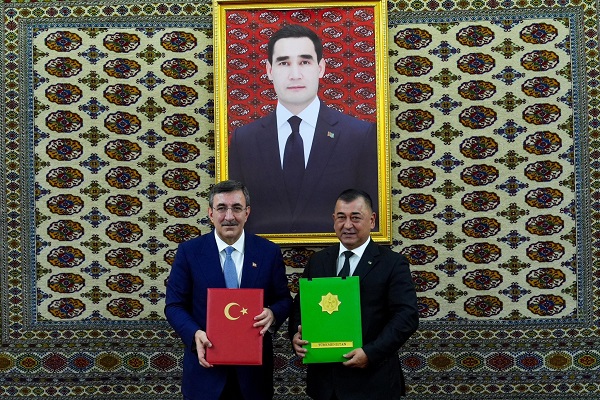
Commenting on the results of the talks on social media, Turkish Vice President Cevdet Yılmaz underscored the global dimension of the Ankara-Ashgabat partnership: “Together with friendly and brotherly Turkmenistan, we are resolutely strengthening an economic partnership aimed at joint production, joint investment, and the development of joint projects in third countries. This cooperation does not merely boost bilateral trade; it generates value on both a regional and global scale.” /// nCa, 5 June 2026