


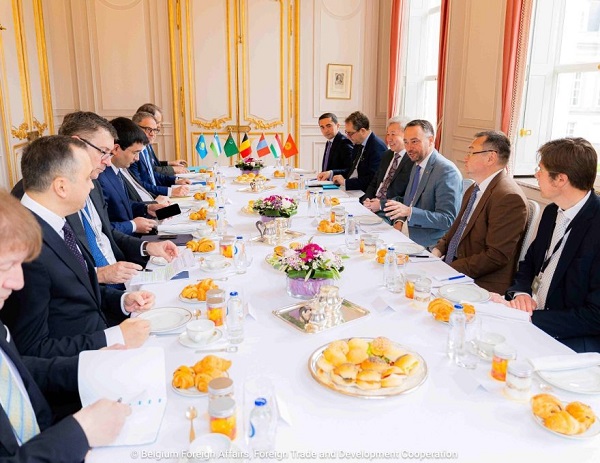
On 3 June 2026, a working breakfast of the Deputy Prime Minister and Minister of Foreign Affairs of the Kingdom of Belgium, Maxime Prévot, with the Ambassadors of the countries of Central Asia and Mongolia took place at the Palais d’Egmont in Brussels, according to the Embassy of Turkmenistan to Belgium.
The meeting was held at the initiative of the Ambassador of Turkmenistan to Belgium Sapar Palvanov and coordinated by the Embassy of Turkmenistan in cooperation with the Ministry of Foreign Affairs of Belgium. The discussion focused on the prospects for cooperation between Belgium, the countries of Central Asia and Mongolia in the areas of economy, transport, energy, critical raw materials, logistics, innovation and sustainable development.
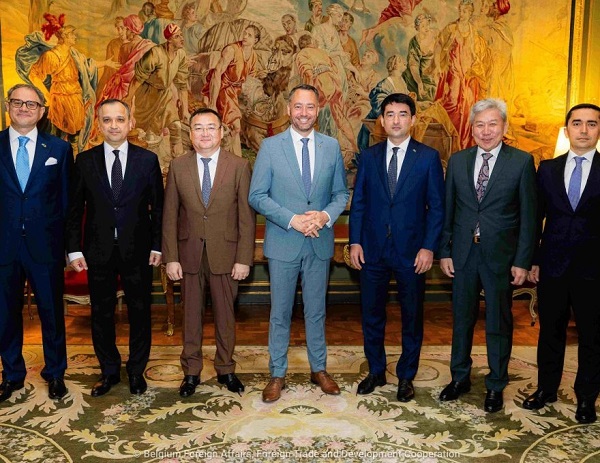
In his remarks, Maxime Prévot emphasized that Belgium views the countries of Central Asia and Mongolia as important and promising partners. He noted the region’s strong economic growth and demographic potential, as well as the need to move from declarations to concrete results. The Minister paid particular attention to critical raw materials, which are essential for Europe’s green transition, energy security and technological development, while highlighting the experience of Belgian companies in processing, recycling and high-tech treatment of raw materials.
In his statement, the Ambassador of Turkmenistan noted that Central Asia and Mongolia today represent a dynamic region connecting East and West. According to him, the region is increasingly seen not as landlocked, but as land-linked, serving as a connecting space for transport, trade and energy routes. He emphasized that the land once described as a buffer is now becoming a bridge, a bridge that the countries of the region are building themselves.
The Ambassador also highlighted the scale and potential of the region: the five countries of Central Asia and Mongolia cover more than 5.5 million square kilometers and have a combined population of almost 86 million people, more than half of whom are under the age of 30. It was noted that the combined GDP of Central Asia has exceeded 500 billion US dollars, while intra-regional trade has almost doubled over the past five years, reaching 12.3 billion US dollars in 2025.
Special attention was given to the Consultative Meeting of the Heads of State of Central Asia, Turkmenistan’s permanent neutrality recognized by the United Nations, and the role of Ashgabat as the headquarters of the UN Regional Centre for Preventive Diplomacy for Central Asia.
In the area of transport, the Ambassador noted the growth of the Trans-Caspian International Transport Route, the potential of the Turkmenbashy International Seaport, and the role of the Port of Antwerp-Bruges as a natural western partner of the Trans-Caspian axis.
As an example of successful Belgian-Turkmen cooperation, the Ambassador referred to the textile industry, noting the contribution of Belgian technologies, including equipment from Picanol, to the development of the sector’s production base after Turkmenistan gained independence.
The Ambassadors of the countries of Central Asia and Mongolia also presented their national priorities and proposals for cooperation with Belgium and the European Union. Their statements addressed transport connectivity, modern Silk Roads, critical raw materials, energy security, the water and glacier agenda, climate change, trade, investment, education and academic cooperation.
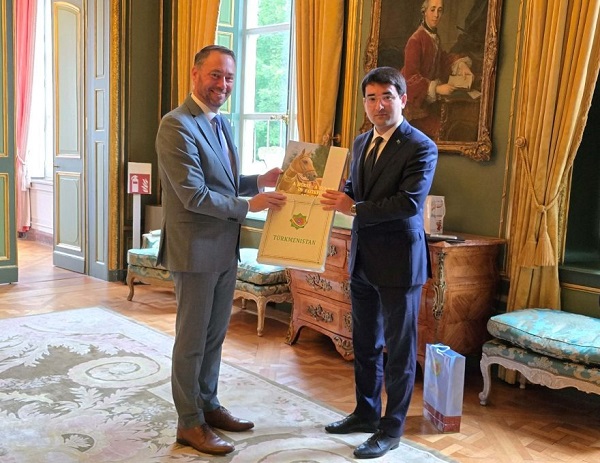
Following the meeting, the participants confirmed their interest in further strengthening Belgium’s dialogue with the countries of Central Asia and Mongolia at both regional and bilateral levels. The common theme of the discussion was the need to move from general statements to practical projects based on mutual benefit, trust and respect for the interests of all parties. ///nCa, 4 June 2026