


Elvira Kadyrova
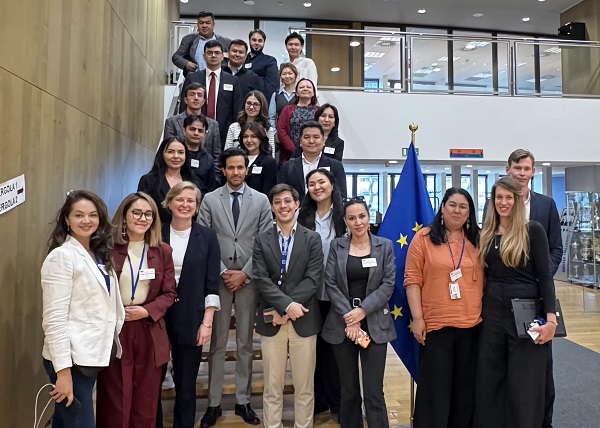
The recently concluded Central Asia Press Trip to Brussels for journalists from the five Central Asian nations provided a valuable opportunity to look behind the scenes of European diplomacy, enriching existing knowledge with fresh insights and perspectives.
Expert discussions and briefings in the EU capital clearly indicate that the European approach to Central Asia is undergoing a qualitative transformation amid the current complex geopolitical environment. The region has firmly shifted into the zone of the European community’s strategic interests, spanning security, energy, transport, and the green transition.
The Strategic Framework
The EU’s engagement is anchored in the 2019 Strategy on Central Asia and the Joint Roadmap for Deepening Ties, adopted in 2023. This document outlines five priority pillars: deepening political dialogue, strengthening economic ties, trade and investment, energy and climate action, security cooperation, and human-to-human contacts and mobility. The roadmap is translated into practical action through no fewer than 79 specific action points.
This high level of engagement is sustained through regular high-level interactions, including the Leaders’ meetings in Astana (2022) and Cholpon-Ata (2023), and culminated in the first-ever full-fledged EU–Central Asia Summit held in Samarkand in 2025. At this historic summit, relations were elevated to a strategic partnership, with the next summit scheduled for 2027.
Global Gateway and Practical Cooperation
The Global Gateway initiative has emerged as one of the primary vehicles for this cooperation. At the Samarkand summit, an investment package of €12 billion for Central Asia was announced. The core priorities are shared uniformly across all five nations of the region:
- Transport and Connectivity: The main focus lies on developing the Trans-Caspian Transport Corridor (the Middle Corridor). Following the outbreak of the war in Ukraine, which compromised the Northern route via Russia, and amid mounting complications along Southern transit routes through Iran and Pakistan, the strategic relevance of this corridor has surged exponentially. The EU is coordinating its efforts closely with the South Caucasus and Türkiye, investing simultaneously in “hard” infrastructure (ports, railways, roads) and “soft” infrastructure (digitalization of borders, customs harmonization, and regulatory alignment). While cargo transit volume along the corridor has grown by 33% in recent years, bottleneck constraints and border queues remain a challenge. In the corridors of European institutions, the ideal vision for the Middle Corridor is a seamless transit system capable of delivering cargo from Central Asia’s eastern borders (the Chinese border) to European ports in under 15 days. Achieving this level of competitiveness, however, requires massive investments estimated at around €18 billion. The EU addresses this by mobilizing a pool of international partners—including the EBRD, the World Bank, and the EIB—leveraging its own financial guarantees to de-risk investments.
- Critical Raw Materials (CRMs): The EU has an existential interest in diversifying its supply chains for rare earth elements and critical minerals necessary to fuel its green transition and advanced industrial manufacturing. Rather than focusing purely on extraction, Brussels proposes developing regional value chains within Central Asia. This mutually beneficial partnership is already formalized through dedicated Memorandums of Understanding (MoUs) and operational roadmaps with Kazakhstan and Uzbekistan.
- Water and Energy: Attention is heavily focused on supporting mega-scale regional infrastructure projects, specifically the Rogun HPP in Tajikistan and the Kamberata-1 HPP in Kyrgyzstan. Concrete parameters of European involvement in completing the Rogun HPP are actively being structured within EU institutions. This may include a substantial credit line through the European Investment Bank (EIB), backed by EU guarantee mechanisms designed to mitigate sovereign and commercial risks.
- Digital Connectivity: The EU is actively expanding digital connectivity across Central Asia, with a particular focus on satellite communications. Implemented primarily via Team Europe initiatives under the Global Gateway framework, this cooperation aims to bridge the digital divide in remote areas and integrate the region into global communication networks. A key differentiator of the European approach emphasized in Brussels is data sovereignty: all transmitted digital data remains entirely within the partner countries rather than being routed to Europe, distinguishing it from the commercial models of other global geopolitical actors.
The Bilateral Track
The EU’s interregional dialogue is systematically complemented by advanced bilateral agreements (Enhanced Partnership and Cooperation Agreements, or EPCAs), though the progress of their implementation varies across the region:
The EPCA with Kazakhstan has been fully operational. The agreements with Uzbekistan and Kyrgyzstan have been signed but require final ratification by parliaments. Meanwhile, the negotiation process with Tajikistan has successfully reached the stage of initialing the text.
The EU and Turkmenistan view the conclusion of their agreement as a vital horizon for qualitative growth, which will establish a robust legal foundation to diversify bilateral ties. In a broader context, finalizing this legal framework is seen as an indispensable step to imbue the declared EU–Central Asia strategic partnership with complete, region-wide practical substance.
Looking Ahead
For the European Union, Central Asia represents a dynamic, growing consumer market, an essential source of critical raw materials, and a pivotal trans-Eurasian transit hub. European policy blends support for deeper regional integration—drawing on the EU’s own historical lessons of economic integration post-WWII—with a pragmatic pursuit of its own strategic interests: supply chain diversification, the green transition, and geopolitical de-risking.
For Central Asia, the opportunities are tangible: the influx of large-scale infrastructure investments, comprehensive modernization of logistics, technology transfer, alignment with international regulatory standards, human capital development, and the adaptation of the EU’s integration best practices to the region’s unique specificities.
A successful and fully operational Middle Corridor has the potential to dramatically enhance Central Asia’s economic sovereignty and diversify its foreign partnerships.
Nevertheless, the headwinds remain formidable. Regional dynamics are constrained by global geopolitical turbulence. Issues related to human rights and democratic freedoms remain core tenets for the European side and can slow down the ratification of bilateral agreements. Furthermore, executing capital-intensive regional projects depends heavily on successfully coordinating complex multi-donor financing structures.
On balance, the EU is demonstrating a long-term commitment to Central Asia, moving decisively past short-term opportunism toward concrete, structural investments. Future success will hinge on the capacity of both sides to bridge internal barriers, build consensus on sensitive political matters, and navigate geopolitical risks, all while maintaining mutual respect for each other’s institutional realities and strategic outlooks. /// nCa, 15 June 2026