


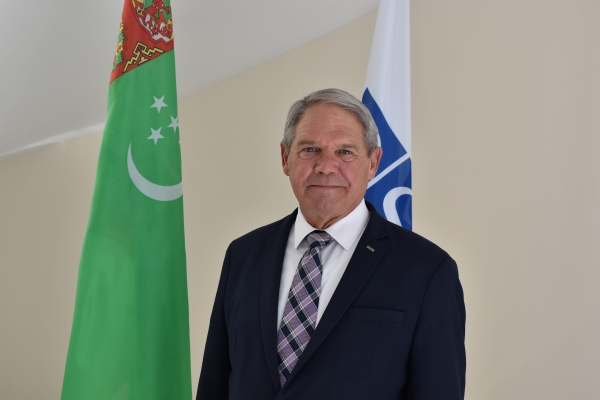
If we were to put a human face on versatile fortitude, it would be William Leaf, the Head of the OSCE Centre in Ashgabat.
Ambassador William R. Leaf is in his second year of tenure as the head of the OSCE mission. Backed by 30 years of rich experience, William Leaf is a kind of institutional memory for all the three dimensions of the OSCE: 1. The Politico-Military Dimension; 2. The Economic and Environmental Dimension; and 3. The Human Dimension.
He speaks Russian, Turkmen, Kyrgyz, German, and Italian.
nCa recently conducted an interview with William Leaf. Here is the transcript:
nCa: The OSCE’s mandate spans hard security, economic and environmental co-operation, and the human dimension — a remarkably broad portfolio. How do you hold all three together coherently in a single country mission, and where do you find the most natural points of connection between them in Turkmenistan?
WL: The OSCE comprehensive approach to security was rooted in the 1975 Helsinki Final Act, the 50th anniversary of which we celebrated on 1 August 2025, exactly one year ago.
The strength of the OSCE’s comprehensive approach is that security is indivisible, meaning that no single dimension delivers security on its own — they have to move together. If an economy and environment are fragile, military strength won’t save it. If human rights are ignored, economic wealth won’t guarantee peace. A deficiency in any one of these areas eventually brings down the others.
In Turkmenistan, this approach perfectly aligns with the country’s policy of permanent neutrality and national priorities. While Turkmenistan is taking an active position in countering transnational threats, the OSCE’s comprehensive approach provides a perfect platform to support the host country’s efforts in this important area. We use the politico-military dimension to build law enforcement’s technical capacity to fight cyber threats. We use the economic dimension to train financial institutions to track and cut off terrorist financing. And we ground it in the human dimension by running media literacy programs for youth to build societal resilience against online radicalization, while always advocating for transparency and due process
What I’ve seen in my nearly seven years with the Centre is genuine openness to co-operation across all three dimensions from all of our partners – both in the government and in civil society. Turkmenistan’s unique position gives our Centre the scope to ensure that durable stability depends on hard security, economic resilience, and human rights protections advancing in parallel. It proves that the OSCE’s comprehensive approach isn’t just a theory; it’s a practical necessity on the ground.
nCa: Central Asia is increasingly seen as a region of strategic importance — for connectivity, energy, and broader geopolitical stability. How is the OSCE positioned to contribute to that moment, and what role do you see Turkmenistan playing in the region’s future?
WL: Central Asia’s strategic moment—as a vital hub for energy and connectivity between Europe and Asia—presents a unique security challenge. The Organization for Security and Co-operation in Europe (OSCE) is well-suited to address this, as its comprehensive approach to security directly mirrors the region’s current, multi-layered needs. The intersection of the OSCE’s commitments and Turkmenistan’s distinct foreign policy highlights how regional cooperation can be systematically strengthened.
Each of the three distinct dimensions of OSCE security is critical to unlocking the potential of Central Asian connectivity. Certainly, connectivity infrastructure needs physical and border security. However, it only delivers real value if trade, transit, economic governance are strengthened alongside it. Of equal importance is energy security, and the OSCE promotes a resilient and sustainable energy sector by advancing renewable energy, energy efficiency, and green connectivity, and by strengthening the resilience of critical energy infrastructure against emerging climate and cyber threats. As development proceeds, it is important to ensure that the communities along those corridors see their rights and livelihoods protected.
Having spent two decades working in Central Asia, I grew in my conviction that Turkmenistan is well-positioned to play a stabilizing, connecting role in this broader regional picture by serving as a platform for effective dialogue. Its UN-recognized policy of permanent neutrality allows the country to act as a highly effective, non-aligned facilitator in a complex geopolitical landscape. Rather than taking sides or balancing major global powers, Turkmenistan utilizes its neutrality to offer a reliable, predictable platform for diplomatic discussion.
The partnership between the OSCE and Turkmenistan demonstrates that physical infrastructure needs to be supported by political teamwork and diplomatic agreements. Combining the OSCE’s comprehensive security tools with Turkmenistan’s neutral status creates a powerful foundation to help turn the region into a secure, interconnected global corridor.
nCa: Confidence- and security-building measures are often abstract concepts to outside observers. Can you walk us through what that work actually looks like on the ground, and why it matters for the broader stability of Central Asia?
WL: While “confidence- and security-building measures” can sound abstract, on the ground they are highly practical actions that span all three of the OSCE’s dimensions. In its effort to create greater transparency among participating states, the OSCE has developed some of the world’s most advanced trust-building tools:
In the Politico-Military Dimension, that means joint training exercises, exchanges between border and security services, and transparency mechanisms regarding military equipment. A key example is the secure OSCE Communications Network, which Turkmenistan participates in. This network goes beyond traditional diplomacy to allow the reliable, real-time sharing of military exercise alerts and weapons control data. But trust isn’t built by military transparency alone — the Economic and Environmental Dimension contributes through co-operation on shared resources like water and energy, where transparent management reduces a classic source of regional friction. And the Human Dimension contributes through dialogue platforms and institutional engagement that build trust between governments and civil society, which is just as important to long-term stability as trust between states. The cumulative effect of these actions is predictability.
When neighboring countries clearly understand each other’s intentions, economic interests, and treatment of their people, the risk of miscalculation or sudden conflict drops dramatically.
This is exactly where Turkmenistan’s policy of permanent neutrality adds unique value. By offering a reliable, non-aligned space free from geopolitical rivalries, it serves as a natural venue for the frank and open dialogue based on mutual trust and respect that is absolutely critical to building confidence, defusing regional tensions, and laying a foundation of lasting peace across Central Asia.
nCa: If you could point to one or several areas where you believe the OSCE’s presence in Turkmenistan will make the most significant difference in the coming years, what would they be?
WL: It is hard for me to point to just one area of impact, as we do not operate in a vacuum—our work exists at the intersection of our mandate, our budget, and the specific priorities of our Turkmen partners. However, recent milestones across all three dimensions establish a powerful baseline that we intend to build upon in our future activities:
Politico-Military Dimension (PMD): Jointly with the OSCE Secretariat’s Gender Programme, we have provided expert support to develop the National Action Plan (NAP) on Women, Peace and Security (UNSCR 1325). The preliminary draft, co-prepared by OSCE experts and national stakeholders, has just been submitted to national authorities, and we expect the NAP to be finalized and approved by the host government in the coming months.
In the Economic and Environmental Dimension (EED), we reached a key milestone by strengthening Turkmenistan’s framework for Anti-Money Laundering and Countering the Financing of Terrorism (AML/CFT/CPF). Backed by the Good Governance Resource Centre established with the Centre’s support, this sustained effort has successfully advanced Turkmenistan’s compliance with global Financial Action Task Force (FATF) standards. In parallel, we continue to bolster energy security and efficiency through data-based planning and renewable energy research. A cornerstone of this work is the Centre of Energy Saving Technologies (CEST)—established with our support in 2020 at the State Energy Institute in Mary—which serves as a unique academic hub for applied research on green energy and grid reliability.
Human Dimension (HD): The Centre has made meaningful progress by reinforcing its grassroots partnerships with civil society. Through our support, dedicated local implementing partners continue to raise awareness of different audiences about domestic violence and provides legal, psychological, and shelter assistance to victims of domestic violence.
Another key milestone in our activities is the preparation of a pool of national trainers on media literacy. We trained some twenty national trainers, and thirteen out of twenty national trainers, delivered a total of six training courses on media literacy within one year targeting about 175 participants, including journalists, representatives of state institutions, journalism students and bloggers.
The Centre will continue to expand its efforts, transforming these shared achievements into a lasting foundation that directly supports Turkmenistan’s implementation of OSCE commitments—strengthening its politico-military security, driving its economic development and environmental sustainability, and advancing its human dimension goals to foster a more resilient society.
nCa: You’ve spent over a decade working in Central Asia with the OSCE — first in Kyrgyzstan, and now for several years in Turkmenistan. What is it about this region that keeps drawing you back, and what makes this work personally meaningful to you?
WL: What keeps me here is the people, and the fact that this comprehensive approach to security is something you can actually see working over time — not just in security statistics, but in stronger institutions, more resilient economies and safer environment, as well as communities whose rights are better protected. I’ve now spent more than two decades in Central Asia, starting here in Ashgabat, then in three cities in Kyrgyzstan, and now finishing my first year as Head of the OSCE Centre in Ashgabat. Each posting has shown me a different facet of how hard security, economic co-operation, and human dimension work reinforce one another, and I’m genuinely energized heading into my second year here in August. Staying with a region long enough to watch all three dimensions mature together and watching my fantastic team at the Centre succeed and grow professionally — that is what makes my job so rewarding. /// nCa, 31 July 2026