


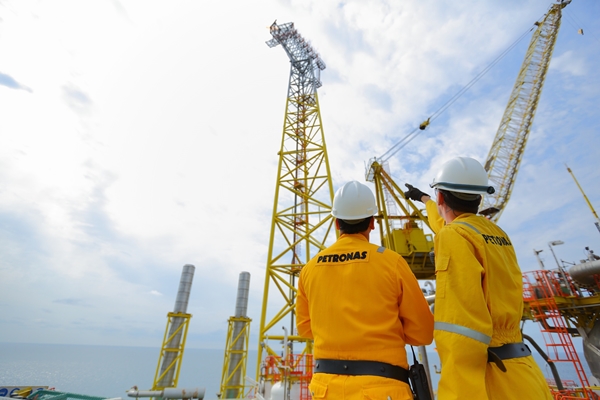
A presidential decree signed by President Serdar Berdimuhamedov has authorized the State Concern Türkmennebit to conclude a new agreement for the development of licensed offshore blocks in the Turkmen sector of the Caspian Sea, opening what is certainly the next phase of cooperation between Turkmenistan and Malaysia’s national energy company, Petronas.
According to the official announcement issued on 17 June, Türkmennebit has been authorized to conclude an agreement together with Petronas Carigali (Turkmenistan) Sdn. Bhd. and the state enterprise Hazarnebit, a subsidiary structure within the Türkmennebit system.
The brief official statement did not identify the blocks concerned, disclose the ownership structure, or provide operational details. Nevertheless, the timing of the decree is noteworthy as it comes just days before the official visit to Turkmenistan by Malaysian Prime Minister Anwar Ibrahim, scheduled for 19 June.
The decree therefore appears likely to form part of a broader package of Turkmen-Malaysian energy cooperation that could be clarified during the high-level visit.
Petronas is not a newcomer to Turkmenistan’s offshore sector. The Malaysian energy giant has maintained a presence in Turkmenistan since 1996 and has been the long-term operator of the offshore Block I development in the Turkmen sector of the Caspian Sea.
For nearly three decades, Block I was developed by Petronas under a Production Sharing Agreement (PSC) with Turkmenistan. The arrangement underwent a significant restructuring in May 2025 when a new consortium was formed.
Under the revised PSC, Petronas retained operatorship and a 57 percent participating interest, while Abu Dhabi’s XRG, the international investment arm of ADNOC, acquired a 38 percent stake. State enterprise Hazarnebit received a 5 percent interest. The consortium simultaneously signed a long-term gas sales agreement with Turkmengaz.
The offshore Block I concession is one of the most productive international energy projects in Turkmenistan. According to Petronas, the block currently produces approximately 400 million cubic feet of natural gas per day and contains access to more than seven trillion cubic feet of gas resources, providing substantial scope for future expansion.
Petronas also operates the gas processing plant and onshore gas terminal at Kiyanly on Turkmenistan’s Caspian coast, making it one of the country’s most deeply established foreign investors in the hydrocarbon sector.
The official decree issued on 17 June provides the framework.
The decree is significant because it signals Turkmenistan’s intention to continue attracting long-term strategic partners for offshore development in the Caspian Sea while building on an established relationship with Petronas that has already lasted three decades.
Turkmenistan and Malaysia have steadily expanded their political and economic relations in recent years, with energy cooperation remaining the central pillar of the partnership.
Preparations for the Malaysian leader’s visit have been discussed at the highest levels of the Turkmen government, and officials have indicated that the visit is intended to elevate bilateral relations to a new stage.
It is therefore possible that additional agreements, investment commitments, or clarifications regarding Petronas’ future role in Turkmenistan’s hydrocarbon sector could emerge during the visit.
The presidential decree should be viewed as the opening chapter of a developing story whose full significance may become apparent only after the outcome of the Malaysian Prime Minister’s visit to Turkmenistan. /// nCa, 18 June 2026