


nCa Report
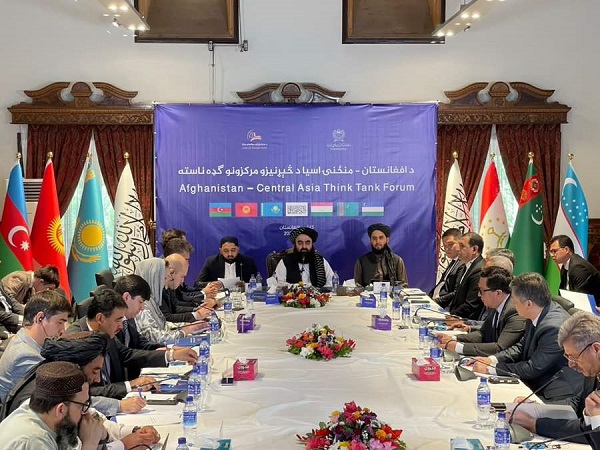
The first Forum of Strategic Studies Centers and Think Tanks of Afghanistan, Central Asia and Azerbaijan, held in Kabul on 16 June, has provided another indication that relations between Afghanistan and its northern neighbours are entering a more structured and institutional phase.
While official information on the forum remains limited and a complete list of participants has not yet been released, available reports show that the meeting brought together representatives of Afghanistan, Kazakhstan, Kyrgyzstan, Tajikistan, Turkmenistan, Uzbekistan and Azerbaijan.
The discussions focused on regional connectivity, economic cooperation, trade, transit, energy, investment and regional stability.
The event was organized by the Strategic Studies Center of Afghanistan’s Ministry of Foreign Affairs and was inaugurated by Acting Foreign Minister Amir Khan Muttaqi.
According to reports from Kabul, Muttaqi emphasized that Afghanistan’s relations with Central Asian countries and Azerbaijan have expanded considerably in recent years, creating new opportunities for regional cooperation. He described Afghanistan as a natural bridge between Central Asia and South Asia and called for stronger intellectual and analytical support for major regional projects.
Among the projects highlighted were the TAPI gas pipeline, CASA-1000 electricity transmission project, the Lapis Lazuli transport corridor, the Trans-Afghan Railway initiative and other regional transit routes.
Beyond the formal statements, the forum appears to have highlighted a broader reality: Afghanistan’s economic links with Central Asia are becoming increasingly substantial and increasingly project-driven.
Uzbekistan Emerges as Afghanistan’s Leading Economic Partner
Among the Central Asian countries, Uzbekistan has established itself as Afghanistan’s most important economic partner.
According to information presented during the forum and related discussions, bilateral trade has reached approximately $1.5 billion, with both sides aiming to increase it to $5 billion in the coming years.
The two countries are jointly involved in several strategic projects, including the Hairatan–Mazar-e-Sharif railway and the proposed Trans-Afghan Railway, which would eventually connect Central Asia with Pakistani seaports.
Uzbek investments have also expanded into Afghanistan’s energy sector, while a series of trade agreements reportedly worth more than $5 billion have been concluded in recent months.
For Tashkent, Afghanistan is increasingly viewed not merely as a neighbour but as a gateway to South Asian markets. For Afghanistan, Uzbekistan offers access to Central Asian transport networks and international markets.
Turkmenistan’s Long-Term Energy Partnership
Turkmenistan remains one of Afghanistan’s most important strategic partners in the energy sphere.
The TAPI gas pipeline continues to be the flagship project linking the two countries.
In addition, cooperation extends to electricity transmission, fibre-optic communications and railway development, particularly the Torghundi–Herat railway.
Trade between the two countries has reportedly exceeded $900 million, while efforts continue to strengthen border infrastructure and transit facilities.
For Ashgabat, Afghanistan is a key transit partner in its strategy of connecting Central and South Asia through energy and transport corridors.
Kazakhstan’s Role in Food Security and Trade
Kazakhstan occupies a distinct position in Afghanistan’s economic relations with Central Asia.
As one of Afghanistan’s largest suppliers of wheat and grain, Kazakhstan contributes directly to Afghan food security.
Bilateral trade is estimated at between $500 million and $1 billion annually, and both sides have expressed interest in increasing trade to $3 billion. Kazakhstan has also shown interest in transport infrastructure projects that would strengthen regional connectivity and facilitate access to southern markets.
The importance of Kazakhstan’s role extends beyond commerce. Reliable grain supplies from Kazakhstan have become an important stabilizing factor for Afghanistan’s food market.
Tajikistan and Kyrgyzstan: Modest Trade, Important Connectivity
Although their trade volumes remain relatively limited compared with Uzbekistan and Turkmenistan, both Tajikistan and Kyrgyzstan play important roles in regional connectivity initiatives.
The CASA-1000 project remains the most visible example of cooperation, linking electricity systems across Central and South Asia through Afghanistan.
Transit cooperation, border trade and regional infrastructure development continue to provide opportunities for deeper engagement in the future.
Azerbaijan’s Emerging Transit Dimension
Azerbaijan’s direct economic presence in Afghanistan remains modest. However, its strategic importance lies elsewhere.
Through the Caspian Sea transport network and the Lapis Lazuli Corridor, Azerbaijan serves as a critical link connecting Afghanistan and Central Asia with the South Caucasus, Türkiye and European markets.
As regional transport corridors gain importance, Baku’s role in connecting East-West trade routes is likely to increase.
From Political Dialogue to Economic Regionalism
The significance of the Kabul forum may lie less in its immediate outcomes and more in what it reveals about regional trends.
The meeting follows a series of initiatives launched during the past year, including the Afghanistan–Central Asia Consultative Dialogue and the Termez Dialogue process. Together, these initiatives suggest the gradual emergence of a regional framework in which Afghanistan is increasingly viewed not primarily through a security lens but through the prism of connectivity, trade and economic cooperation.
Think tanks and strategic studies centers are being called upon to support this process by providing research, policy recommendations and long-term planning for major regional projects.
Whether these ambitions translate into practical results will depend on security conditions, financing and political will. Nevertheless, the Kabul forum demonstrates that Afghanistan and its regional partners are investing increasing effort in building an intellectual and institutional foundation for a more connected regional future.
Based on information available so far, organizers have not yet published a comprehensive list of delegates or a final communiqué detailing specific recommendations adopted by the forum. As additional information becomes available, a clearer assessment of the meeting’s outcomes will be possible.
For now, the forum appears to represent another step in the gradual evolution of Afghanistan from a subject of regional concern into a participant in regional economic planning. /// nCa, 18 June 2026