


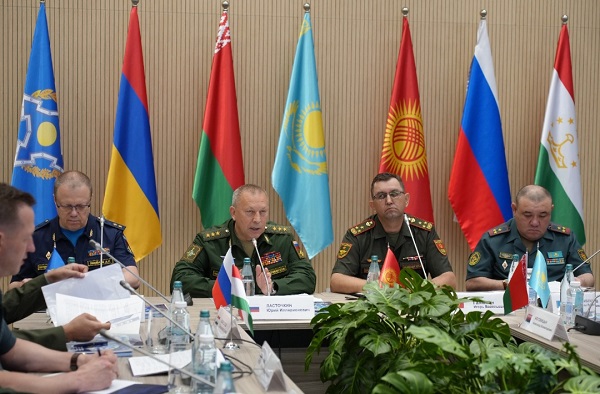
Defense officials from Central Asian states joined their CSTO counterparts in St. Petersburg on 17 June 2026 for a key meeting on electronic warfare (EW), highlighting the alliance’s push to integrate modern capabilities for collective defense in a region facing persistent security challenges.
The Working Group on Electronic Warfare under the CSTO Council of Defense Ministers convened in Saint Petersburg, chaired by Colonel General Yury Lastochkin, Chief of the Electronic Warfare Troops of the Russian Armed Forces. Representatives from the defense ministries of Belarus, Kazakhstan, the Kyrgyz Republic, Russia, and Tajikistan, along with officers from the CSTO Joint Staff led by Lieutenant General Anatoly Yakovlev, participated in the discussions.
In a video address, Colonel General Andrey Serdyukov, Chief of the CSTO Joint Staff, underscored the critical role of electronic warfare in contemporary conflicts. Drawing on lessons from recent operations, including Russia’s special military operation, he stressed the importance of coordinated EW support for joint military groupings. Serdyukov highlighted priorities such as developing a unified interstate EW system, equipping CSTO armed forces with advanced technologies, and training specialized personnel.
Participants focused on several practical areas: refining the CSTO’s regulatory framework for electronic warfare, planning joint training exercises for EW units within the Collective Forces, and analyzing the effective use of Russian EW assets in modern battlefields. They also explored the structure and legal foundations for a Joint (Unified) Electronic Warfare System across member states.
Central Asian Relevance
For Central Asia, home to key CSTO members Kazakhstan, Kyrgyzstan, and Tajikistan, these developments carry direct strategic weight. The region contends with border tensions, terrorism risks linked to instability in Afghanistan, drug trafficking, and potential hybrid threats involving drones, communications jamming, and information operations.
The CSTO maintains dedicated Rapid Deployment Collective Forces for the Central Asian region, designed for rapid response to external threats. Enhanced EW integration would significantly strengthen these forces by improving situational awareness, protecting command-and-control systems, and countering adversarial electronic systems—capabilities increasingly vital given the proliferation of unmanned aerial vehicles and sophisticated electronic threats in nearby conflicts.
Previous CSTO exercises, such as those simulating responses to drone swarms and decentralized threats, have already incorporated EW elements tailored to Central Asian scenarios. Today’s meeting builds on this foundation, aiming to harmonize standards and interoperability among member states’ forces.
Analysts note that Russia’s leadership in EW technology provides an opportunity for technology transfer and capacity-building that could help smaller Central Asian militaries modernize. At the same time, the initiative reflects broader efforts to assert collective security amid great-power competition and regional volatility.
The Working Group’s recommendations are expected to feed into higher-level CSTO decisions, potentially shaping future joint exercises and procurement priorities. As hybrid warfare tactics evolve, such collaboration underscores the alliance’s adaptation to protect shared borders and stability across Eurasia, with Central Asia positioned as a critical sector.
This story draws directly from official CSTO reporting and aligns with the organization’s ongoing focus on military-technical cooperation in the post-Soviet space.
/// nCa, 18 June 2026