


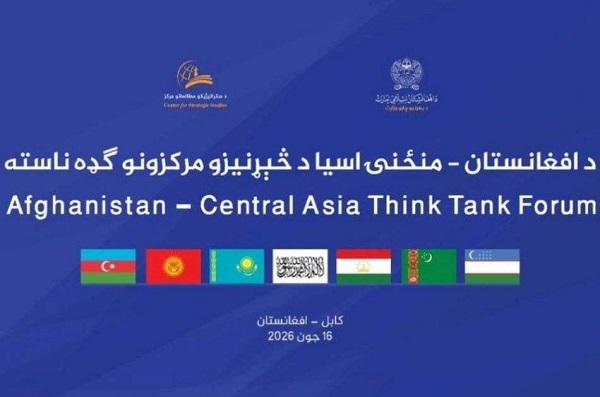
Research institutions and strategic studies centers from Afghanistan, the five Central Asian countries, and Azerbaijan gathered in Kabul on Tuesday for a high-level regional forum aimed at strengthening cooperation on connectivity, trade, energy, transit, investment, and regional stability. The meeting underscored the growing role of expert and analytical communities in supporting interstate dialogue across the wider Central Asian region.
The forum was organized by the Strategic Studies Center of Afghanistan’s Foreign Ministry and brought together researchers, policy experts, and representatives of think tanks operating under or affiliated with the presidential administrations and state institutions of participating countries. Delegations were reported from Afghanistan, Kazakhstan, Kyrgyzstan, Tajikistan, Turkmenistan, Uzbekistan, and Azerbaijan.
According to reports from Kabul, the discussions focused on regional connectivity, transport corridors, trade facilitation, energy cooperation, investment opportunities, and the development of practical recommendations for future collaboration. Participants also exchanged views on common regional challenges and opportunities, reflecting an increasing effort to institutionalize dialogue among policy research centers in the region.
The forum was opened by Afghanistan’s Foreign Minister, Amir Khan Muttaqi, who emphasized Afghanistan’s role as a bridge between Central and South Asia. He also highlighted security cooperation, describing the threat posed by ISIS-K (Daesh) as a shared concern for Afghanistan and the countries of Central Asia.
The gathering appears to be part of a broader trend of intensified regional engagement involving Afghanistan and its northern neighbors.
In recent months, a number of regional dialogue formats have focused on connectivity, economic integration, and transit cooperation linking Central and South Asia, including the Termez Dialogue process promoted by Uzbekistan.
Turkmenistan’s official media described the meeting as evidence that the expert and analytical potential of Central Asia and Afghanistan is being actively utilized to advance interstate cooperation. The discussions reportedly highlighted the importance of informed policy recommendations in supporting governmental efforts aimed at regional development, connectivity, and stability.
Participants Still Not Fully Identified
Based on information available so far, organizers and participating institutions have not yet released a comprehensive list of delegates or speakers. Public reports confirm the participation of researchers and policymakers from strategic studies centers in Afghanistan, Kazakhstan, Kyrgyzstan, Tajikistan, Turkmenistan, Uzbekistan, and Azerbaijan, but the names of most delegation members have not been published.
As additional information becomes available, particularly from the participating think tanks and strategic research institutes, a clearer picture of the composition and outcomes of the forum is expected to emerge. /// nCa, 17 June 2026