


nCa Report
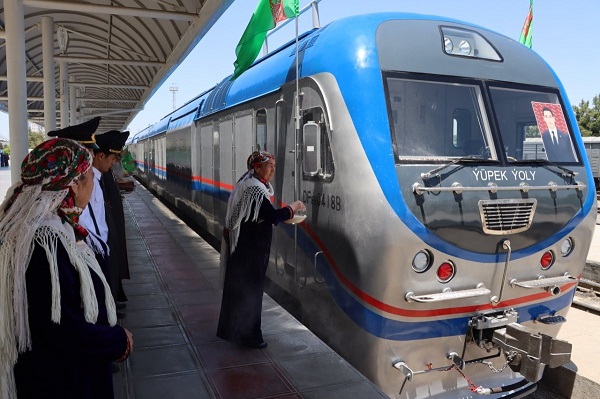
The unveiling of the first of 15 new Chinese-built CKD9A-1 freight locomotives in Ashgabat last week may appear at first glance to be a routine procurement event. However, a review of publicly available information suggests that it marks another step in a much broader transformation of Turkmenistan’s railway sector, one in which Chinese-built locomotives have emerged as the dominant source of motive power on the national rail network.
According to information available from Chinese manufacturer CRRC Ziyang and railway industry publications reviewed by nCa, Turkmenistan has been acquiring locomotives from China for more than two decades.
The latest delivery stems from a contract signed in 2022 for 15 twin-section CKD9A-1 freight locomotives designed for heavy-haul operations on the country’s non-electrified railway network. Upon completion of the order, CRRC says its cumulative deliveries to Turkmenistan will reach 281 locomotives, including passenger, freight and shunting units.
The significance of this figure becomes apparent when viewed against the broader history of Turkmenistan’s railway fleet.
Much of the country’s freight traffic has traditionally relied on Soviet-era locomotives. The new Chinese units are intended to replace a portion of this ageing fleet while increasing the capacity and reliability of freight transport over long distances.
Chinese sources make particularly strong claims regarding the role of their locomotives in Turkmenistan. CRRC publications state that locomotives supplied by the company account for between 80 percent and 95 percent of railway transport activity in the country, depending on the measure used. These figures could not be independently verified by nCa, and should therefore be treated with caution. Nevertheless, even allowing for possible promotional exaggeration, the volume of locomotives supplied indicates that Chinese equipment now occupies a central position within Turkmenistan’s railway operations.
The relationship between Turkmenistan and CRRC has also evolved beyond locomotive deliveries alone. In January 2023, the two sides signed a locomotive spare-parts agreement reportedly worth more than US$30 million. Chinese sources described it as the largest spare-parts contract concluded between the partners up to that time. The agreement suggests that cooperation is increasingly focused on long-term maintenance, modernization and lifecycle support rather than simply the purchase of new locomotives.
This does not mean that China is Turkmenistan’s only railway supplier.
In recent years Turkmenistan has also expanded cooperation with Russia’s Transmashholding. In 2021, Demiryollary acquired a Russian-built passenger locomotive and a freight locomotive. In 2022, five additional Russian-built 2TE25KM freight locomotives were delivered under a separate contract. These acquisitions indicate that Turkmenistan continues to diversify its procurement sources while modernizing its railway fleet.
At the same time, available public information suggests that the scale of Chinese deliveries far exceeds that of other recent suppliers. The result appears to be a gradual transition from a fleet historically dominated by Soviet-era technology to one increasingly supported by modern Chinese railway equipment.
The development carries implications beyond the railway sector itself. Turkmenistan has invested heavily in its role as a regional transport and logistics hub linking Central Asia with the Caspian region, the Caucasus, Türkiye, South Asia and China.
Modern locomotives are a critical component of this strategy, particularly as freight volumes grow along international transport corridors crossing the country.
The arrival of the new CKD9A-1 locomotives represents more than the delivery of another batch of railway equipment. It is part of a long-term trend that is reshaping the technological foundation of Turkmenistan’s railway system and strengthening the role of Chinese railway technology in one of Central Asia’s most strategically positioned transport networks. /// nCa, 17 June 2026 (photo credit – Ministry of railway transport of Turkmenistan)