


Tariq Saeedi and Elvira Kadyrova
The recent five-day visit of Hong Kong Chief Executive John Lee to Kazakhstan and Uzbekistan may appear at first glance to be another chapter in the rapidly expanding relationship between China and Central Asia. Yet a closer examination suggests that something more significant is taking shape.
China and Central Asia already maintain extensive political, economic, and strategic engagement. Trade volumes have grown dramatically over the past decade. Infrastructure projects under the Belt and Road Initiative have reshaped regional connectivity. Chinese companies are active across sectors ranging from energy and transport to manufacturing and digital technologies. High-level exchanges have become routine, culminating in the institutionalization of the China-Central Asia Summit mechanism.
Against this backdrop, an obvious question arises: if China and Central Asia are already closely connected, why is Hong Kong undertaking a separate and intensive outreach effort?
The answer lies in the distinctive role that Hong Kong plays within China’s national development framework.
One Country, Two Systems in Economic Practice
Under the “One Country, Two Systems” principle, Hong Kong is an integral part of China while maintaining its own legal system, financial architecture, customs territory, and international commercial networks.
This arrangement does not create a separate foreign policy. Foreign affairs remain the responsibility of the Central People’s Government. However, the framework allows Hong Kong to conduct extensive external economic, commercial, financial, educational, cultural, and professional exchanges.
Viewed from this perspective, Hong Kong’s engagement with Central Asia is not separate from China’s broader regional engagement. Rather, it represents a complementary channel that introduces capabilities and networks that differ from those typically associated with mainland Chinese institutions.
The concept repeatedly emphasized during the visit—Hong Kong as a “super connector” and a “super value-adder”—is not merely a slogan. It reflects a practical division of functions within China’s overall international economic engagement.
The Missing Link in China-Central Asia Relations
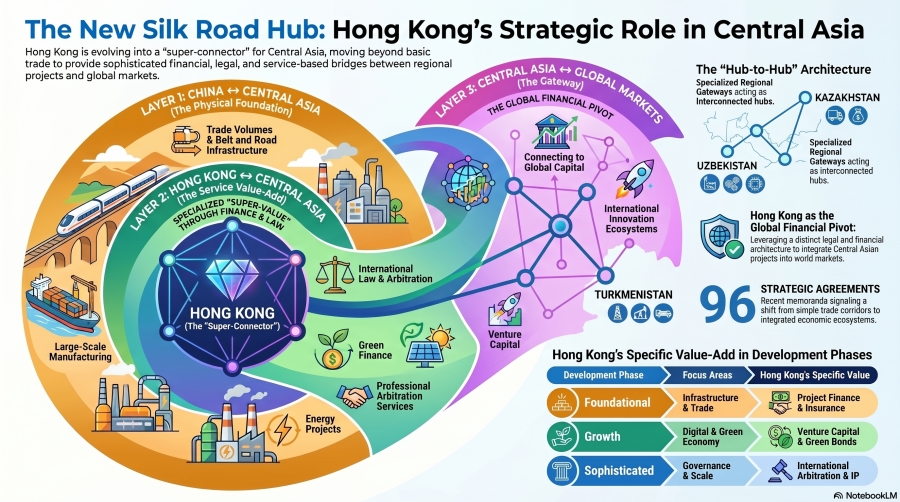
Despite the impressive growth of China-Central Asia relations, one area remains relatively underdeveloped: the integration of Central Asian projects into global capital, professional services, risk management, arbitration, and international financial ecosystems.
Many Central Asian countries have successfully attracted investment and infrastructure financing. The next phase of development requires something more sophisticated.
As the region moves up the value chain, it increasingly requires:
- Access to international capital markets;
- Project finance structures;
- Green financing mechanisms;
- International arbitration services;
- Insurance and reinsurance solutions;
- Cross-border wealth management;
- Technology commercialization;
- Venture capital and startup financing;
- Global corporate governance expertise.
These are areas where Hong Kong possesses decades of accumulated experience and internationally recognized institutions.
In many respects, Hong Kong can serve as the bridge between Central Asia’s development ambitions and global financial markets.
Central Asia as a Regional Economic Space
An important aspect of Hong Kong’s outreach is that it increasingly appears to view Central Asia not simply as five separate national markets, but as a single emerging economic space whose collective significance is greater than the sum of its individual economies.
This perspective mirrors broader regional trends. Over the past decade, the Central Asian states have significantly expanded regional cooperation, strengthened political dialogue, improved cross-border connectivity, and developed a growing habit of presenting themselves collectively in international forums.
For external partners, the attraction of Central Asia increasingly lies not only in the opportunities offered by individual countries but also in the region’s combined strategic position at the heart of Eurasia.
From transport corridors and energy networks to digital infrastructure and critical minerals, many of the most promising opportunities are regional in nature.
The growing tendency to view Central Asia as an integrated economic space is therefore becoming one of the defining features of the region’s development.
The Emergence of a Hub-to-Hub Architecture
Perhaps the most important concept emerging from the visit is the idea of “hub-to-hub” cooperation.
Historically, Silk Road commerce connected a chain of commercial centers rather than a simple point-to-point network. The modern version may involve a similar architecture.
Hong Kong functions as a global financial, logistics, and professional-services hub. Central Asia, meanwhile, is gradually developing into an interconnected network of specialized hubs, each contributing distinct strengths to the region’s overall economic profile.
Kazakhstan has established itself as a major transport, logistics, and financial gateway linking East Asia, Central Asia, the South Caucasus, Türkiye, and Europe. Uzbekistan is emerging as a manufacturing, demographic, and innovation center with growing ambitions in technology and digital services. Kyrgyzstan and Tajikistan occupy strategically important positions in regional connectivity and cross-border commerce, while Turkmenistan continues to expand its role as an energy producer and a critical transit bridge connecting Central Asia with the Caspian region, the Middle East, and South Asia.
Viewed collectively, these complementary strengths create opportunities that extend beyond bilateral relationships. What is gradually taking shape is a broader network linking Hong Kong’s global financial and professional-services capabilities with Central Asia’s expanding role in transport, energy, industry, digital development, and Eurasian connectivity.
The interaction of these hubs could create economic effects far greater than the sum of individual projects.
Instead of merely facilitating trade between China and Central Asia, the emerging model seeks to create interconnected platforms capable of attracting investment, talent, technology, and services from multiple regions simultaneously.
Such a framework is particularly relevant at a time when Central Asia is attracting growing international attention as a source of critical minerals, a transit region connecting major markets, an emerging destination for manufacturing diversification, and a participant in the digital transformation of Eurasia.
From this perspective, the significance of Hong Kong’s outreach extends beyond Kazakhstan and Uzbekistan. The two countries were natural starting points because of their economic scale, reform momentum, and growing international engagement, but the logic underlying the initiative is regional rather than bilateral. As transport corridors, financial networks, digital infrastructure, and people-to-people exchanges continue to develop, opportunities for engagement are likely to expand across all five Central Asian states.
The concept of hub-to-hub cooperation therefore represents more than a collection of commercial agreements. It reflects an attempt to build a new layer of connectivity between one of the world’s leading international business centers and a region that is increasingly emerging as a strategic pivot of Eurasia.
In this sense, Hong Kong is positioning itself not merely as a gateway to China, but as a gateway connecting Central Asia with broader global markets, capital flows, professional services, and innovation ecosystems. At the same time, Central Asia is evolving from a transit region into a collection of increasingly sophisticated economic hubs capable of engaging with international partners on a much wider range of issues than was possible even a decade ago.
Looking Ahead: The Next Decade
The 96 agreements and memoranda announced during the visit are important, but their deeper significance lies in the trajectory they suggest.
Several developments are likely over the coming years:
- Expansion of direct air connectivity between Hong Kong and Central Asian cities;
- Increased use of Hong Kong financial services for Central Asian projects;
- Growth of educational and professional exchanges;
- Greater participation of Hong Kong institutions in digital economy initiatives;
- Cooperation in green finance and sustainable infrastructure;
- Development of new logistics and supply-chain partnerships;
- Enhanced support for Central Asian companies seeking access to Asian and global capital markets;
- Expanded collaboration in technology, innovation, and startup ecosystems.
The mutual visa-free arrangements and aviation agreements discussed during the visit may ultimately prove as important as the commercial agreements themselves, because they create the human connectivity necessary for long-term partnerships.
More Than an Economic Mission
The significance of Hong Kong’s Central Asia outreach should therefore not be measured solely by the value of the agreements signed.
Rather, it reflects a broader evolution in Eurasian economic geography.
As Central Asia gains strategic importance and as China continues to deepen engagement with the region, the relationship is entering a more sophisticated phase. Infrastructure and trade remain essential, but finance, innovation, professional services, technology, and human capital are becoming equally important.
Hong Kong’s role is to help provide these additional layers of connectivity.
In that sense, the mission was not simply about opening new markets. It was about expanding the architecture of cooperation between China and Central Asia, adding new channels through which investment, knowledge, technology, and opportunity can flow across Eurasia.
The significance of that process is likely to become increasingly visible in the years ahead.
More broadly, the visit may come to be seen as an early indication of a new stage in China-Central Asia relations—one in which the focus shifts from building connections to deepening them, from infrastructure to institutions, and from trade corridors to integrated economic ecosystems.
If that proves to be the case, Hong Kong’s role as a connector between Central Asia, China, and global markets could become one of the more important yet less immediately visible dimensions of Eurasia’s emerging economic landscape. /// nCa, 8 June 2026