


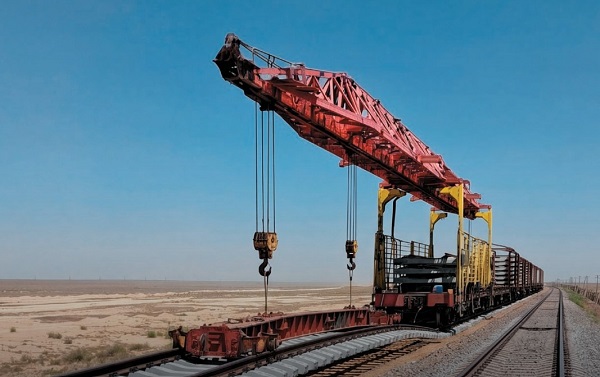
Eurasia’s transport landscape is set for a major expansion, with 402 ongoing and planned projects valued at $345 billion, alongside an additional $100 billion worth of ventures slated for launch.
Central Asian countries account for over 21% of the total investments directed toward the development of the Eurasian Transport Network. A total of 114 projects worth over $71.75 billion are being implemented or planned for implementation in the region. These figures were released by the Eurasian Development Bank (EDB) in its new report titled “Transport Corridor Infrastructure: Observatory and Interactive Map of Eurasian Transport Network Projects – 2026.”
The Observatory of Eurasian Transport Network (ETN) Projects is a digital platform that aggregates data on transport corridor development across 13 Eurasian countries, including Armenia, Azerbaijan, Afghanistan, Belarus, Georgia, Iran, Kazakhstan, Kyrgyzstan, Mongolia, Russia, Tajikistan, Turkmenistan, and Uzbekistan.
The Observatory enables comprehensive tracking of developments in transport corridor infrastructure, identification of priority projects, and support for more effective investment decision-making.
Since the Observatory was published in the summer of 2025, significant progress has been made in developing Eurasian transport corridors.
In 2025, infrastructure facilities with total investments exceeding $10 billion were commissioned in the Eurasian region. In Central Asia, major projects with total investments exceeding $6 billion were completed. These projects include:
- Kazakhstan: Commissioning of the modernized Dostyk–Moyynty railway line (its capacity increased fivefold due to the construction of second main tracks);
- Turkmenistan: Ashgabat–Mary–Turkmenabat motorway, as well as a section of the INSTC (International North–South Transport Corridor) along the Turkmenbashi–Garabogaz–border with Kazakhstan route in Turkmenistan;
- Kyrgyzstan: Kok-Art Pass Tunnel on the Alternative North–South Road;
- Tajikistan: Sections of the Obigarm–Nurobod road;
- Uzbekistan: Completion of the electrification of the Bukhara–Urgench–Khiva railway with the launch of high-speed passenger services.
Almost 56% of investments in Central Asian countries are targeted at expanding the road network, highlighting the key role of road transport in advancing international transit and trade in the region.
Another 29.8% of investments are directed toward developing railway sections of transport corridors traversing Central Asia.
The majority of investments in the development of the Eurasian Transport Network in Central Asia—$42.8 billion—are focused on developing sections of the TRACECA corridor, including the Trans-Caspian International Transport Route (TITR).
The 10 top transport corridor development projects in Central Asian countries account for 42% of the total investment in the development of the Eurasian Transport Network. These include:
- Trans-Afghan Railway Corridor – $4.8 billion
- China–Kyrgyzstan–Uzbekistan Railway Corridor – $4.7 billion
- Tashkent–Andijan Toll Motorway – $4.3 billion
- Reconstruction of the Astana–Kostanay–Russian Border Road – $4.1 billion
- Tashkent–Samarkand High-Speed Railway (HSR) – $3 billion
- Center–West Motorway (Astana–Shalkar–Kandyagash Section) – $2.6 billion
- Ashgabat–Turkmenbashi Motorway – $2.5 billion
- New Tashkent International Airport – $2.5 billion
- Serakhs–Mary–Serhetabat Motorway – $2.2 billion
- Tashkent–Samarkand Toll Motorway – $2.2 billion
/// nCa, 24 July 2026