


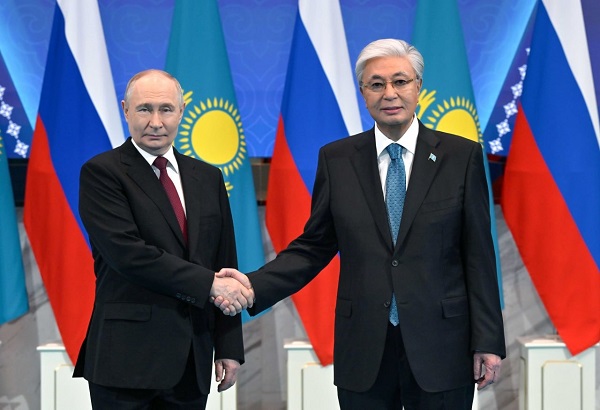
The state visit of Russian President Vladimir Putin to Kazakhstan is taking place from 27 to 29 May 2026. The main highest-level events were held in Astana on 28 May. The program traditionally included talks in narrow and expanded formats between President Kassym-Jomart Tokayev and President Putin, statements by the heads of state to the press, and the launch of joint projects.
Meanwhile, it is not the protocol ceremonies themselves that matter, but the fruits borne by months of negotiations at the interagency and diplomatic levels on both sides to fill the Astana summit with practical substance.
Among the key results of the visit announced so far are agreements on the construction of two units of the “Balkhash” nuclear power plant financed by a Russian export credit, the signing of a currency swap agreement to de-dollarize trade, and the launch of the world’s first continuous 3,000-kilometer route for autonomous “Kamaz” trucks. The conceptual outcome of the meetings was the signing of a document on the “Seven Pillars” of friendship and good-neighborliness.
Tricolor Over Astana
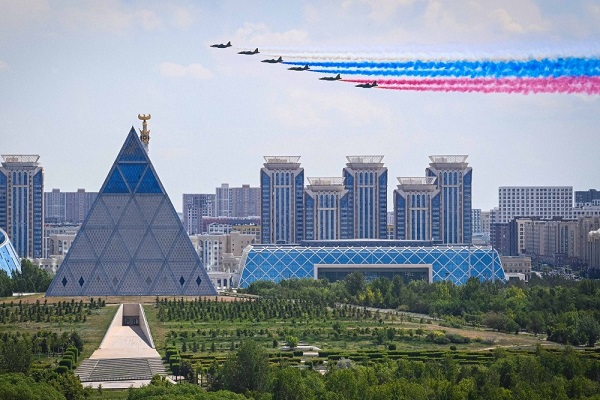
The official visit commenced at the Palace of Independence with a grand welcoming ceremony, where Kazakh President Kassym-Jomart Tokayev personally greeted the Russian leader. The most striking and symbolic moment of the reception featured a flypast by a fighter jet squadron from the Air Defense Forces of Kazakhstan. Swooping over the square, the jets painted the Astana sky with a white, blue, and red smoke trail—the colors of the Russian national flag—underscoring the high-profile nature of the visit.
Economic Foundations and Key Cooperation Projects
Trade and economic cooperation anchored the bilateral talks, reflecting robust and accelerating momentum, with Russia firmly established as Kazakhstan’s top trading partner:
- Trade Volume: By the end of 2025, bilateral trade surged to a record $29 billion.
- Investment Inflow: Russia’s direct investment in the Kazakh economy crossed the $29 billion mark, while Kazakh investments in Russia reached approximately $9 billion.
- Corporate Footprint: Over 23,000 joint ventures and Russian-backed companies are currently operating in Kazakhstan, making Russia the absolute leader in foreign business presence.
The industrial cooperation portfolio between the two nations now features 177 joint projects valued at $52.7 billion, which collectively support over 60,000 jobs. To date, 122 projects worth $22.4 billion have already been commissioned.
Currently, another 24 projects totaling $10 billion are underway, spanning the chemical industry, construction materials, and downstream raw material processing. Once operational, these initiatives will generate 11,000 new jobs.
Major Breakthrough: Russia to Construct Kazakhstan’s First NPP via Export Credit
The definitive geo-economic milestone of the visit was the official exchange of intergovernmental agreements outlining the framework for cooperation and the provision of a Russian state export credit to finance Kazakhstan’s inaugural nuclear power plant, “Balkhash”.
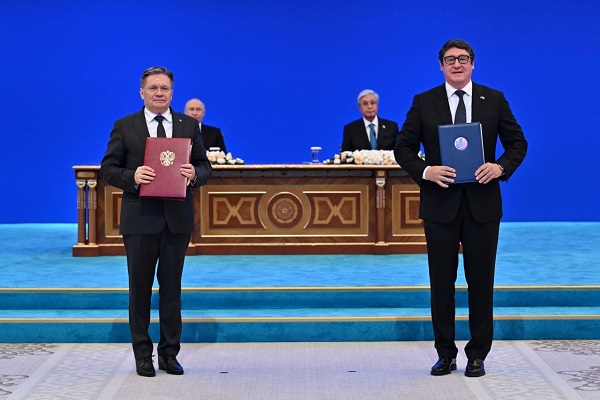
Key financial, technical, and operational parameters of the mega-project have now been unveiled:
- Financial Scope and Cost Breakdown: Almasadam Satkaliev, chairman of Kazakhstan’s Nuclear Energy Agency, stated that the project’s total cost is estimated at approximately $16.4 billion. Roughly $14.4 billion will fund the direct construction of the two power units, while the remaining $2 billion is allocated for social infrastructure, physical security systems, and initial nuclear fuel procurement for the warranty period.
- Financing Structure: The Russian export credit will anchor the bulk of the capital expenditures. Alexey Likhachev, Director General of the “Rosatom” state corporation, clarified that while the loan covers “the larger part of the capital investment, it will not cover the entirety—a portion will be funded by the Kazakh side”.
- Project Timeline: The active rollout of construction facilities and the preparation of technical documentation required for licensing are slated to begin as early as 2027. The phased commissioning of the plant is scheduled for the mid-2030s. To ensure operational safety, the commercial launches will be staggered, with an 8-to-10-month interval between the grid connection of the first and second reactors.
Beyond addressing the anticipated power deficits in southern Kazakhstan, the Balkhash NPP cements Astana and Moscow’s status as long-term strategic allies in high-tech industries and peaceful nuclear energy for decades to come.
Currency Swap: De-dollarization in Action
To insulate bilateral trade from external market volatility, the National Bank of Kazakhstan and the Central Bank of the Russian Federation have signed a bilateral tenge-ruble currency swap agreement.
According to the Bank of Russia, the framework provides each central bank with access to short-term liquidity in the other country’s currency to support their respective operational mandates. The swap line is capped at 35 billion rubles (225 billion Kazakhstani tenge) under a three-year agreement. Under the terms of the facility, individual transactions are limited to a maximum maturity of one year and will utilize market-based interest rates.
The move solidifies Astana and Moscow’s strategic push toward deeper financial integration, aiming to transition the bulk of their commercial trade into national currencies. By leveraging this swap mechanism, both nations expect to lower transactional costs for businesses and guarantee uninterrupted cross-border settlements.
Connectivity of the Future: First Autonomous Run of “Kamaz” Trucks
A revolutionary step in regional logistics unfolded with the presentation of a new transport connectivity project, as the ministries of transport of both nations, in partnership with PJSC “Kamaz”, successfully launched and tested an autonomous freight transit along the Astana–Moscow route.
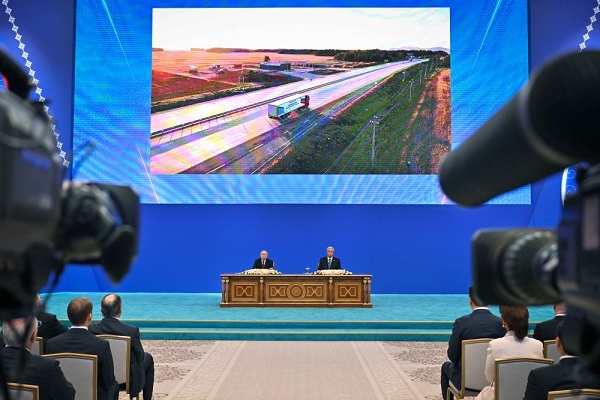
Operating in automated mode, the driverless trucks synchronously crossed the Kazakh-Russian border through the “Zhana Zhol” checkpoint and seamlessly delivered their cargo to the final destinations.
A Global First in Logistics: Marking a milestone in global transport practice, heavy-duty autonomous trucks covered a continuous, non-stop route spanning approximately 3,000 kilometers. The deployment of self-driving technology slashed transit times by more than half, compressing the entire cross-border journey into just two days.
To scale this pioneering initiative, both sides agreed to collaborate on developing a comprehensive regulatory and institutional framework, alongside the targeted modernization of supporting road infrastructure.
Seven Pillars of Strategic Partnership: A New Manifesto of Good-Neighborliness
The ideological and political core of the state visit was the signing by Kassym-Jomart Tokayev and Vladimir Putin of a monumental political document—the Joint Statement on the Seven Pillars of Friendship and Good-Neighborliness of the Peoples of Kazakhstan and Russia.
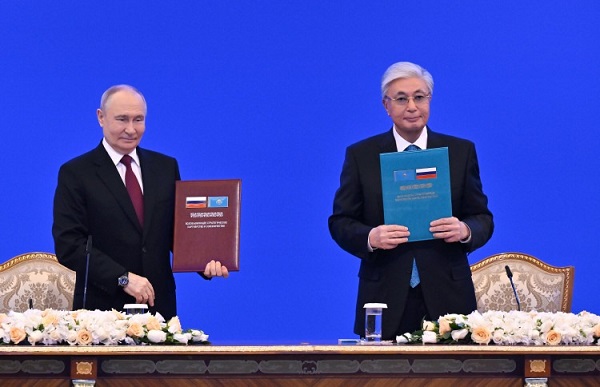
The text of the statement outlines the following seven key pillars of friendship and good-neighborliness between the two countries:
- Shared history and a responsible approach to its objective understanding. This pillar is based on close historical ties, jointly overcoming trials, and significant achievements, such as the first human space flight from Baikonur.
- Joint efforts to develop Eurasian integration. The countries view the CIS as an important dialogue platform, the EAEU as the core of economic integration, and the CSTO as a key element in ensuring regional stability and security.
- The shared border as a space of good-neighborliness and cooperation. The longest continuous land border in the world serves as a factor of economic interconnectedness and development of border regions. This also includes joint responsibility for ecology, the rational use of transboundary water bodies, and the Caspian region.
- Economic partnership. The complementarity of the economies allows for the development of trade, transport and logistics routes (such as the “North-South” corridor), and industrial cooperation. Important attention is paid to mutual settlements in national currencies and minimizing the consequences of sanctions.
- Linguistic and cultural diversity, traditional values, and civilizational closeness. The sides support cultural sovereignty and multilingualism. The Russian language remains an important means of communication, while the teaching of the Kazakh language is expanding in Russia. Mutual values are recognized as respect for family, older generations, labor, and the memory of ancestors.
- Youth cooperation, educational exchanges, and sports. The future of relations is linked with academic mobility, the creation of joint schools, branches of universities, and holding international sports events.
- A joint look into the future. Kazakhstan and Russia strive to act as equal partners and strategic allies, jointly solving tasks in the sphere of technology, ecology, and social justice. All emerging disagreements are intended to be resolved in the spirit of constructive dialogue and mutual trust.
The full text of the statement is available here: https://www.akorda.kz/ru/sovmestnoe-zayavlenie-prezidenta-respubliki-kazahstan-kktokaeva-i-prezidenta-rossiyskoy-federacii-vvputina-o-semi-osnovah-druzhby-i-dobrososedstva-narodov-kazahstana-i-rossii-284262
Documents Signed
A comprehensive package of 15 bilateral documents and pacts was signed and adopted during the state visit, expanding the legal and operational framework across several critical sectors:
- Energy and Nuclear Industry: Bilateral agreements established the foundational principles for constructing the Balkhash NPP and finalized the terms of the Russian state export credit. Additionally, the sides approved a joint nuclear and radiation safety cooperation plan spanning 2026–2030.
- Oil and Energy Sector: Frameworks were secured to deepen and expand bilateral energy cooperation in crude oil production and transit.
- Finance and Banking: Alongside the landmark tenge-ruble currency swap agreement, the respective central banks signed a memorandum of cooperation, accompanied by a joint protocol on countering money laundering and the financing of terrorism (AML/CFT).
- Education and Youth Policy: Agreements were reached to establish an international school and a dedicated center for gifted children, named “Kazakhstan – Sirius”. The package also covers funding mechanisms for Russian citizens studying at the Omsk branch of Al-Farabi Kazakh National University (KazNU), alongside a new academic partnership between the L.N. Gumilyov Eurasian National University and the All-Russian Academy of Foreign Trade.
- Transport and Digitalization: Roadmap initiatives were adopted to fast-track digitalization across the broader transport sector, with a specific focus on optimizing rail freight operations.
- Healthcare: A comprehensive action plan was signed to scale up joint efforts in public healthcare and sanitary-epidemiological surveillance.
- Media and Information: A memorandum of cooperation was inked between the Teleradiocomplex of the President of Kazakhstan and Russia’s JSC “TATMEDIA”.
///nCa, 28 May 2026 (based on materials from the official website of the President of Kazakhstan and Russian media)