


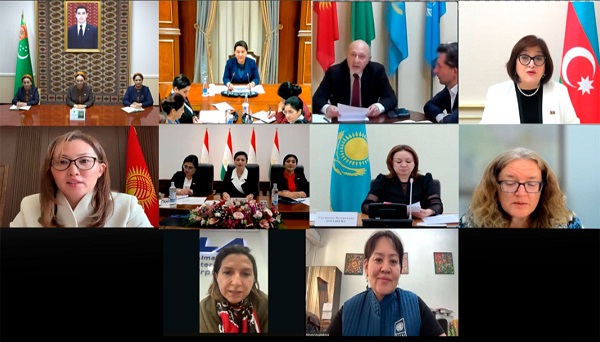
The Chairperson of the Mejlis of Turkmenistan joined on 21 April 2026 a growing regional effort to institutionalize cooperation among women leaders as she took part—via video link—in the first meeting under Uzbekistan’s 2026 chairmanship of the Dialogue of Women Leaders of Central Asian States, a platform that has been steadily gaining political weight across the region.
Chaired by Uzbekistan and led by Senate Chairperson Tanzila Narbayeva, the meeting brought together women parliamentary leaders and senior representatives from across Central Asia—Kazakhstan, Kyrgyzstan, Tajikistan and Turkmenistan—as well as Azerbaijan, alongside officials from international organizations including the UN Regional Centre for Preventive Diplomacy for Central Asia (UNRCCA) and UN Women.
The hybrid format reflected an increasingly flexible approach to regional diplomacy, allowing high-level participation despite geographical constraints.
Uzbek media coverage and earlier sessions of the Dialogue indicate that the platform has evolved into a structured forum with a defined agenda and outputs. Established in 2020, it is designed to coordinate regional approaches to gender equality, expand women’s role in governance, and develop joint initiatives aligned with global commitments such as the Sustainable Development Goals and the Beijing Platform for Action.
The latest meeting, held under the theme “Women of Central Asia: Priority Tasks and Joint Actions,” focused on shaping the work programme for Uzbekistan’s chairmanship in 2026.
Participants exchanged views on planned events and priority areas, while reaffirming the Dialogue’s role as a mechanism for consolidating regional efforts.
Discussions during the session reflected a broad and structured agenda that has become characteristic of the Dialogue. Uzbek sources note that such meetings typically include multiple thematic tracks covering women’s participation in decision-making, economic empowerment and entrepreneurship, access to education and healthcare, and the role of women in innovation, media, and climate policy. Legal protection mechanisms and measures to combat violence against women also feature prominently.
A key outcome of previous gatherings—likely to shape the current cycle of work—has been the development of joint documents and roadmaps aimed at strengthening inter-parliamentary cooperation and ensuring continuity through monitoring and exchange of best practices.
Within this broader regional context, Turkmenistan’s participation highlighted its emphasis on legislative and policy frameworks supporting women’s rights. Representatives of the Mejlis have consistently pointed to the country’s National Action Plan on Gender Equality (2021–2025), which focuses on increasing women’s participation in public administration, expanding their role in the economy, and strengthening legal protections.
During the latest meeting, the Turkmen side reiterated these priorities while supporting closer regional coordination. The participation of the Chairperson of the Mejlis at the highest parliamentary level underscored Ashgabat’s intent to remain actively engaged in shaping the Dialogue’s agenda during Uzbekistan’s chairmanship year.
At the regional level, speakers emphasized that advancing women’s leadership is not only a matter of social policy but also a driver of stability and sustainable development. Uzbek officials have repeatedly framed women’s participation as essential to economic growth and regional cooperation, a view echoed by international partners such as UN Women, which has been supporting Central Asian states in aligning national reforms with global gender equality frameworks.
The Dialogue itself has increasingly become a venue for aligning national strategies with regional priorities. Participants have stressed the importance of removing barriers to women’s political participation, expanding access to financial resources, and supporting entrepreneurship and innovation ecosystems that include women-led initiatives.
The inclusion of Azerbaijan alongside the five Central Asian states reflects a broader effort to widen the geographic scope of cooperation, particularly on issues such as access to justice and legal reforms, which have been the focus of parallel regional initiatives hosted by Uzbekistan in partnership with UN Women.
Overall, the first meeting of the Dialogue under Uzbekistan’s 2026 chairmanship demonstrated continuity with earlier sessions while setting the stage for a more action-oriented phase.
With Turkmenistan and other participating countries reaffirming their commitments, the platform is expected to continue evolving as a key mechanism for regional policy coordination—linking parliamentary diplomacy with practical initiatives aimed at advancing gender equality and sustainable development across Central Asia. /// nCa, 22 Apil 2026