


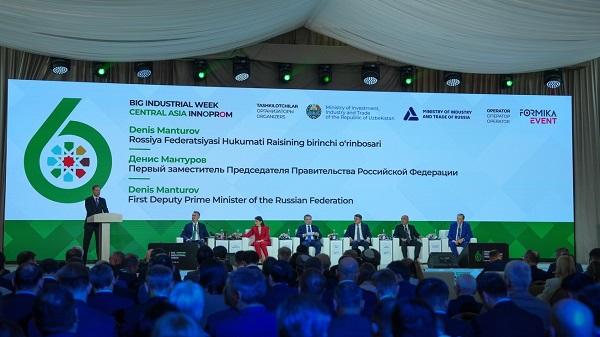
Russian and Turkmen partners are stepping up industrial cooperation with a focus on establishing a full-cycle ferrous metallurgy industry in Turkmenistan, according to statements made by Denis Manturov at the International Industrial Exhibition Innoprom Central Asia in Tashkent.
Manturov said Russian companies are actively working with Turkmen counterparts not only on steel production but also in the automotive sector and the manufacturing of equipment for the oil and gas industry. The initiative reflects a broader push by Moscow to expand industrial partnerships across Central Asia and deepen value-added production chains in the region, reports TASS.
While specific project timelines and investment figures for Turkmenistan were not disclosed, the move aligns with Ashgabat’s long-standing objective to diversify its economy beyond hydrocarbons by developing domestic manufacturing capacity. Turkmenistan has in recent years promoted import substitution and industrialization, particularly in construction materials and machinery.
The proposed “full cycle” in ferrous metallurgy typically involves the entire production chain—from raw material processing to finished steel products—suggesting that any future projects could significantly reduce reliance on imports while supporting infrastructure and industrial development domestically.
Manturov also outlined Russia’s broader regional engagement. In Tajikistan, Russian companies are involved in metallurgy, mechanical engineering, pharmaceuticals, and light industry projects. Meanwhile, in Kyrgyzstan, Russia remains among the top three foreign investors, with cooperation spanning renewable energy projects such as solar and wind power plants, as well as railway infrastructure.
Energy cooperation remains a central pillar of Russia’s engagement in Central Asia. Manturov emphasized collaboration in hydropower and water supply systems across the region, alongside continued interest in constructing nuclear power plants based on Russian technology—an area Moscow presents as key to enhancing long-term energy security for Eurasian countries.
The discussions at Innoprom highlight an emerging pattern of industrial integration between Russia and Central Asian economies, with Turkmenistan increasingly positioned as a potential hub for new manufacturing capabilities tied to regional demand. /// nCa, 21 April 2026