


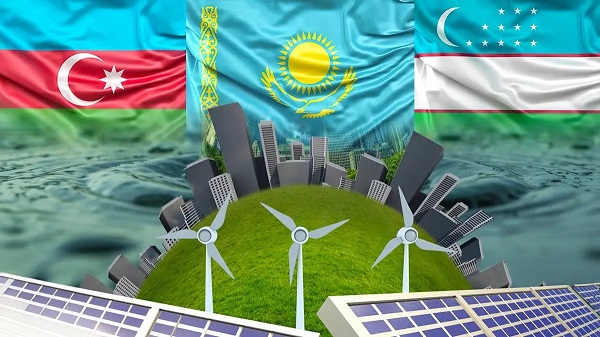
A new regional energy axis is taking shape across Central Asia and the Caspian region, as Uzbekistan, Kazakhstan, and Azerbaijan advance plans to export renewable electricity to Europe through the ambitious “Green Corridor” project.
The initiative reflects a deepening strategic partnership among the three countries, combining expanding renewable energy capacity with cross-border infrastructure aimed at delivering clean power to international markets. Officials describe the project as a milestone not only for regional energy security but also for the broader global transition toward low-carbon energy.
At the core of the effort is Uzbekistan’s rapid transformation of its domestic energy mix. Over recent years, the country has commissioned 15 solar and 5 wind power plants with a combined capacity of 5,582 MW. These include nearly 4,000 MW of solar and over 1,600 MW of wind generation, supported by 12 energy storage systems totaling 1,545 MW.
The results are already visible. In 2025, Uzbekistan generated 10.5 billion kWh of electricity from solar and wind sources. By mid-April 2026, output had surpassed 2.5 billion kWh, with a target of reaching 15 billion kWh by year’s end. Longer-term plans are even more ambitious: by 2030, renewable capacity is expected to reach 21 GW, accounting for 54% of total electricity generation. This shift is projected to save 18 billion cubic meters of natural gas annually and reduce harmful emissions by 25 million tons.
Regional cooperation has been central to this progress. Strengthened ties between Uzbekistan and Kazakhstan—highlighted during recent high-level meetings between their leaders—have laid the groundwork for broader energy integration. Azerbaijan’s participation extends the partnership across the Caspian, creating a strategic corridor linking Central Asia to European markets.
The “Green Corridor” concept formally emerged with a memorandum of understanding in May 2024 and was elevated through a strategic partnership agreement signed at the COP-29 summit in Baku later that year. Since then, implementation has moved steadily forward.
National grid operators from the three countries—Uzbekistan’s National Electric Grid, Kazakhstan’s KEGOC, and Azerbaijan’s Azerenerji—have aligned their efforts under a joint framework. The establishment of the Green Corridor Alliance LLC in Baku in July 2025 provided an institutional base for the project.
International interest has also grown. Discussions in Tashkent involving representatives from Saudi Arabia’s Ministry of Energy underscored the project’s widening global relevance. Meanwhile, Italy’s CESI has been tasked with preparing a comprehensive feasibility study, supported by the Asian Development Bank, with completion expected by early 2027.
Experts say the project could become a cornerstone of a future transcontinental energy system, linking renewable-rich regions of Central Asia with demand centers in Europe. Beyond exports, it also signals a shift toward a more integrated, digital, and environmentally sustainable regional grid.
According to the Ministry of Energy of Uzbekistan, the initiative reflects not only economic priorities but also a shared commitment by the three countries to long-term sustainability and regional solidarity. /// nCa, 21 April 2026