


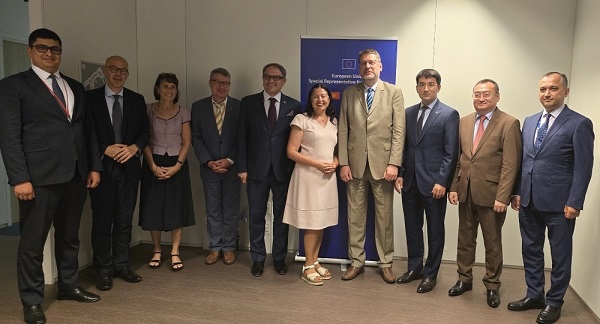
The European Union and the five Central Asian countries—Turkmenistan, Kazakhstan, Kyrgyzstan, Tajikistan, and Uzbekistan—are preparing a series of high-level political events for 2026–2027. The plans were discussed during a recent joint meeting between the ambassadors of the Central Asian states and senior officials from key EU institutions at the European External Action Service (EEAS) in Brussels, according to the Embassy of Turkmenistan in Belgium.
The meeting brought together Audrone Perkauskiene, Deputy Managing Director for Eastern Europe and Central Asia at the EEAS; Eduards Stiprais, EU Special Representative for Central Asia; Pēteris Ustubs, Director at the European Commission’s Directorate-General for International Partnerships (DG INTPA); Dietmar Krissler, Head of the EEAS Central Asia Division; along with representatives of the European Commission, the EEAS, and the ambassadors of the Central Asian countries.
EU officials confirmed that a ministerial meeting on connectivity and security involving the countries of Central Asia, the Eastern Partnership, and the Black Sea region will take place on 16 November 2026.
Preparations are also underway for the Second European Union–Central Asia Summit, scheduled for 2027.
Another key event on the agenda is the Global Gateway Forum, which will be held on 7–8 June 2027. The EU reaffirmed its commitment to advancing investment projects under the Global Gateway initiative, including those supported by the European Investment Bank (EIB), the European Bank for Reconstruction and Development (EBRD), and other international financial institutions. Current priorities include the digitalization of transport procedures, modernization of customs administration, and the removal of administrative barriers to trade.
The participants also discussed expanding cooperation with European financial institutions, implementing infrastructure projects, and strengthening collaboration in critical raw materials, digitalization, energy, education, counterterrorism, and responses to emerging security challenges.
The sides reaffirmed their commitment to deepening the strategic partnership between the European Union and Central Asia, maintaining regular political dialogue, and advancing practical joint initiatives.
Turkmenistan–EU Cooperation
The meeting also devoted special attention to further developing the legal and institutional framework governing cooperation between Turkmenistan and the European Union.
Brussels confirmed its readiness to continue working with Ashgabat on a roadmap aimed at strengthening bilateral cooperation across key areas.
In his remarks, Turkmenistan’s Ambassador to Belgium, Sapar Palvanov, said that cooperation between Central Asia and the European Union is becoming increasingly practical and results-oriented.
He noted that summits, ministerial meetings, expert platforms, and bilateral consultations should be viewed as components of a single long-term process focused on delivering tangible outcomes.
The Turkmen side also welcomed the Connectivity Agenda Platform, launched in June, as an important mechanism for enhancing regional transport cooperation. Ambassador Palvanov stressed the need to further improve coordination mechanisms and strengthen the resilience of regional transport corridors.
///nCa, 15 July 2026