


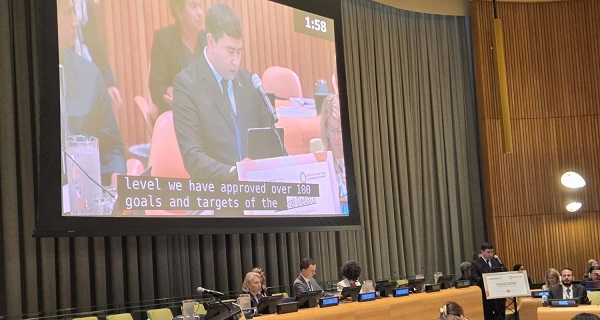
Turkmenistan has integrated 85% of the Sustainable Development Goals (SDGs) into its national and sectoral development programmes, with 131 national SDG targets and 175 indicators officially adopted. The announcement was made by Perhat Yagshiyev, Deputy Minister of Finance and Economy of Turkmenistan, during the High-Level Political Forum on Sustainable Development held under the auspices of the UN Economic and Social Council (ECOSOC) at the United Nations Headquarters in New York.
On 15 July 2026, the Turkmen delegation participated in the ECOSOC High-Level Segment general debate, held under the theme: “Advancing sustainable, inclusive, science- and evidence-based solutions for the 2030 Agenda and its Sustainable Development Goals, leaving no one behind.”
In his address, Yagshiyev said that expanding cooperation with the United Nations and its specialized agencies remains one of the key priorities of Turkmenistan’s foreign policy. He stressed that peace, stability, and security are viewed by the country as essential prerequisites for sustainable development and the achievement of the SDGs.
He also highlighted environmental protection, sustainable water resource management, climate action, and efforts to combat desertification as national priorities. In this context, Yagshiyev referred to the initiative of the President of Turkmenistan to establish a Regional Centre for Combating Desertification for Central Asian countries.
Speaking on regional water issues, he emphasized that cooperation should be based on universally recognized principles and norms of international law while taking into account the interests of all countries in the region.
The deputy minister also outlined Turkmenistan’s efforts to promote a green economy, expand the use of environmentally friendly technologies, implement sustainable energy projects, and meet its international commitments to reduce methane emissions.
Part of his remarks focused on the city of Arkadag, described as the first smart city in Central Asia built in accordance with the principles of sustainable development, inclusiveness, and environmental sustainability. He noted that the city has been included in an OSCE project on sustainable and climate-resilient urban development and has received several international awards and certifications.
Yagshiyev also underscored the importance of strengthening international transport connectivity. He said Turkmenistan continues to develop major transport and transit corridors along the East–West and North–South routes, including the Trans-Caspian International Transport Route, viewing these projects as an important contribution to resilient global trade and improved connectivity for landlocked developing countries.
On the sidelines of the forum, the Turkmen delegation is also studying international best practices in preparing Voluntary National Reviews (VNRs) on SDG implementation. Turkmenistan plans to present its next national review in 2027. ///nCa, 15 July 2026