


[This is developing story. Final version will be published on 23 June 2026]
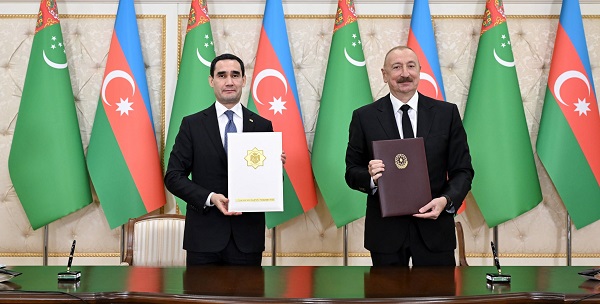
The state visit of Turkmen President Serdar Berdimuhamedov to Azerbaijan on 22 June has already produced a substantial package of political, economic, transport and humanitarian outcomes, underscoring the rapidly deepening strategic partnership between the two Caspian neighbors.
Azerbaijani media have portrayed the visit as one of the most significant bilateral engagements in recent years, taking place against the backdrop of expanding East-West transport corridors, growing Caspian connectivity and increasing cooperation in energy and logistics.
Ceremonial Welcome and Presidential Talks
President Berdimuhamedov arrived in Baku on a state visit and was formally welcomed by Azerbaijani President Ilham Aliyev. During the visit, the Turkmen leader also paid tribute to Azerbaijan’s national leader, Heydar Aliyev, by laying a wreath at the Alley of Honors.
The two presidents held both restricted and expanded-format talks, reviewing the entire spectrum of bilateral cooperation. According to Azerbaijani reporting, discussions focused on political dialogue, transport and logistics, energy cooperation, trade, customs modernization, humanitarian ties and regional connectivity initiatives.
Joint Statement and Package of Agreements
One of the central outcomes of the visit was the signing of a Joint Statement by Presidents Aliyev and Berdimuhamedov, reaffirming the strategic nature of Azerbaijani-Turkmen relations.
The sides also exchanged a number of sectoral agreements and memoranda, including:
- Technical specifications for the initial exchange of customs information on goods and vehicles moving between the two countries.
- A protocol on cooperation in customs statistics.
- A memorandum on sports cooperation.
- A memorandum on cooperation in labor and social protection.
- A memorandum on healthcare cooperation.
These agreements indicate that cooperation is expanding beyond traditional energy and transport sectors into broader areas of state administration and social development.
Azerbaijan Presents the “Dostlug” Tanker to Turkmenistan
The most symbolic event of the visit was the presentation ceremony of the newly built oil tanker “Dostlug” (“Friendship”), gifted by Azerbaijan to Turkmenistan.
The ceremony was attended virtually by both presidents. The vessel was constructed at the Baku Shipyard and represents one of the most tangible demonstrations of Azerbaijan’s support for Turkmenistan’s maritime and transport capabilities. According to Azerbaijani sources, the tanker is 141 meters long, 16.9 meters wide, has a draft of 4.54 meters and a deadweight capacity of approximately 7,875 tons.
The choice of the name “Dostlug” is itself highly significant. “Dostlug” (“Friendship”) is also the name of the offshore hydrocarbon structure jointly developed by Azerbaijan and Turkmenistan in the Caspian Sea, symbolizing the transformation of a once-disputed maritime area into a platform for cooperation.
The gifting of a modern tanker goes beyond symbolism. It strengthens Turkmenistan’s maritime fleet while highlighting Azerbaijan’s growing shipbuilding industry and ambition to become a major Caspian logistics and industrial hub.
Arrival of a Turkmen Vessel in Azerbaijan
A related maritime event that attracted attention in Azerbaijani media was the arrival of a Turkmen vessel in Azerbaijan in connection with the tanker presentation and broader maritime cooperation activities. Together with the transfer of the Dostlug tanker, the event highlighted the increasing operational integration of the two countries’ transport and shipping sectors across the Caspian Sea.
Observers in Baku noted that maritime cooperation is becoming a cornerstone of bilateral relations, especially as both countries seek to expand cargo movement through the Trans-Caspian International Transport Route, often referred to as the Middle Corridor.
Transport and Middle Corridor Dimension
Azerbaijani analysts have linked the visit directly to the development of Eurasian transport networks. As two key Caspian states, Azerbaijan and Turkmenistan occupy strategic positions on the route connecting China and Central Asia with the South Caucasus, Türkiye and Europe.
The strengthening of customs cooperation, shipping capabilities and port connectivity during the visit is expected to facilitate faster cargo movement across the Caspian and reinforce the competitiveness of the Middle Corridor. Azerbaijani commentators have described the partnership as a critical component of the emerging Eurasian logistics architecture.
Relations Built on a Strong Upward Trajectory
The visit did not emerge in isolation. It follows an intense period of bilateral engagement that has included ministerial exchanges, cultural programs, economic consultations and high-level meetings. Azerbaijani and Turkmen officials had already signaled that the state visit would produce a new package of agreements aimed at broadening cooperation.
Since the settlement of major Caspian issues and the launch of cooperation around the Dostlug hydrocarbon field, relations between Ashgabat and Baku have moved steadily from cordial neighborliness toward a more structured strategic partnership. Energy cooperation, maritime transport, logistics, customs modernization and cultural ties have all become pillars of this relationship.
Strategic Significance
The early outcomes of President Berdimuhamedov’s state visit suggest that Azerbaijan and Turkmenistan are seeking to institutionalize their partnership across multiple sectors simultaneously.
The Joint Statement, the package of cooperation agreements, the transfer of the Dostlug tanker, enhanced customs coordination and growing maritime connectivity collectively point toward a relationship that is increasingly focused on practical integration. At a time when Eurasian trade routes are undergoing rapid transformation, both countries appear determined to leverage their shared Caspian geography to become indispensable transit, logistics and energy partners.
For Turkmenistan and Azerbaijan alike, the visit represents not merely another diplomatic exchange but a visible step toward building a more interconnected Caspian region and a stronger role in the evolving economic geography of Eurasia. /// nCa, 22 June 2026