


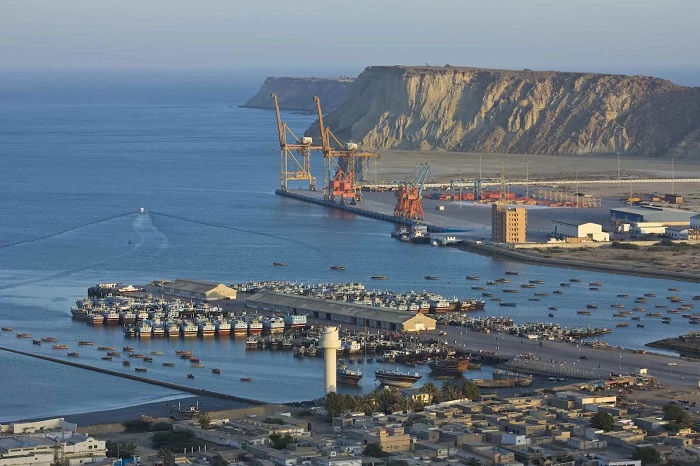
Pakistan is actively pursuing integration into the Russia-backed International North–South Transport Corridor (INSTC) by connecting it with the strategically vital Gwadar Port, officials from both Moscow and Islamabad have confirmed.
Special Assistant to the Pakistani Prime Minister Talha Burki announced Pakistan’s interest during the second Russia–Pakistan International Conference on the sidelines of the Kazan Forum in Russia on May 13. Burki stated that linking Gwadar — operated by China’s China Overseas Ports Holding Company — to the INSTC would enhance regional integration across Eurasia and complement China’s Belt and Road Initiative (BRI), also known as One Belt One Road (OBOR).
This nCa story is based on an article by Syed Fazl-e-Haider, published by the Jamestown Foundation.
Russian Deputy Prime Minister Alexei Overchuk, who oversees Eurasian integration efforts, confirmed that discussions between Moscow and Islamabad are underway. Overchuk noted that various connectivity options, including potential railway links, are under consideration.
The 7,200-kilometer INSTC, originally established in 2000 by Russia, Iran, and India, connects Russian hubs with Iranian ports and extends to the Indian Ocean. It has since expanded to include countries such as Azerbaijan, offering a shorter route between South Asia, Central Asia, Russia, and Europe.
For Pakistan, joining the corridor would provide overland access to Russia, the Caucasus, Central Asia, and European markets. Landlocked Central Asian nations would gain access to warm-water ports on the Arabian Sea, while Russia could secure faster routes to the Persian Gulf and Indian Ocean via Gwadar.
Gwadar, located 624 nautical miles east of the Strait of Hormuz, forms the cornerstone of the $62 billion China-Pakistan Economic Corridor (CPEC), a flagship BRI project. The corridor includes extensive networks of highways, railways, and energy pipelines linking Gwadar to China’s Xinjiang region. Pakistani officials estimate that full development of Gwadar as a transshipment hub could add up to $25 billion to the national economy.
Geopolitical Context
The initiative comes as India’s alternative gateway at Iran’s Chabahar port faces uncertainty amid ongoing regional tensions and unresolved aspects of a potential U.S.-Iran agreement. India operates the Shahid Beheshti terminal at Chabahar, which serves as its primary route to Afghanistan, Central Asia, and Eurasia — bypassing Pakistan. The port is also a component of the INSTC.
By aligning Gwadar with both Chinese and Russian-led connectivity projects, Pakistan aims to position itself as a central hub in emerging Eurasian trade networks. This includes synergies with the planned China–Kyrgyzstan–Uzbekistan railway, which would link to CPEC routes southward to Gwadar, granting Central Asia direct sea access.
Strengthening Russia-Pakistan Ties
Bilateral relations between Russia and Pakistan have warmed significantly in recent years. Pakistan began purchasing discounted Russian crude oil in 2023. In 2024, the two countries initiated talks on transport and logistics cooperation, including plans for a new freight railway line and direct air services. In December 2025, they agreed to test cargo shipments along the eastern route of the INSTC.
Analysts view Pakistan’s move as a strategic effort to diversify its connectivity options and capitalize on shifting geopolitical dynamics. Successful integration could generate substantial revenue from transit trade, port operations, and infrastructure development while elevating Islamabad’s role in broader Eurasian economic architecture.
The discussions reflect Pakistan’s ambition to serve as a crossroads between the Russia-led INSTC and China’s expansive BRI network, potentially reshaping trade flows across South and Central Asia. /// nCa, 22 June 2026