


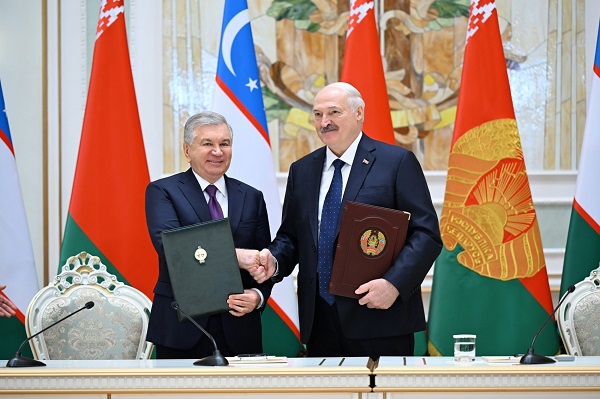
On 9 July 2026, Minsk hosted a historic summit talks between the President Aleksandr Lukashenko of Belarus, and the President Shavkat Mirziyoyev of Uzbekistan. The centerpiece of the summit was the signing of the Declaration on Establishing Strategic Partnership Relations—a fundamental document that charts the course for long-term bilateral cooperation.
The Declaration: Core Objectives and Leaders’ Assessment
The Declaration establishes a qualitatively new, top-tier level of interstate relations based on equality, mutual respect, deep trust, and a strict alignment of interests.
Its primary objective is to inject fresh momentum into joint efforts across political, trade, economic, investment, scientific, technical, cultural, and humanitarian fields, as well as in regional security and addressing contemporary challenges. The document specifically targets deep integration in key sectors, including manufacturing, agriculture, and transport logistics.
The leaders of both nations were unanimous in their high praise for the agreement.
Aleksandr Lukashenko described the move as “historic,” noting that the Declaration cements an atmosphere of solid friendship and trust, opening new horizons for ambitious initiatives.
Shavkat Mirziyoyev also characterized the document as truly historic, emphasizing that it confirms “a unified course toward the long-term development of partnership and friendly relations.”
Roadmap for Implementation: A Robust Package of Agreements
The Declaration is backed by immediate practical substance, supported by a comprehensive package of bilateral agreements and roadmaps. The governments of both nations have detailed five-year plans specifying clear targets, timelines, and responsible agencies.
The key documents of this package is the strategic Roadmap for Trade and Economic Cooperation between Belarus and Uzbekistan for 2026–2030 (Action Plan). In addition, ministers and agency heads exchanged a series of key documents, including:
- A Roadmap for Deepening Agricultural Cooperation for 2026–2028;
- A Memorandum of Intent on Investment Cooperation in the Agro-Industrial Sector;
- A Protocol on Cooperation in Light Industry;
- Cooperation programs and memoranda covering forestry, culture, tourism, social protection, finance, science, and education.
The Agricultural Sector: A Pillar of National Security
The expansion of Belarusian-Uzbek cooperation is directly aimed at strengthening the food security of both nations. In today’s geopolitical climate, food security stands out as a critical, strategic pillar of overall state security. Minsk and Tashkent are demonstrating exemplary dynamics in this area: in 2025 alone, bilateral trade in food products and agricultural raw materials surged nearly 1.5 times compared to 2024.
Future agricultural plans involve large-scale, deep integration projects:
- Belarusian Investment and Technology in Uzbekistan: The sides are successfully expanding their first joint venture—a state-of-the-art, full-cycle poultry complex in the Tashkent region. Belarus is ready to launch additional joint meat and dairy processing facilities in Uzbekistan.
- Uzbek Agribusiness in Belarus: A breakthrough agreement has been reached regarding the entry of Uzbek investors into the Vitebsk region. They will be allocated land plots to set up modern livestock complexes. High-quality meat and dairy products produced there will be exported directly back to Uzbekistan. This provides Tashkent with a guaranteed food supply chain while generating new jobs and rural development for Belarus.
- Furthermore, Minsk expressed readiness to ensure stable wholesale supplies of sugar, frozen beef, butter, and canned goods for Uzbekistan’s state reserves and domestic consumer markets.
Industrial Cooperation and Technological Sovereignty
A key priority of the five-year plans is industrial joint ventures, which are already making a tangible contribution to strengthening Uzbekistan’s technological sovereignty. Moving beyond simple trade, the two countries are prioritizing the localization of high-tech manufacturing on Uzbek soil.
At the same time, as follows from Aleksandr Lukashenko’s statements, the industrial alliance between Minsk and Tashkent carries an even broader geo-economic dimension: Belarus aims to leverage its partnership with Uzbekistan to gain access to other markets across the macro-region. “It is crucial that, in addition to our joint projects, we can expand into third countries with your assistance—especially those close to Uzbekistan. They show great interest, and we will work together. Moreover, this work has already begun,” the Belarusian leader emphasized.
The industrial agenda looks highly ambitious.
Over the past year, around 1,300 MTZ Belarus tractors were assembled in Uzbekistan, with localization rates for certain models nearing 30%. Production is slated to scale up to 3,000 units annually in the near future. Belarus will oversee the expansion of the service network, open a specialized training center, and provide on-the-line training for Uzbek technicians directly at the Minsk assembly plants.
The nations have successfully established joint production of 130-ton BELAZ mining dump trucks and are now preparing to transition to assembling ultra-heavy 220-ton vehicles.
In light of Uzbekistan’s ongoing construction of its first nuclear power plant, Shavkat Mirziyoyev expressed deep interest in utilizing Belarusian expertise. Belarus, which possesses highly efficient digital energy solutions and extensive experience operating its own NPP, is fully prepared to share its knowledge, technology, and trained personnel.
Joint industrial ventures will also extend into cable manufacturing, microelectronics, pharmaceuticals, electrical engineering, and textiles.
Targeting a $2 Billion Trade Volume
Trade will serve as the bedrock for these joint projects. While a $1 billion trade turnover seemed like an ambitious goal until recently, the relevant agencies have now been tasked with a clear and achievable objective: reaching a bilateral trade volume of $2 billion by 2030.
Uzbekistan currently ranks among Belarus’s top ten global trade partners and holds the third spot within the CIS.
To achieve a balanced trade flow, Minsk is keen to scale up imports of Uzbek rolled metal, cotton yarn, knitwear, apparel, fresh produce, and dried fruits. A significant step forward was the opening of the Uzbekistan Trade House in Minsk. To ensure Uzbek goods are accessible across the country, Aleksandr Lukashenko proposed replicating this model by opening similar trade facilities in every regional center of Belarus. Growth in trade and investment will also be propelled by Uzbekistan’s recent accession to the multilateral CIS Agreement on Trade in Services and Investments.
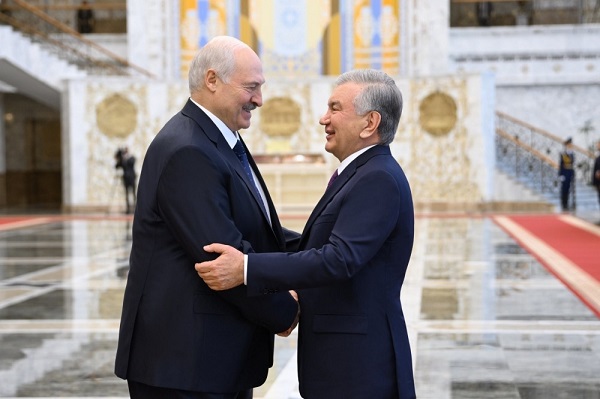
In conclusion, the signing of the Declaration on Strategic Partnership alongside this comprehensive package of agreements opens a new chapter in Belarus-Uzbekistan relations. The summit effectively channels top-level political trust into reinforcing the sovereignty, food security, technological independence, and sustainable development of both nations.///nCa, 9 July 2026