


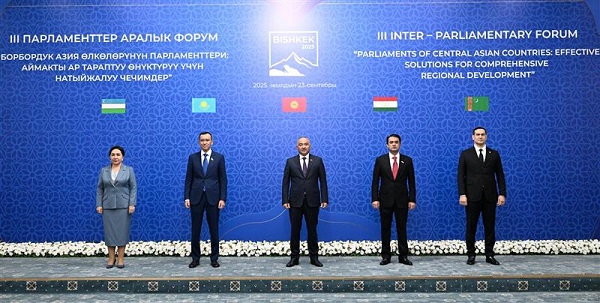
On 23 September 2025, the 3rd Inter-Parliamentary Forum of Central Asian States was held in Bishkek under the theme “Parliaments of Central Asian Countries: Effective Solutions for Comprehensive Regional Development.”

Opening the forum, Speaker of the Jogorku Kenesh (Parliament of Kyrgyzstan) Nurlanbek Shakiev emphasized that in a short period, the forum has become the main platform for discussing important initiatives.
Following this, the heads of parliaments from Central Asian countries delivered their reports.

Chairman of the Senate of the Parliament of Kazakhstan Maulen Ashimbayev addressed the issues of regional cooperation: “I believe the III Inter-Parliamentary Forum of Central Asian States will become a key driving force of regional integration and open new opportunities for collaboration. The successful signing of the border agreement between Kyrgyzstan and Tajikistan, as well as the historic trilateral agreement between Kyrgyzstan, Tajikistan, and Uzbekistan, have become a vivid symbol of commitment to stability and prosperity in the region. Last year, the treaty on allied relations between Kazakhstan and Uzbekistan also came into force. All these efforts will contribute to maintaining stability in the Central Asian region, ensuring economic growth, and fostering inter-state cooperation,” he said.
Chairperson of the Senate of the Oliy Majlis of Uzbekistan Tanzila Narbayeva noted that over three years of its existence, the forum has convincingly proven that it is both relevant and essential: “The forum has become the most important center for dialogue and harmonization of interests. Over these years, our countries have truly reached a high level of trust and good-neighborly relations. This is the result of the political will of our heads of state. Such cooperation covers all areas — from security to cultural and humanitarian interaction. In this process, parliaments play a key role by creating a solid legislative foundation and ensuring practical implementation. During this forum, we discussed the most pressing issues for our future.”

Narbayeva further highlighted that this high level of cooperation is reflected in specific trade and economic indicators. The trade turnover between Central Asian countries has tripled, while the number of joint enterprises has increased sixfold.
Chairman of the National Council of the Supreme Assembly of Tajikistan Rustami Emomali stated that holding another inter-parliamentary forum demonstrates the firm commitment of Central Asian states to strengthening dialogue and cooperation in the interests of their peoples: “Through the promotion of parliamentary diplomacy, we can make a significant contribution to creating a favorable legal framework for achieving our countries’ goals. Thanks to the stable and constructive policies of our leaders, Central Asia is gradually becoming a region of mutually beneficial cooperation. Considering today’s sensitive and complex global situation, only political solidarity and mutual understanding can ensure peace and sustainable development,” he said.

Rustami Emomali also highlighted important recent events, particularly the signing of the Treaty between Kyrgyzstan, Tajikistan, and Uzbekistan on the junction point of the state borders of the three countries, which took place on March 31 in Khujand.
He described this as a historic step that opens new horizons for strengthening good-neighborly relations. He also noted that the signing of the Kyrgyz-Tajik State Border Agreement will give a new impetus and create a solid foundation for multi-faceted cooperation.
He concluded his speech by proposing to hold the next session of the forum in Dushanbe, Tajikistan.
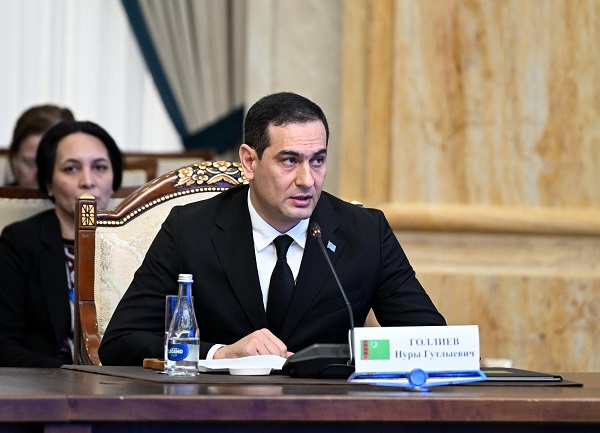
Representing Turkmenistan, the country’s Ambassador to Kyrgyzstan Nury Golliyev delivered a speech at the forum. He emphasized that the forum serves as an important platform for discussing current issues of regional development, inter-parliamentary cooperation, and for developing constructive solutions to matters of mutual interest.
“Turkmenistan reaffirms its commitment to developing inter-parliamentary contacts as a key mechanism for mutual understanding. This cooperation fully encompasses the political-diplomatic, trade-economic, and cultural-humanitarian spheres,” he said.
At the end of the forum, the Bishkek Declaration was adopted.
Nurlanbek Shakiev highlighted the importance of each proposal voiced during the event: “We exchanged views on how we can work together to ensure regional stability and contribute to the development of our five neighboring countries. Every issue raised has been taken into account and included in the Bishkek Declaration. I am convinced that this declaration will expand dialogue between the parliaments of Central Asian states and become the main roadmap for regional unity.” ///nCa, 24 September 2025 (based on the press releases from the Parliament of Kyrgyzstan)