


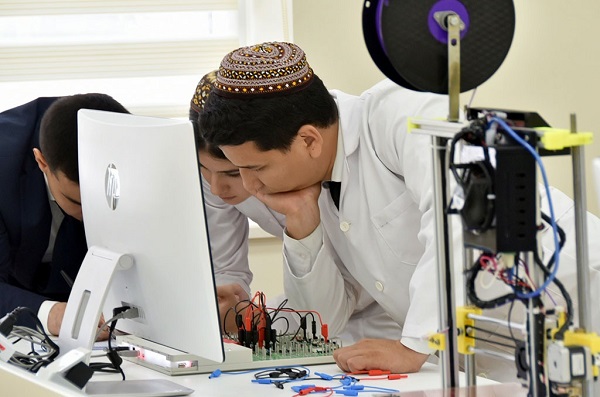
Scientists from the Academy of Sciences of Turkmenistan and its affiliated sectoral institutes are currently conducting research and development in nanotechnology, biotechnology, ecotechnology, chemistry, smart technologies, electronics, as well as computer and mobile software systems.
Under state-sponsored programs, research institutes and higher education establishments across the country are carrying out work on a total of 586 scientific topics.
Pharmaceuticals: The Laboratory for Pharmaceutical Manufacturing Technology at the International Science and Technology Park has derived a preparation named “ýowşan melhemi” (wormwood balm) from Artemisia cina (wormwood), an endemic plant of Turkmenistan. The medication was subsequently produced at the “Saglyk” pharmaceutical enterprise.
Chemical Industry: The Institute of Chemistry analyzed field data to identify valuable elements contained in the associated water from select wells at the Galkynysh, South Yoloten, Malay, and Chartak gas fields. As a result, the feasibility of industrial iodine extraction from associated water at the Dovletabat gas field was identified.
Additionally, scientists developed a production technology for a lime-sulfur solution—an environmentally safe pesticide. Widely used to protect agricultural crops from pests, this product is currently imported. Field trials yielded positive results.
Seismology: Monitoring of seismic, geophysical, and geodynamic crustal characteristics is being carried out across the country’s seismic forecasting sites. By analyzing regional seismic data, researchers are identifying high-stress zones requiring future seismic and geophysical monitoring. The Institute of Seismology and Atmospheric Physics is conducting a comprehensive analysis of how engineering-geological parameters affect the amplification and frequency spectrum of seismic waves in western Turkmenistan.
Work is also underway to create a new National Seismic Zoning Map.
Linguistics: At the Magtymguly Institute of Language, Literature, and National Manuscripts, Ibn Khordadbeh’s “Kitab al-Masalik wa al-Mamalik” (“Book of Roads and Kingdoms”) and Muhammad ibn Ahmad al-Muqaddasi’s “Ahsan al-Taqasim fi Ma’rifat al-Aqalim” (“The Best Divisions for the Knowledge of the Regions”) were translated into Turkmen from Persian and Arabic. Furthermore, handwritten and lithographic manuscripts related to the nation’s literary heritage were acquired from Türkiye and Georgia.
Archaeology: The Institute of History and Archaeology conducted archaeological excavations and surveys at the Paryzdepe, Shekhrikhaybar, and Shekhrislam sites, as well as the Gyzylayak historical-cultural site dating to the 1st–6th centuries, located in the Gyzylayak local council area of the Kerki district, Lebap province.
Oguz Han Engineering and Technology University: Research is ongoing across a wide spectrum of topics. These include: establishing scientific foundations for cultivation of microalgae and processing facilities in Turkmenistan; application methods for medicinal plants in the phytopharmaceutical industry; potential agricultural reuse of treated drainage waters via phytomechanical filtration; electro-optical properties of liquid crystal and carbon nanoparticle mixtures; the role of digital education in advancing the information society; establishing a market for eco-friendly products in Turkmenistan; mathematical modeling of fresh groundwater systems using artificial intelligence; and ecolinguistic studies across Turkmen, Japanese, English, and Russian languages, among others.
Biology: The Institute of General and Applied Biology is working on the in vitro propagation of rare plant species native to the Sumbar Valley and surrounding areas.
/// nCa, 23 July 2026 (based on materials from the newspaper Turkmenistan)