


nCa Report
Overview
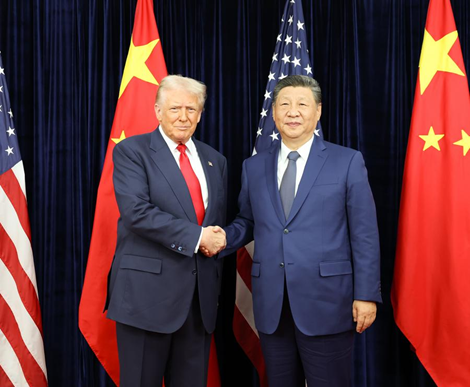
On October 30, 2025, President Donald Trump and Chinese President Xi Jinping met for approximately one hour and forty minutes at Gimhae International Airport in Busan, South Korea, marking their first face-to-face meeting in six years. The summit took place at the conclusion of Trump’s three-country Asia tour, which also included stops in Malaysia and Japan.
Key Outcomes and Agreements
Tariff Reductions
Trump announced he would cut tariffs on Chinese imports from 20% to 10%, reducing the overall tariff rate on Chinese goods from approximately 57% to 47%. According to Fox News, this reduction was linked to China’s commitment to work harder on stopping the flow of fentanyl precursors into the United States.
Rare Earth Materials
A critical breakthrough involved China’s rare earth export controls. China agreed to suspend for one year the sweeping export controls on rare earths that had been announced on October 9, according to multiple sources. The New York Times reported that these export controls had dramatically escalated tensions earlier in the month, as China strengthened its hand by announcing limits on sales of critical minerals needed for almost all modern technology.
Trump characterized this as a significant achievement, stating the agreement would be “routinely extended as time goes by”, according to CNBC. As part of this understanding, the US agreed to postpone a rule announced on September 29 that blacklisted majority-owned subsidiaries of Chinese companies on an entity list.
Agricultural Trade
China agreed to begin immediate purchases of US soybeans and other farm products, according to Fox News. NBC News provided more specific details, reporting that Treasury Secretary Scott Bessent stated China would buy 12 million metric tons of soybeans between now and January as part of an agreement to purchase 25 million metric tons annually for three years. This was particularly significant as China had not purchased any US soybeans since May, sourcing instead from South American countries.
Port Fees and Maritime Trade
The US and China agreed to suspend fees for one year on ships that dock in each other’s ports, according to CNBC.
Trade Truce Extension
The two sides agreed to a one-year extension of a truce to limit additional tariffs that was originally set to expire on November 10, according to The New York Times.
Topics Discussed
Fentanyl Crisis
Trump emphasized China’s commitment to combating fentanyl trafficking. Trump stated that Xi agreed to work “very hard” to block fentanyl from entering the US, expressing his belief that “he’s going to work very hard to stop the death that’s coming in”, according to Fox News.
Ukraine
Trump said Ukraine “came up very strongly” and that the two leaders discussed “working together” to see if they could help end the war, with both sides agreeing to work together on the issue, according to NBC News and NPR.
Future Diplomatic Visits
Trump announced he would visit China in April, and Xi would visit the United States afterward, either in Palm Beach, Florida or Washington, DC, according to CNBC.
Topics Not Discussed
Several significant issues were notably absent from the discussions:
Taiwan
“Taiwan never came up. It was not discussed actually,” Trump told reporters on Air Force One, according to The Hill. The New York Times noted this was significant, observing that in a potential concession by Beijing, China’s official summary of the meeting did not mention Taiwan, which is a topic Chinese leaders usually bring up when meeting US counterparts.
Nvidia’s Blackwell Chips
Trump stated there was no discussion about approving the sale of Nvidia’s advanced Blackwell chips to China, saying “We’re not talking about the Blackwell. That just came out yesterday”, according to The Hill.
TikTok
While China’s Ministry of Commerce said Beijing would work with the US to “resolve issues related to TikTok,” no further detail was provided, according to CNBC, and Trump did not mention TikTok during his comments to reporters.
Russian Oil Purchases
When asked about China’s history of purchasing Russian oil, Trump said “we really didn’t discuss the oil,” focusing instead on trying to end the war, according to The Hill.
Tone and Rhetoric
The meeting was characterized by cordial rhetoric from both leaders. Trump called Xi “a great leader of a great country” and “a great friend,” while Xi said it felt “very warm seeing you again”, according to NPR.
Xi acknowledged that “it is normal for the two leading economies of the world to have frictions now and then” but emphasized that China and the US “can still find ways to thrive side by side”, according to Fox News.
In China’s official readout, Xi stated that “China and the United States should be partners and friends. That is what history has taught us and what reality needs,” calling on both sides to “stay the right course” and avoid falling “into a vicious cycle of mutual retaliation”, according to Xinhua.
Trump expressed high satisfaction with the meeting, telling reporters he would rate it “on a scale from zero to 10, with 10 being the best, I would say the meeting was a 12”, according to NPR.
Analytical Perspectives
Chinese Leverage
The New York Times provided analysis suggesting China achieved significant gains. By flexing China’s near monopoly on rare earths and its purchasing power over US soybeans, Xi won key concessions from Washington—a reduction in tariffs, a suspension of port fees on Chinese ships, and the delay of US export controls.
Julian Gewirtz, a former senior China policy official in the Biden administration, observed that “What’s clear is they have become increasingly bold in exerting leverage and they are happy to pocket any and all US concessions”, according to The New York Times.
The newspaper also quoted Zhu Feng, a professor at Nanjing University, who noted that “After Trump launched his trade and tariff war, China was the only country that matched the United States blow for blow,” suggesting China’s biggest win could be that the US might think twice before imposing new measures.
Limited Strategic Framework
Jonathan Czin, a fellow at the Brookings Institution and former CIA analyst, characterized the US approach as “tactics without a strategy,” arguing that China had “successfully orchestrated a game of ‘whack-a-mole’ for the Trump Administration”, according to The New York Times.
Nicholas Burns, former US ambassador to China during the Biden administration, described the outcome as “an uneasy truce in a long, still simmering trade war” rather than a comprehensive deal, according to CNBC.
Durability Concerns
Several analysts expressed skepticism about the longevity of the agreements. Any progress could easily be erased by moves on either side that are interpreted as violating the agreement, as a deal struck last month was almost undone when the US expanded the range of companies banned from accessing US technology, according to The New York Times.
Ja Ian Chong, a professor at the National University of Singapore, noted these “are issues that are relatively easy to roll back and also to accuse the other side of bad faith”, according to The New York Times.
Status Quo Restoration
The New York Times suggested that Xi seemed to grasp what Trump needed—a deal he could sell as a victory at home—even though China had largely restored the status quo by agreeing to buy soybeans and hold off on further restricting rare earth exports.
Conclusion
The Busan summit produced tangible short-term agreements on tariffs, rare earths, and agricultural trade, offering both sides a temporary reprieve from escalating tensions. However, significant strategic issues remain unresolved, and analysts question whether this represents a fundamental shift in US-China relations or merely a tactical pause in ongoing competition. The agreement’s one-year timeframe for several key provisions suggests both countries view this as a provisional arrangement subject to renegotiation. /// nCa, 31 October 2025 (photo credit – Xinhua)