


Elvira Kadyrova and Liliya Zhirnova
Long before “connectivity” became a term of art in Central Asian diplomacy, the Seljuks had already built the infrastructure to prove the concept. Nine centuries before the Middle Corridor and the Trans-Caspian transit routes became fixtures of regional summitry, the Seljuk state was solving an identical problem: how do you make a landlocked, multi-jurisdictional trade route safe and predictable enough that merchants choose it over the alternatives?
Their answer was the caravanserai — and the system behind it was, in effect, the world’s first state-run logistics network.
A network built for a purpose
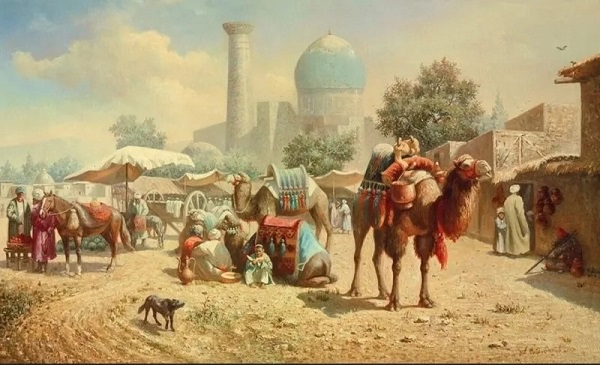
Stretching from the Iranian plateau through Anatolia and along the Silk Road corridors of Central Asia, Seljuk caravanserais were spaced roughly 30 to 40 kilometers apart — a single day’s caravan journey. That spacing was not incidental. It was engineering: a fortified, guaranteed stopping point built into the geometry of the route itself, so that a merchant train of camels or a modest party of donkeys always had a secure destination by nightfall, regardless of who they were or where they had come from.
The most basic khans offered lodging, stables, fresh water, and a small mosque. The larger complexes — the “Sultanhans” endowed by the Seljuk sultans themselves — expanded into full service compounds, staffed with an innkeeper, a physician, a veterinarian, a blacksmith, a cook, and an imam. Baths, infirmaries, and communal kitchens meant a caravanserai functioned less like a roadside inn and more like an integrated logistics-and-welfare station: a caravan’s people, animals, and cargo could all be tended to under one roof.
Crucially, these services were free — typically for up to three days — funded not through tolls or taxation at the point of use but through waqf endowments, permanent charitable trusts that generated income independent of any single ruler’s patronage.
The Seljuks paired this hospitality network with an early insurance mechanism for merchandise, and according to Anatolian Seljuk sources, agreements with foreign trade agencies to keep goods moving securely across jurisdictions.
A trader on the Bukhara–Samarkand road or the Sivas–Kayseri route was, in a real sense, operating inside a state-backed system of risk management — one built for permanence, not for the lifespan of a single endowment or a single reign.
That last point is what makes the caravanserai network more than an architectural curiosity.
A waqf-funded institution was designed to outlast the individual who founded it. In an empire otherwise defined by dynastic turnover and shifting fortunes, the caravanserai system was infrastructure engineered for continuity — a genuinely early example of statecraft that separated the durability of an institution from the durability of the ruler who built it.
The women who built it, too
The caravanserai’s endowment records leave us a second, quieter story — one usually told less often than the trade statistics.
Among the best-documented patrons of the Anatolian Seljuk period is Mahperi Hatun, mother of Sultan Ghiyath al-Din Kaykhusraw II, who ruled the Sultanate of Rum — the Anatolian successor state to the Great Seljuk Empire — in the 1230s and ’40s.
Rather than remaining a passive dynastic figure, Mahperi Hatun became one of the most prolific builders of her era. In 1238 she endowed the Huand Hatun complex in Kayseri — a mosque, madrasa, mausoleum, and bathhouse built as a single foundation — and personally funded caravanserais near Tokat and Yozgat, structures that still stand today.
She was not alone, though she is among the best-recorded. Waqf endowment was, by its legal structure, open to women of means, and the surviving inscriptions of Seljuk and post-Seljuk Anatolia show royal women — mothers, wives, and daughters of sultans — among the patrons who financed mosques, caravanserais, and public infrastructure alongside their male relatives.
The documentation is thinner here than historians would like; far fewer women’s endowment deeds survive than men’s. But what does survive tells us that the connectivity infrastructure of the Seljuk world was not purely a project of sultans and generals. It was, in part, a project of women who used the same legal and financial instruments — the waqf — to leave a permanent mark on the routes their societies depended on.
Why it still matters
The caravanserai model endures as a case study precisely because it solved a problem regional states are still solving.
Security, hospitality, and predictable service along a trade corridor were treated as strategic assets in their own right — not afterthoughts to the diplomacy happening at either end of the route. The 21st-century tools look different: customs harmonization, port modernization, multilateral transit agreements. The underlying logic — that a corridor is only as valuable as the trust merchants place in every stop along it — has not changed at all.
Turkmenistan and its neighbors, as they build out the Middle Corridor and modern Trans-Caspian connectivity, are inheriting a lineage that goes back further than most summit communiqués acknowledge.
The Seljuks did not just move armies across this space. They built the world’s first state-run logistics system to move trade across it safely — and left behind a record, however partial, of women who helped build it too. /// nCa, 14 July 2026