


Tariq Saeedi
There is a particular kind of poem that refuses to stay in its own century. It gets copied, memorized, quoted at funerals and summits and protests, stitched into carpets and set to music, until it no longer feels like literature — it feels like conscience.
Bani Adam, written by the Persian poet and sage Saadi Shirazi in the thirteenth century, is one of those rare poems. In six short lines it says something so simple and so demanding that no age has yet been able to fully answer it: we are one body, and the suffering of any part of that body is the suffering of all.
For nearly eight centuries, those lines have been impossible to ignore.
The Poem
Bani Adam appears in the first chapter of Saadi’s masterpiece the Gulistan — the Rose Garden — completed in 1258. The original Persian reads:
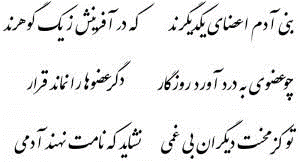
Among its most admired English translations is the rendering often associated with the nineteenth-century Persian scholar Edward Rehatsek:
The sons of Adam are limbs of each other, Having been created of one essence. When the calamity of time afflicts one limb, The other limbs cannot remain at rest. If thou hast no sympathy for the troubles of others, Thou art unworthy to be called by the name of a man.
What strikes any reader immediately is the poem’s refusal of sentiment. It does not merely ask us to feel kindness. It declares that indifference to another’s suffering is a forfeiture of our very humanity — that compassion is not a virtue we may choose to cultivate, but a condition of being human at all.
The Man Behind the Poem
Saadi was born in Shiraz around 1210, into a world coming apart. The Mongol invasions were tearing through the Islamic heartland, leveling cities and displacing millions. Death and displacement were not abstractions to him; they were the weather of his age.
Yet what Saadi carried out of that catastrophic era was not bitterness but a profound, almost stubborn tenderness toward human beings in all their variety.
Unlike poets who composed for courts or retreated into mystical isolation, Saadi was a traveler. He moved through Persia, Central Asia, and the Levant, lingering in markets and caravanserais, listening to merchants and pilgrims and wandering dervishes. His poetry has the texture of a man who has sat with many kinds of people and found something worth honoring in all of them.
Bani Adam is the distillation of that lifelong encounter with humanity. It transformed empathy from a personal feeling into a civilizational argument.
A Poem Summoned by History
What is extraordinary about Bani Adam is not just the depth of its moral claim but its strange ability to find the exact moment when the world needs it.
In 1928, as the League of Nations — the world’s first attempt at collective international governance — struggled to establish its own moral foundations, the poem was formally proposed as a motto for the organization. The world, still raw from the First World War, seemed to recognize in Saadi’s lines something that official declarations had not yet found the words to say.
On New Year’s Eve 1977, at a dinner toasting the Shah of Iran, U.S. President Jimmy Carter quoted the poem before his host and the assembled guests. It was a gesture of cultural respect from one head of state to another, an acknowledgment that beneath diplomatic protocol lay something older and more enduring.
In March 2009, President Barack Obama addressed the Iranian people directly in a Nowruz video message and invoked Saadi’s words. The United States and Iran had spent decades in mutual hostility; embassies had been seized, wars had been fought by proxy, and trust had been all but extinguished. Obama’s choice to reach for a thirteenth-century Persian poem rather than a political argument was itself a kind of statement: that some conversations between peoples can only begin through culture. It was a reminder that poetry sometimes goes where diplomacy cannot.
The United Nations and the Golden Thread
The most enduring institutional home that Bani Adam has found is perhaps the United Nations building in New York. In 2005, a magnificent hand-knotted Persian carpet — the verses of Bani Adam woven into it in golden calligraphy — was installed in one of the building’s meeting halls, a gift from Iran. There is also a separate plaque on a wall of the UN commemorating the United Nations Year of Dialogue Among Civilizations in 2001, which carries a translation of the poem.
The legend that the poem is inscribed above the main entrance is, strictly speaking, an embellishment — but it is a revealing one. People want to believe it is there because it so perfectly belongs there. The poem’s founding premise — that no human suffering is truly the business of only those who experience it — is so close to the animating spirit of the UN’s Universal Declaration of Human Rights that the association feels almost inevitable.
Former Secretary-General Ban Ki-moon publicly praised the poem during a visit to Tehran, calling it a profound articulation of human interconnectedness. One can understand why: institutions built on paper principles need poetry to remember what those principles actually feel like.
Across Cultures, Across Centuries
One of the more moving things about Bani Adam is the company it keeps across time. The German literary genius Johann Wolfgang von Goethe, deeply influenced by Persian and Islamic philosophy and poetry, wrote in his West-Eastern Divan — an early manifesto against the idea of cultures sealed off from one another — words that seem to rhyme with Saadi’s: “When people keep themselves apart in mutual disdain, a truth is hidden from the heart. Their goals are much the same.” Two poets from different civilizations and different centuries, arriving at the same place by different roads.
Scholars have also drawn comparisons between Bani Adam and John Donne’s famous meditation “No Man is an Island,” written in the early seventeenth century. Neither poem borrowed from the other; they simply drew the same conclusion from the same human evidence. There is something consoling in that convergence — the idea that the truth of human interdependence does not belong to any single tradition but keeps being discovered, independently, by anyone who pays close enough attention.
The Poem in Living Memory
In the spring of 2020, as the COVID-19 pandemic moved across the world with terrible indifference to borders, Bani Adam was everywhere again. Medical workers shared it. Teachers sent it to students. Scholars wrote essays about it. The poem’s insistence on a common human fate felt newly urgent, as a communicable disease made vivid what it means for one limb to suffer and the others to be unable to remain at rest.
The poem has been cited in the same breath as conversations about refugees, displaced communities, racial injustice, poverty, and disaster relief — any moment, in short, when the temptation to look away from the suffering of strangers is at its strongest. Its moral logic is a rebuke to that temptation: to turn away is not neutrality but a diminishment of one’s own humanity.
Art, Music, and the Classroom
Persian calligraphers have long treated Bani Adam as something close to sacred text. It appears in carpets, wall inscriptions, manuscripts, ceramics, and public monuments across the Persian-speaking world. For generations of students in Iran, Afghanistan, Tajikistan, and parts of South Asia, memorizing the poem has been as natural a part of moral education as learning to read.
In 2019, the British band Coldplay wove the poem into a track on their album Everyday Life, introducing Saadi’s words to millions of listeners who had never encountered classical Persian poetry. It is a strange and rather beautiful thing to imagine: a seventh-century ethical argument arriving in someone’s headphones on a Tuesday morning commute, and still, somehow, landing.
Why It Still Matters
There is an argument to be made that we are living in an age particularly hostile to Bani Adam’s central claim. Nationalism is assertive. Borders are hardening. The instinct to separate “us” from “them” — to regard the suffering of distant others as essentially their own affair — is well-funded and politically potent.
Against all of this, Saadi’s poem is not a comfort. It is a demand.
It does not say that unity is easy, or that common humanity dissolves real differences. It says only — and this is the hard part — that indifference to the pain of others is a kind of self-betrayal. That whatever we call ourselves — whatever nation, faith, or ideology we attach to our identity — beneath it is a body, and that body is shared.
Saadi wrote those words in the aftermath of the Mongol devastation, in a world of real and catastrophic violence. He did not write them from a place of ease. He wrote them from experience, and that is why, eight centuries later, they do not feel like idealism. They feel like a reckoning.
The poem is, in the end, unfinished business — not Saadi’s, but ours. It describes a humanity we have not yet become, and keeps asking us, with patience and without mercy, when we intend to begin. /// nCa, 27 May 2026