


Tariq Saeedi
A quarter century into the new millennium, humanity finds itself caught in a strange contradiction. We have mapped the human genome, placed rovers on Mars, and connected billions of people through invisible networks that span the globe. Yet as world leaders are gathered in Ashgabat and nCa is covering the international conference on the permanent neutrality of Turkmenistan from the press centre here, the question looming large is not whether we as mankind possess the tools to solve our greatest challenges—it is whether we possess the will, mainly the political will.
The goodwill that goes into building the political will was visible right as the day began in Ashgabat with the high level guests including the presidents and prime ministers from ten countries placed flowers at the newly opened extension to the monument of neutrality.
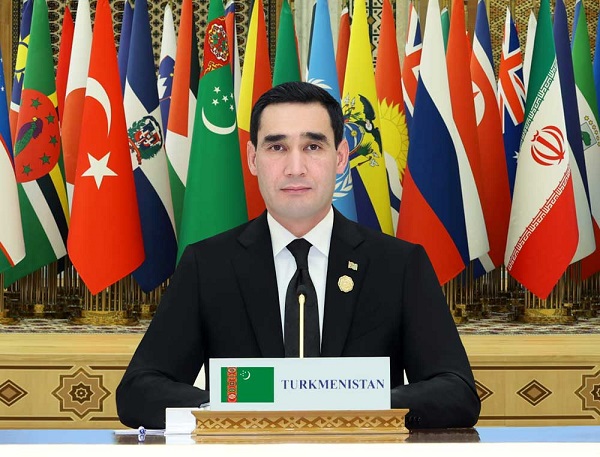
Before the start of the conference, President Serdar Berdimuhamedov received the guests individually, a show of hospitality that is the expression of immense goodwill, creating the base for robust political will.
In his inaugural speech, the Turkmen president outlined the long history of the permanent neutrality and the role Turkmenistan has played at various platforms, demonstrating a consistent stance in the service of peace and progress.
He mentioned the kinds of challenges facing the mankind today and expressed the confidence that the joint efforts of the world community would adequately overcome them.
“Turkmenistan can rightfully be proud that new humane and far-sighted foundations of the world order, realistic and responsible development strategies are being formed on our land today”, he said.
The President of Turkmenistan thanked the guests for their participation.
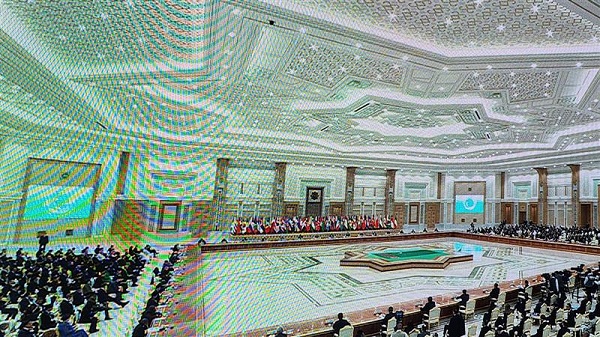
(The speech of the President will be available later.)
President Serdar Berdimuhamedov’s address to the international conference this morning comes at a moment when the gap between human capability and human cooperation has never been wider. The same technologies that allow doctors in rural clinics to diagnose diseases with artificial intelligence, that enable farmers to optimize water usage down to the milliliter, that have brought literacy rates to historic highs across developing nations—these same innovations exist in a world where the zero-sum instinct of earlier centuries persists with surprising tenacity.
The mathematics of our age should be straightforward. CRISPR technology offers pathways to end genetic diseases. Desalination advances and precision agriculture are chipping away at water scarcity. Solar and wind energy have become cheaper than coal in most markets. The Sustainable Development Goals, for all their uneven implementation, have provided a framework that has lifted millions from extreme poverty. Progress, by nearly every measurable metric, is real.
Yet progress is not linear, and it is certainly not universal. The SDGs tell a story of sporadic advancement—spectacular gains in some regions existing alongside stubborn stagnation in others. Bangladesh has reduced its maternal mortality rate by two-thirds since 2000, while parts of West Africa have seen minimal change. The global hunger rate declined for decades before beginning to creep upward again after 2015. It is a landscape of patches rather than patterns, of breakthroughs that seem unable to break through everywhere at once.
This unevenness is not, however, the central problem facing the international community that has converged on Turkmenistan this week. Uneven progress is still progress. The more troubling dynamic is the way certain actors, certain modes of thinking, continue to view the world through the lens of finite resources and inevitable conflict—a perspective that treats every gain by one nation as a loss for another, every agreement as a concession, every act of cooperation as a strategic vulnerability.
The zero-sum mentality is not new. It dominated the Cold War, shaped colonial enterprises, and has been the default setting of great power competition for most of recorded history. What makes its persistence so striking in 2025 is how thoroughly the material conditions that once justified it have been superseded.
The great challenges we face—climate disruption, pandemic preparedness, cybersecurity, artificial intelligence governance—are not amenable to zero-sum solutions. They are, by their nature, problems that cascade across borders and require coordinated responses. A virus does not respect sovereignty. Carbon emissions do not pause at checkpoints. The benefits of scientific advancement, if hoarded, diminish.
Turkmenistan’s permanent neutrality, recognized by the United Nations General Assembly in 1995, was premised on a different calculation.
In a region scarred by the collapse of empire and the subsequent scramble for resources and influence, neutrality represented a wager that stepping outside the logic of blocs and alliances could create space for development, dialogue, and stability.
Thirty years on, as the country marks this anniversary during its designated Year of Peace and Trust, the question extends beyond Turkmenistan itself: Can the principle of neutrality—of refusing the zero-sum frame—offer insights for a world that technologically has outgrown such thinking but politically cannot seem to escape it?
The conference agenda suggests the hosts believe it can. Discussions are slated to address energy security, water diplomacy, connectivity infrastructure, and preventive diplomacy—all domains where cooperation yields compound returns and competition yields compounding risks. The attendance of heads of state and government from across continents indicates at least a receptive audience for this proposition.
But receptivity is not commitment. The same week this conference convenes, trade disputes simmer, military budgets expand, and multilateral institutions find themselves paralyzed by the veto power of competing interests. The infrastructure for global cooperation exists—the United Nations, regional organizations, treaty frameworks, civil society networks. What seems to be eroding is not the machinery but the underlying assumption that such cooperation serves national interest better than its alternatives.
This is the reality check that President Berdimuhamedov’s address confronts: We have built a world of extraordinary capability and stubborn self-sabotage. We possess solutions to challenges that once seemed insurmountable, yet we struggle to deploy them because deployment requires trust, and trust requires abandoning the comfortable fatalism of zero-sum thinking.
The world is moving ahead—not in lockstep, not at the same pace, but ahead nevertheless. The question is whether that movement is fast enough to outrun the countervailing forces that view progress itself as a threat.
Twenty-five years into this century, we have learned that scientific advancement is the easy part. The hard part is convincing people that another nation’s progress need not be their decline, that cooperation is strength rather than weakness, that the pie can grow. In an age when we can edit genes and generate energy from sunlight, the most sophisticated technology we need may be the oldest one: the ability to see beyond the immediate horizon and recognize that in a globally interconnected world, someone else’s loss eventually becomes everyone’s.
Ashgabat’s conference on neutrality, then, is less about celebrating a single nation’s policy choice and more about testing whether the international community can absorb the lessons that choice implies. In a city rebuilt with the optimism that comes from energy wealth and political stability, surrounded by a region that has known both empire and its aftermath, the question being posed is not whether we can solve our problems. It is whether we will let ourselves. /// nCa, 12 December 2025