


On 14 May 2026, during his visit to Kazan, Tatarstan, the National Leader of the Turkmen people and Chairman of the Halk Maslahaty of Turkmenistan, Gurbanguly Berdimuhamedov, attended the Meeting of Ministers of Culture of the member states of the Organization of Islamic Cooperation (OIC) as a guest of honor.
Kazan: A Hub of the Islamic World
The Second Meeting of Ministers of Culture of the OIC countries was held in Kazan as part of the XVII International Economic Forum “Russia – Islamic World: KazanForum.” Participants included representatives from 18 countries and three international organizations. The central theme of the discussion was cultural dialogue as the foundation for preserving identity and diversity in a multipolar world.
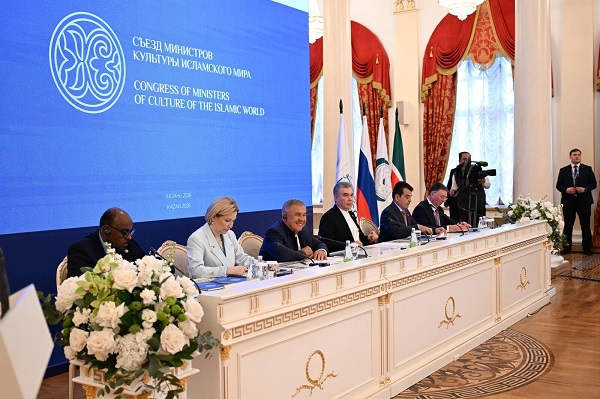
Opening the forum, the Rais of Tatarstan, Rustam Minnikhanov, emphasized that the status of “Cultural Capital of the Islamic World” granted to Kazan is more than just an honorary title. “For us, being the capital means being a place of power. Tatarstan historically chose the path of enlightened Islam, becoming the northern outpost of Muslim culture since the days of Volga Bulgaria. The fates of dozens of nations have intertwined here,” he stated.
Turkmenistan’s Initiatives: Culture and “Smart” Cities
Gurbanguly Berdimuhamedov was the first to address the forum.
“This year, as in the past, the capital of Tatarstan is hosting a series of important events aimed at strengthening international economic relations and further deepening cultural and humanitarian ties,” the National Leader stated, specifically highlighting the 15th session of the General Conference of the Islamic World Educational, Scientific and Cultural Organization (ICESCO).
“We view this meeting as a valuable opportunity to intensify multilateral dialogue in the cultural and humanitarian sphere, seeing it as a vital factor in ensuring sustainable development, strengthening mutual understanding between peoples, and promoting a culture of peace,” Berdimuhamedov continued.
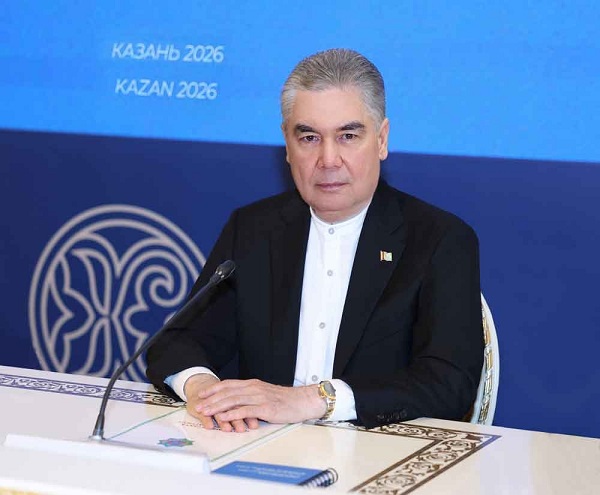
The Chairman of the Halk Maslahaty presented several concrete proposals for cooperation within the framework of ICESCO. Turkmenistan’s initiatives include:
- The development of a long-term ICESCO Strategy for the preservation and enrichment of the cultural and historical heritage of Islamic countries.
- The launch of a large-scale program titled “Islamic Poetic Dialogue: Wisdom and the Connection of Centuries.”
- The promotion of “Smart City Diplomacy” within the Islamic world.
Reaffirming Turkmenistan’s commitment to the principles of peace, creativity, cultural diversity, and sustainable development, the National Leader of the Turkmen people expressed his conviction that education, science, and culture are universal values capable of uniting states and nations.
New Status and Plans for 2028
The visit was marked by a significant diplomatic achievement: during the 15th session of the ICESCO General Conference, which commenced on 13 May, Turkmenistan was officially granted observer status in this prestigious organization.
The prospects for cooperation are already moving to a new level. ICESCO Director General Salim bin Mohammed Al-Malik announced that preparations have already begun to declare Ashgabat the Cultural Capital of the Islamic World in 2028. This step serves as a testament to Turkmenistan’s growing authority as a center for cultural heritage and inter-civilizational dialogue.
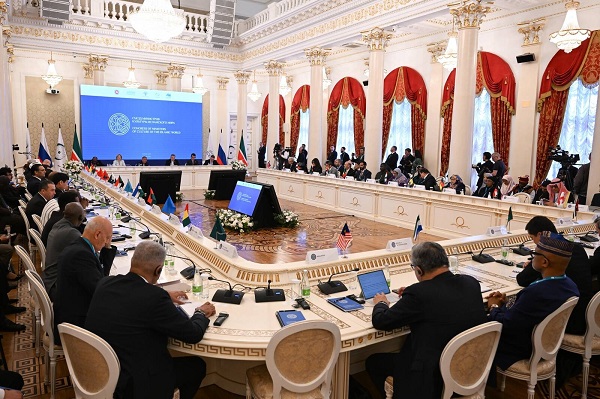
Address by the National Leader of the Turkmen People, Chairman of the Halk Maslahaty, Gurbanguly Berdimuhamedov
Distinguished session participants! Ladies and Gentlemen!
First and foremost, allow me to express my sincere gratitude to the Rais of the Republic of Tatarstan of the Russian Federation, Rustam Nurgaliyevich Minnikhanov, and to all our Russian friends and colleagues for the invitation to participate in the international events of “KazanForum 2026,” for the warm hospitality extended to us, and for the excellent conditions created for productive work.
The internationally recognized “KazanForum” annually brings together high-level delegations from various countries and international organizations, fostering an atmosphere and providing the conditions for the development of cooperation across a broad spectrum of sectors.
This year, as in previous years, the capital of Tatarstan is hosting a series of important events aimed at strengthening international economic relations and further deepening cultural and humanitarian ties.
Among these, special mention should be made of the 15th session of the General Conference of the Islamic World Educational, Scientific and Cultural Organization (ICESCO).
We view this meeting as a valuable opportunity to intensify multilateral dialogue in the cultural and humanitarian sphere, regarding it as a vital factor in ensuring sustainable development, strengthening mutual understanding between peoples, and promoting a culture of peace.
In the current context of global transformation, the preservation of cultural diversity—rooted in unique identities and traditional values—takes on particular importance. In this regard, the work of international organizations and their role in consolidating state efforts in the social sphere becomes increasingly significant.
In this context, Turkmenistan highly values the activities of ICESCO as an authoritative international organization. It is called upon to facilitate broad and effective humanitarian partnerships, to preserve and augment the great civilizational foundation of Islam and its humanistic values, and to support and promote achievements in science, education, and culture.
Today, it is of the utmost importance to remain active in developing the intellectual potential of youth and fostering their engagement with the rich historical and cultural heritage of the world’s nations.
Distinguished session participants!
The foreign policy course of Turkmenistan is based on the principles of positive, permanent neutrality. Its legal status has been reaffirmed three times by relevant resolutions of the United Nations General Assembly, serving as a reliable foundation for the consistent promotion of a policy of peace, good-neighborliness, and broad international cooperation.
Neutral status is also a key factor in the implementation of Turkmenistan’s cohesive and long-term cultural and humanitarian strategy.
Turkmenistan has acceded to major international conventions and treaties of a humanitarian nature and is working jointly with the Community of Nations toward their practical implementation at both the national and global levels.
In this context, it should be emphasized that for many years, in close cooperation with UNESCO, our country has carried out large-scale work to protect and preserve the historical, cultural, and natural heritage of the Turkmen people. As a result, today more than 1,500 historical and cultural monuments are registered on the territory of Turkmenistan.
The most significant fact is the inclusion of the historical sites of Ancient Merv, Kunya-Urgench, and the Parthian Fortresses of Nisa in the UNESCO World Heritage List as outstanding monuments of world civilization.
Special attention is also paid to the preservation of intangible cultural heritage. Currently, many nominations—such as “The Turkmen National Art of Carpet Making,” “The Craft of Dutar Making, Traditional Music Performing Art on It, and the Art of Bakshi,” “The Art of Akhal-Teke Horse Breeding and Traditions of Horse Decoration,” and “The Art of Turkmen Alabay Breeding”—have been included in the relevant UNESCO lists.
Today, we are actively promoting the cultural agenda within Turkmenistan’s foreign policy, working on the preparation and practical implementation of new initiatives aimed at addressing current issues in education, science, the arts, and culture.
At the same time, we believe that the positive experience of our joint activities within established projects—which have proven to be effective forms of multilateral interaction—serves as a solid foundation for increasing our cooperative potential. Chief among these is the “Cultural Capital of the Islamic World” project. Its implementation allows each of our countries to demonstrate the centuries-old cultural achievements, customs, traditions, and the spiritual and cultural values of our peoples.
I would like to take this opportunity to sincerely congratulate the leadership of the Republic of Tatarstan of the Russian Federation on the city of Kazan being granted the status of “Cultural Capital of the Islamic World 2026.”
Turkmenistan holds the activities of ICESCO in high regard and views the development of cooperation with this Organization as a vital direction of its international humanitarian policy.
We express our strong interest in expanding our partnership with ICESCO, participating in the Organization’s specialized initiatives, and developing practical cooperation in areas of mutual interest.
For us, it is particularly significant that in March 2026, Turkmenistan submitted an official letter regarding the granting of observer status to our country within ICESCO.
We view joining the activities of this important international body as a milestone in the development of Turkmenistan’s international cooperation in the fields of education, science, and culture.
I am convinced that this creates a new, additional platform for our state’s systematic and multifaceted participation in programs, the exchange of best practices, and the further strengthening of engagement with the Organization’s member states.
In this regard, I would like to present for your consideration a series of specific proposals that we believe can provide creative momentum and direction for our further joint efforts:
First, historical heritage.
Turkmenistan proposes the development of a long-term ICESCO Strategy for the Preservation and Enrichment of the Cultural and Historical Heritage of Islamic Countries. We consider it appropriate to focus not only on study and research but also on the active promotion of Islamic cultural heritage through the creation of literary and journalistic works, cinematic productions, virtual museums, galleries, and other widely accessible internet platforms.
Second, education and enlightenment.
We put forward an initiative to launch a large-scale program titled “Islamic Poetic Dialogue: Wisdom and the Connection of Centuries.” The goal of this project is the broad, systematic familiarization of the public in our countries and throughout the world with the finest works of Islamic poetic and philosophical heritage—from antiquity to the modern era. A historical hallmark of Islamic philosophical thought is its lyrical and poetic expression. Therefore, as a first step, we propose considering the creation of a “World Anthology of Islamic Poetry,” which would include the works of outstanding poets, thinkers, and philosophers of the Muslim world, as well as those authors who identify with Islam and the Islamic cultural code and worldview.
Third, Turkmenistan puts forward the initiative of “Smart City Diplomacy” of the Islamic world.
We proceed from the fact that in a number of our states, including Turkmenistan, the creation of “smart” cities is actively developing as a direction of state policy. Today, the concept of a “smart” city is a fusion of intelligence, creativity, architecture, culture, science, technology, aesthetics, and social knowledge—concepts that form the very foundation of cooperation within ICESCO. In this regard, we believe it is appropriate for this Organization to use “Smart City Diplomacy” to establish partnership and professional mechanisms for exchanging experience, knowledge, best practices, and plans among Islamic countries in this promising development segment.
We expect that the proposals and ideas we have expressed will be carefully considered.
In conclusion, I would like to reaffirm Turkmenistan’s commitment to the principles of peace and creativity, cultural diversity, and sustainable development.
We are convinced that education, science, and culture are universal values capable of uniting states and nations.
Turkmenistan stands ready to continue contributing to the development of inter-civilizational dialogue, the strengthening of trust and mutual understanding, and to actively participate in promoting humanistic ideals and values in interstate relations.
We express our confidence that the outcomes of the 15th session of the ICESCO General Conference will contribute to the achievement of these goals. /// nCa, 15 May 2026