


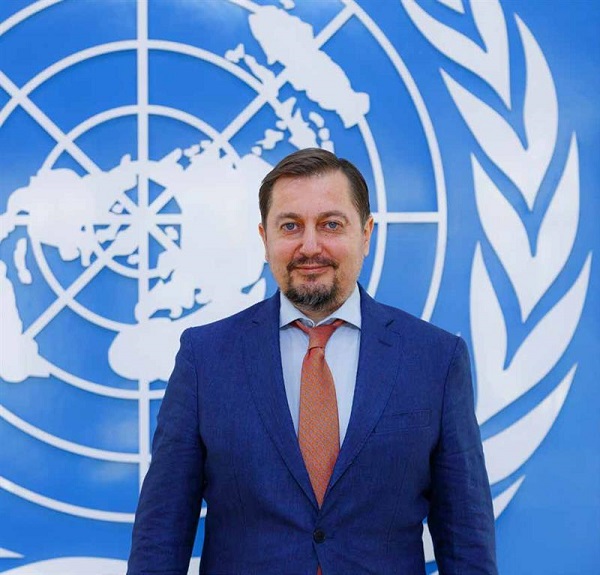
By Dmitry Shlapachenko, UN Resident Coordinator in Turkmenistan
As the year 2025 comes to a close, I would like to stick to a tradition of drawing conclusions to the joint cooperation between Turkmenistan and the UN system in the country. As always, the partnership has remained strong and mutually reinforcing. Throughout 2025, the United Nations Country Team in Turkmenistan worked closely with the Government and a broad range of partners to turn shared priorities into tangible progress for the people of Turkmenistan. This year—marking the International Year of Peace and Trust, the 30th anniversary of Turkmenistan’s permanent neutrality, and the 80th anniversary of the United Nations—provided a unique opportunity to reflect on the power of partnership and collective action. A major highlight was Turkmenistan’s successful hosting of the Third UN Conference on Landlocked Developing Countries in Awaza, which underscored the country’s leadership in promoting connectivity, sustainable development, and regional cooperation.
In 2025, the UN Country Team—19 agencies working under the leadership of the UN Resident Coordinator—joined forces to deliver major achievements across all five Outcomes of the Cooperation Framework (2021–2025). Together, and with the support of development partners, we turned shared priorities into real results.
Outcome 1: Governance and Rule of Law
Our journey began with a strong focus on aligning national policies and strategies with international standards. This year, Turkmenistan, with the support of UNDP and OHCHR, developed the National Action Plan on Human Rights 2026–2030, grounded in UPR recommendations. The UN agencies, led by UNFPA, contributed to the preparation of the National Action Plan on Gender Equality 2026–2030. OHCHR and UNICEF, together with national partners, conducted a comprehensive CRPD-aligned legal review, paving the way for the National Strategy on the Rights of Persons with Disabilities. UNICEF also supported the development of the National Strategy for Early Childhood Development 2026–2030 and its Action Plan, ensuring the youngest citizens are at the heart of our efforts.
At the same time, UNDP’s support for the Central Election Commission resulted in recommendations to the Draft Law on the Single Voter Registry and the creation of a digital e-library, making legal resources more accessible than ever. Our partnership with the Mejlis, Ministry of Finance and Economy, and Ministry of Energy led to the Digital Economy Development Concept and State Programme 2026–2028, as well as key legislative reforms in energy efficiency and environmental protection.
To tackle human trafficking, IOM and UNODC supported the adoption and launch of the National Action Plan on Trafficking in Persons 2025–2029, and UNODC helped develop national procedures for identifying and referring victims. With funding from the European Union, the ILO developed a two-year programme to advance international labour standards and promote decent work, and conducted monitoring of recruitment and working conditions during the cotton harvest.
Institutional strengthening was a cornerstone of our work, with UNICEF, UNDP, UNFPA, and OHCHR supporting a new Department for Women’s and Children’s Rights in the Ombudsperson’s Office and providing technical support for Temporary Special Measures to boost women’s political participation. Our commitment to inclusivity was also celebrated through the fourth Inclusive Festival “We are strong—we are equal”, bringing public attention to disability inclusion and the importance of leaving no one behind.
Evidence-based policymaking and inclusive governance were further strengthened through the Multiple Indicator Cluster Survey (MICS7), supported by UNICEF. The collection and publication of MICS7 data provided robust evidence to inform government decision-making and track progress on 29 SDG indicators and national targets. Additionally, implementation of the Roadmap on SDGs successfully closed data gaps for 9 out of 40 indicators. The UN Resident Coordinator’s Office (RCO), in partnership with ESCAP, has commenced the technical exercise of setting SDG indicator targets for Turkmenistan; this work remains a priority for completion in 2026.
Outcome 2: Sustainable Economic Growth and Diversification
As Turkmenistan’s economy continues to modernise, our joint efforts focused on digital transformation, trade integration, and sustainable financing. With UNDP support, the Digital Economy Development Concept and State Programme (2026–2028) was prepared, positioning the country for strategic innovation. UNDP’s analysis of the Tax Code and capacity-building programmes strengthened Turkmenistan’s readiness for WTO accession.
UNECE played a pivotal role in advancing trade facilitation and digital standards. In March, Turkmenistan hosted a landmark seminar on “Digital Transformation in the KTI (Kazakhstan-Turkmenistan-Iran) Corridor”, where UNECE showcased practical steps toward modernising regional trade corridors. Discussions on port-to-port data exchange and digital rail freight documentation marked a shift from traditional paper-based processes to seamless digital solutions. The pilot project on the electronic equivalent of the SMGS railway consignment note, using UN/CEFACT standards, was a major milestone—bringing Turkmenistan closer to global best practices and reinforcing its role as a connectivity hub at the heart of Eurasia.
The UN Resident Coordinator’s Office played a pivotal role at the Turkmenistan Investment Forum 2025, helping to convene government, private sector, and international partners to explore financing solutions for SDG-aligned projects and strengthen partnerships for sustainable development. The discussions highlighted sustainable energy investments and innovative financing mechanisms, ensuring that green growth, just transition and inclusive development remain at the core of Turkmenistan’s economic agenda.
Macro-fiscal and statistical capacities were reinforced through the introduction of the System of National Accounts 2008, which included gender-responsive methodologies and digital visualisation tools. SDG financing was promoted through the work of the Joint Expert Group on SDG Financing, creating new pathways for sustainable investment.
Looking ahead, the RCO is leading preparations to host the Regional SPECA Economic Forum in Ashgabat, which will unite Central Asian countries to advance regional cooperation on trade, transport, and sustainable development—underscoring the UN’s commitment to supporting Turkmenistan as a connectivity hub and promoting regional integration aligned with the SDGs.
Outcome 3: Environment and Climate Change
The UN Country Team supported the Government to implement its climate action commitments. The UN Resident Coordinator’s Office reinforced this commitment by co-facilitating a high-level pre-conference event ahead of the Oil and Gas of Turkmenistan Conference, highlighting Turkmenistan’s interest in advancing sustainable energy and global climate action. The discussions focused on accelerating the energy transition, promoting renewable energy, and aligning national strategies with global climate goals.
Together with development partners, the UN system engaged youth in climate action by supporting country-wide Local Climate Conference of Youth (LCOY). The consultations resulted in the adoption of the National Youth Statement for COP30, representing the collective vision and solutions of Turkmen youth for sustainable and climate-resilient development.
The journey towards a greener future also gained momentum in 2025. UNEP, UNECE, and UNOPS partnered to develop a joint programme proposal on methane emissions reduction, conducting national assessments that resulted in a 10-year renewable energy roadmap and draft regulatory frameworks. UNDP continued to support the establishment of the Green Taxonomy and new regulations for small-scale renewable energy systems, as well as the development of the National Biodiversity Strategy and Action Plan.
UNICEF joined UNDP in supporting the preparation of NDC 3.0, ensuring child-sensitive climate commitments are at the forefront of Turkmenistan’s climate agenda. Land restoration and ecosystem management improved across more than a million hectares in the Aral Sea Basin, including Tugai forest regeneration through a UNDP project. UNDP’s support was also instrumental in approving six bylaws for hydrometeorological services, strengthening forecasting and hazard observation, and building national disaster risk reduction and climate awareness through training and outreach events.
To deepen resilience at the water–land interface, FAO supported Turkmenistan in securing approval of the GEF Central Asia Water–Land Nexus Programme—“Enhancing Water–Land Nexus Approaches for Strengthening Water Security, Increasing Resilience and Improving Rural Livelihoods in the Amu Darya and Syr Darya River Basins.” This basin-level effort promotes integrated water, land, and ecosystem management across transboundary systems, directly contributing to water security, climate resilience, and sustainable rural livelihoods in line with national and regional priorities.
Strengthening climate transparency was a priority. Through the GEF CBIT project “Strengthening Turkmenistan’s National Capacities to Meet the Enhanced Transparency Framework,” FAO advanced institutional capacity for mitigation and adaptation reporting across NDC-relevant sectors—bolstering MRV/ETF systems, improving sectoral data, and providing analytical inputs that support NDC implementation, climate policy development, and international reporting under the UNFCCC.
Agriculture is central to a climate-resilient future. FAO backed the development and approval of the GEF project “Catalyzing the Nature-Positive Transformation of the Agricultural Sector in Turkmenistan towards Enhanced Resilience to Climate Change,” promoting climate-smart agriculture, ecosystem restoration, and sustainable land management. Complementing this, GCF Readiness support in 2025 delivered analysis on private sector engagement, climate finance opportunities, and AFOLU technologies, laying the groundwork for future climate investments. FAO also produced knowledge products and policy studies—including work on irrigation services, NDC analysis, climate smart agriculture, and AFOLU technologies—that directly informed evidence-based decision-making and national planning.
At the same time, UNESCO helped connect climate science with policy and public understanding. A participatory National Action Plan (NAP) on the cryosphere was developed , integrating risks related to snow, ice, and water resources into national adaptation and water management planning. Regionally, UNESCO facilitated Turkmenistan’s contribution to a Central Asian Strategic Action Programme, strengthening cooperation among five countries on shared climate, water, and ecosystem challenges.
Through innovation-shaped learning and awareness. UNESCO introduced Virtual Reality tools to visualise cryosphere processes and climate impacts on water resources—supporting capacity building for experts, educators, and youth, and making complex climate risks accessible and interactive. Turkmenistan also engaged in a regional knowledge platform consolidating scientific data, analytical tools, and best practices on cryosphere dynamics and water management, promoting regional data exchange and supporting evidence based policy, planning, and education.
Translating knowledge into practice, UNESCO facilitated the co-design of a pilot project on climate resilient water management, in close cooperation with national institutions. By applying snow and ice monitoring and water forecasting, the pilot aims to strengthen integrated water resources management and demonstrate practical solutions for climate preparedness, ecosystem resilience, and sustainable water use in basins dependent on snow and glacier melt.
Outcome 4: Health and Social Protection
Our collective efforts in health and social protection significantly improved access to quality services and strengthened resilience. WHO and Turkmenistan developed a National Strategic Plan for Tuberculosis Control (2026–2030), updated treatment guidelines, and expanded the electronic TB recording and reporting information system. UNDP supported the enrolment of 700 patients with multidrug‑resistant TB, offered psychological counselling and legal‑literacy sessions, and installed solar energy solutions and modern medical‑waste management systems in remote hospitals.
UNICEF supported the nationwide rollout of Integrated Management of Childhood Illnesses with a special focus on neonatal care; under WHO guidance, changes to the national immunisation schedule in May 2025—including the hexavalent vaccine, an updated polio schedule, and single‑dose HPV—raised coverage and protected more children. UNFPA supported national cervical cancer screening, achieving 72% coverage of the target group, and launched psychological counselling and referral services for survivors of domestic and sexual violence.
IOM’s mobile medical resource centre delivered essential health services to 4,000 people in remote areas, ensuring no one is left behind. UNICEF, the World Bank, and the ILO supported the ongoing CODI assessment for social protection, while UNICEF’s collaboration with the Charity Fund for Children in Need of Guardianship culminated in a World Children’s Day celebration and a new partnership MoU.
At the same time, WHO advanced digital health through the CCAR‑Phase 2 project—building capacity, enabling peer‑to‑peer knowledge exchange, and providing technical support for national policy‑makers and experts.
WHOprovided ongoing assistance for ICD‑11 implementation, including translation into Turkmen, and supported the development of a basic data structure and interface for Electronic Health Records, laying foundations for future system design.
WHO strengthened NCD and mental health services by revising treatment protocols, improving COPD and asthma care, and implementing mhGAP guidelines. In oncology, WHO, with IAEA and IARC, conducted an imPACT Review in Ashgabat and Dashoguz, issued recommendations across cancer care, and trained oncologists in modern therapies.
On communicable diseases, Turkmenistan joined the WHO regional initiative “A TB-Free Central Asia by 2030” and, with WHO support, upgraded the National TB Reference Laboratory, introduced new vaccines, revised the immunisation schedule, and trained health workers on measles, rubella, polio, and hepatitis B. WHO also advanced elimination of mother-to-child transmission of Hepatitis B and Syphilis and launched Immune Patrol, a digital platform promoting health literacy among students.
For pandemic preparedness and One Health, WHO strengthened readiness at points of entry, reviewed WASH baselines, conducted a zoonotic risk assessment, reinforced AMR surveillance, and improved influenza vaccination policies. Laboratory specialists were trained in advanced PCR diagnostics, and WHO supplied 40 refrigerators and 20 freezers to boost cold-chain and biosafety capacity.
Turkmenistan, as a WHO PIP PC pilot country, strengthened surveillance for acute respiratory infections with WHO support, introducing electronic data systems, advanced influenza diagnostics, and maintaining its WHO-recognised National Influenza Centre. A draft National Pandemic Preparedness Plan was developed. Turkmenistan was the first in the region to pilot the WHO FAIR tool for seasonal influenza vaccination, leading to a national vaccination policy in 2025.
WHO also supported antimicrobial resistance strategies, compliance with International Health Regulations through SPAR reporting and JADE simulation, and implementation of the Pandemic Fund One Health project to enhance surveillance, laboratories, and workforce capacity. A baseline analysis on water, sanitation, hygiene, and health was completed under the UNECE–WHO Protocol. These efforts contribute to SDG 3 on health and well-being for all.
Outcome 5: Education and Skilling
Education and skilling were at the heart of our vision for an inclusive, future-ready Turkmenistan. With UNICEF’s support, the Joint “Green School” Programme was launched through an MoU with the Ministry of Education, selecting 20 pilot schools to integrate climate resilience, environmental sustainability, and climate awareness into the education system. UNICEF also supported the development of the National Strategy for Early Childhood Development (ECD) 2026–2030 and its Action Plan through a multi-sectoral process.
Capacity-building was a major focus: UNDP supported training on employment, multi-agency cooperation, and community resilience for 120 government representatives, and 32 officials received specialised training on inter-agency coordination delivered by the “Hedayah” Training Centre. Digital skills were strengthened through UNDP-led programmes, with 320 public and private sector IT specialists trained on X-Road, cybersecurity, and digital governance, and 120 officials receiving digital public administration training, including programmes by Estonia’s e-Governance Academy.
Vocational education was scaled up with UNDP support: four TVET institutions were equipped with modern IT infrastructure, and targeted training in electric welding, IT literacy, and sewing benefited 177 vulnerable youth. The Massive Open Online Courses via Coursera reached 732 young people with courses on entrepreneurship, AI, blockchain, and digital skills, complemented by job readiness initiatives, career fairs, and labour market assessments. IOM expanded vocational opportunities for vulnerable communities through sewing training for 123 women and girls in Lebap province.
In 2025, the UN Country Team with participation of all five Central Asian UN Resident Coordinators hosted a regional training programme for young diplomats from Central Asia in Ashgabat, supported by Italy and Switzerland, strengthening skills in preventive diplomacy, climate negotiations, public policy, and SDGs.
In closing, I reaffirm the UN Country Team’s commitment to working side by side with Turkmenistan—bringing the UN’s convening power, technical expertise, and partnerships to support national priorities through the new UN Sustainable Development Cooperation Framework 2026–2030, implement the Awaza Programme of Action, advance the Sustainable Transport Decade, and finalise ambitious and inclusive climate commitments. Together, we can turn global resolutions and national strategies into tangible results for people across Turkmenistan—safer mobility, cleaner energy, stronger institutions, resilient communities, and expanded opportunities for every child and young person. ///nCa, 31 December 2025 (in cooperation with the UN Resident Coordinator Office in Turkmenistan)