


nCa Analysis
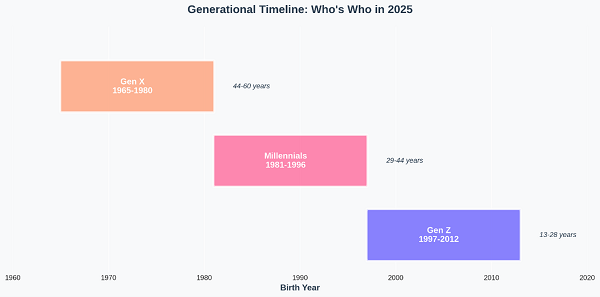
As Generation Z (born roughly 1997-2012) steps into adulthood, they are increasingly populating workplaces, public services, and decision-making arenas alongside Millennials (born 1981-1996) and Generation X (born 1965-1980).
Currently aged 13-28, with the oldest cohort now in their late 20s, Gen Z is influencing corporate cultures, social media landscapes, and economic trends.
Shaped by global events like the Great Recession, the COVID-19 pandemic, and rapid technological advancement, Gen Z consumes information via short-form digital content, prioritizes mental health, and seeks purpose-driven lives.
There is the need to explore their interactions with older generations, viewpoint differences, the role of education in preparing them for mainstream roles, and whether their traits are universal or culturally bound. We’ll also include practical insights to foster better coexistence and mutual growth.
How Gen Z Interacts with Millennials and Gen X in the Workplace and Beyond
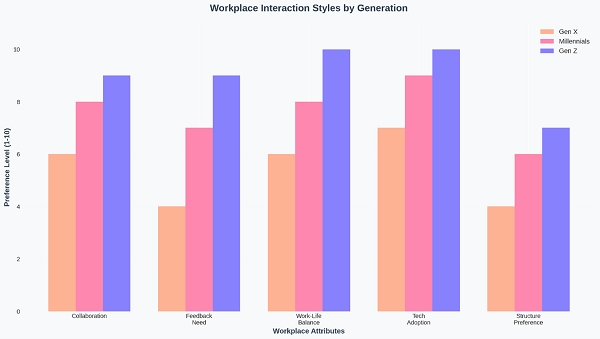
In multigenerational environments like offices, public services, and diplomatic roles, Gen Z often brings a fresh, collaborative energy but can clash with established norms.
They value open communication, mental health support, and flexibility—such as remote work or wellness programs—more than hierarchical structures favored by Gen X, who emphasize independence and self-sufficiency.
Millennials, as a bridge generation, share Gen Z’s tech-savviness but may prioritize career advancement over the work-life balance Gen Z demands.
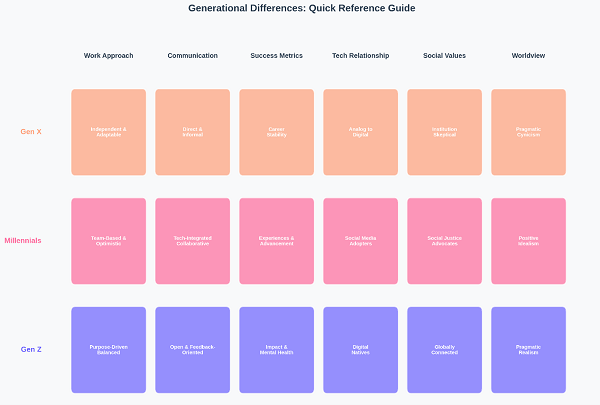
Interactions can be tense: Gen Z seeks frequent feedback and emotional affirmation, viewing the workplace as a space for personal fulfillment, which some older managers see as entitlement.
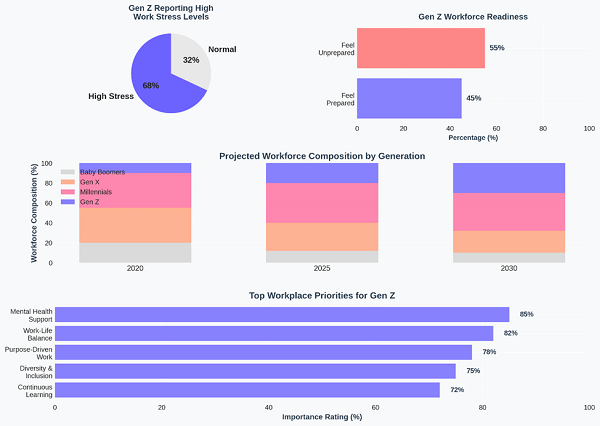
For instance, 68% of Gen Z report high stress levels at work, leading them to push for changes like generous benefits and diversity initiatives. On social media and in public discourse, Gen Z influences decisions through viral campaigns, often aligning with Millennials on social justice but challenging Gen X’s pragmatic, institution-skeptical approach.
Positive dynamics emerge when older generations mentor on resilience, while Gen Z teaches digital efficiency and innovation.
| Generation | Preferred Interaction Style | Common Challenges in Mixed Settings |
| Gen Z | Collaborative, feedback-heavy, purpose-oriented | Perceived as demanding; higher expectations for support |
| Millennials | Team-based, optimistic, tech-integrated | Balance-seeking but may view Gen Z as less committed to long hours |
| Gen X | Independent, adaptable, informal | Frustration with Gen Z’s need for structure and affirmation |
Differences in Viewpoints Between Gen Z and the Previous Two Generations
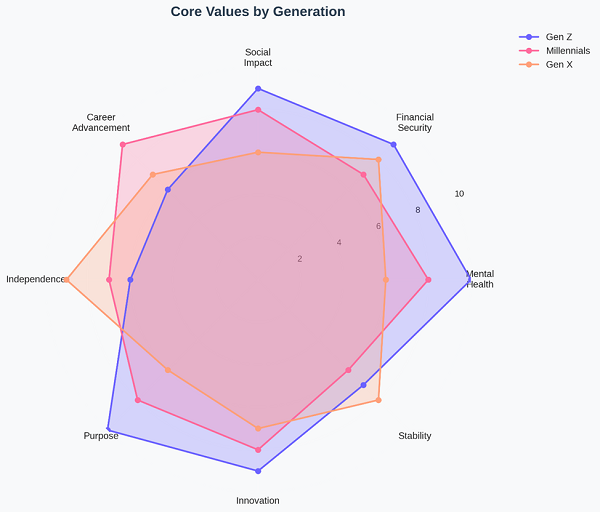
Gen Z’s worldview diverges significantly from Millennials’ optimism and Gen X’s cynicism, shaped by economic instability and digital immersion.
They are pragmatic realists, prioritizing mental health, financial security, and social impact over traditional success metrics like promotions. In contrast, Millennials focus on positive self-views and experiences, while Gen X values self-reliance and distrusts institutions.
On work: Gen Z redefines productivity as smart, balanced effort rather than long hours, often juggling side hustles and questioning “outdated systems.” They trust creators over institutions and participate in content creation, unlike Gen X’s analog-to-digital transition or Millennials’ social media adoption.
Socially, Gen Z is more globally connected, anxious, and open about mental health, challenging norms in ways Millennials boosted and Gen X adapted to. They show lower hedonism, with fewer teenage pregnancies and less alcohol consumption.
Does the Current Educational System Equip Gen Z for Integration, or Will They Dictate Their Own Ways?
Despite being the most educated generation, over half of Gen Z feels unprepared for the workforce, citing gaps in soft skills like communication and adaptability.
Traditional education emphasizes academic knowledge but often overlooks practical training for corporate or public service realities, such as navigating hierarchies or building resilience. In public sectors, Gen Z’s push for outcomes-driven cultures highlights this mismatch.

However, Gen Z’s focus on continuous learning—prioritizing skills over ladder-climbing—positions them to innovate. As they would comprise 30% of the workforce by 2030, they may dictate changes like hybrid models and purpose-driven roles, especially in AI-influenced jobs.
Innovative educational approaches, like peer-led learning, could bridge this, but without adaptation, Gen Z may reshape systems from within.
Universal Traits of Gen Z vs. Influences from Society, Culture, and More
Gen Z exhibits universal traits like tech-savviness, social consciousness, and pragmatism, driven by global digital access and shared events.
They are racially diverse, educated, and fatalistic about challenges like climate change. Yet, these are modulated by cultural contexts: In individualistic societies, entrepreneurship thrives; in collectivist ones, community activism dominates.
Religion and country influence values—e.g., Gen Z in the U.S. prioritizes mental health more than in some Asian cultures emphasizing duty. Overall, core digital-native behaviors are global, but expressions vary by local factors.
Additional Insights: Bridging Generations for Mutual Benefit
There are no clear-cut dividing lines between the generations. Also, this is not the first time that a younger generation is behaving differently from the older generations. The merger of generations is gradual and subtle, like a vignette screen.
For here and now, we can just offer a sliver of advice:
- For Gen Z: Embrace mentorship from Gen X’s adaptability and Millennials’ optimism; build resilience through odd jobs or internships to counter delayed maturity. Focus on meaningful work but learn corporate navigation to amplify your voice.
- For Older Generations: Adapt to Gen Z’s authenticity and participation style; offer rotational roles and feedback to retain talent. Recognize their lower labor participation stems from systemic issues, not laziness.
Benefits include innovation from Gen Z’s AI fluency and diversity, fostering inclusive environments that boost productivity.
Debunk myths: Generational differences are often overstated, rooted in life stages rather than inherent flaws.
In the end, we would say that the Gen Z’s integration signals a shift toward more equitable, tech-driven societies. By understanding interactions, viewpoints, educational gaps, and trait influences, all generations can collaborate effectively, turning potential conflicts into opportunities for progress. /// nCa, 15 October 2025