


nCa Analysis
Tajikistan is moving energetically, and pretty fast, to position itself as the regional powerhouse in artificial intelligence (AI) and related disciplines. It is following a hybrid model, merging the indigenous components with the foreign partnership elements. The sum total can possibly be more than its component parts.
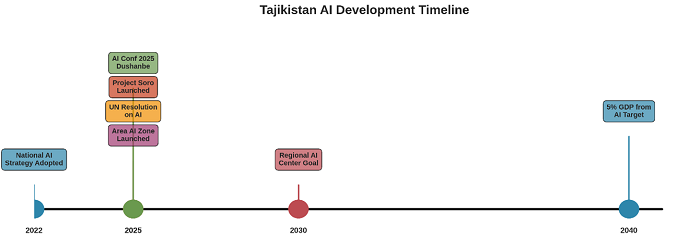
Under the vision and patronage of President Emomali Rahmon, the country adopted its National Strategy for Artificial Intelligence Development for the period up to 2040 in September 2022, becoming the first in Central Asia to formalize such a comprehensive framework.
It is a brilliant choice considering that Tajikistan is landlocked, does not have abundant hydrocarbon resources, but has a greatly talented population accustomed to hard work.
This strategy not only aims to integrate AI across key sectors like education, healthcare, agriculture, and infrastructure but also positions Tajikistan as a leader with influence extending beyond the region, fostering international collaborations and UN-led resolutions.
* * *
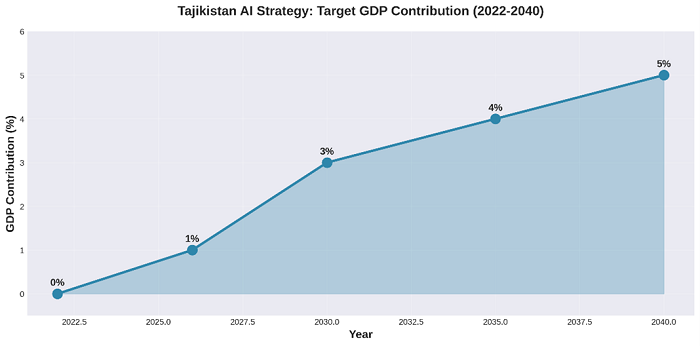
Tajikistan’s AI journey began with a foundational policy commitment. The 2022 National AI Strategy sets bold targets, including deriving up to 5% of the country’s GDP from AI-related economic activities by 2040. This document outlines a roadmap for building domestic AI capabilities, emphasizing ethical development, data sovereignty, and green technologies—leveraging Tajikistan’s abundant hydropower resources for sustainable computing.
A pivotal decision was the establishment of the AI Council under the Ministry of Industry and New Technologies, tasked with coordinating national efforts and international partnerships.
Building on this, Tajikistan has initiated groundbreaking infrastructure projects. In 2025, the country launched “Area AI,” described as the world’s first dedicated AI Zone—a technopark and cluster designed to serve as a hub for research, development, and application of AI technologies. This zone aims to create a complete AI ecosystem, from education to data centers, attracting global investment.
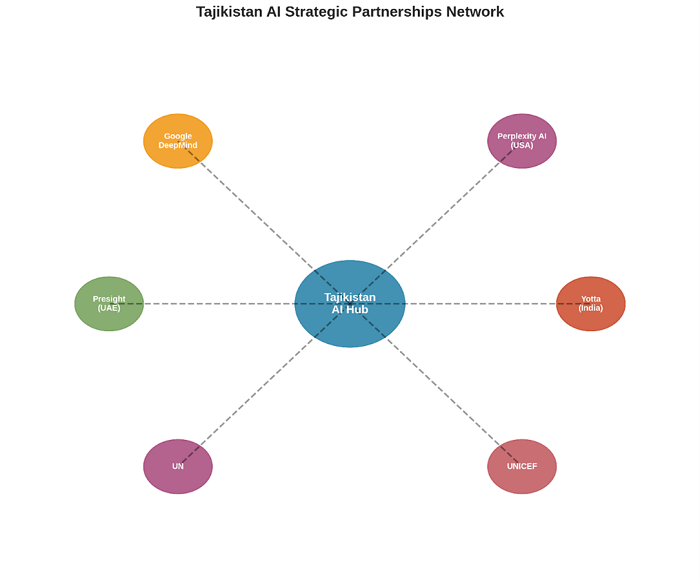
Additionally, Tajikistan has forged partnerships with international tech firms, including Perplexity AI (USA), Google DeepMind, Yotta (India), and Presight (UAE), to accelerate technology transfer and innovation. These decisions reflect a top-down approach, with presidential patronage ensuring alignment across government ministries.
On the global stage, Tajikistan has demonstrated leadership by initiating a historic UN General Assembly resolution on AI in July 2025, promoting equitable access and ethical standards worldwide, with a focus on sustainable development in Central Asia. This move extends Tajikistan’s influence beyond Central Asia, positioning it as a voice for developing nations in AI governance.
* * *
Tajikistan’s AI initiatives are in active rollout, with several high-profile projects underway. “Project Soro,” launched in October 2025 in collaboration with UNICEF, represents the region’s first large-scale integration of AI into national education systems. Targeting 4,000 schools and 2 million students, it involves training up to 2,000 AI specialists and is projected to generate $150 million in economic value through enhanced digital literacy and personalized learning tools. This initiative addresses a critical gap in AI education, emphasizing inclusive access for national development.
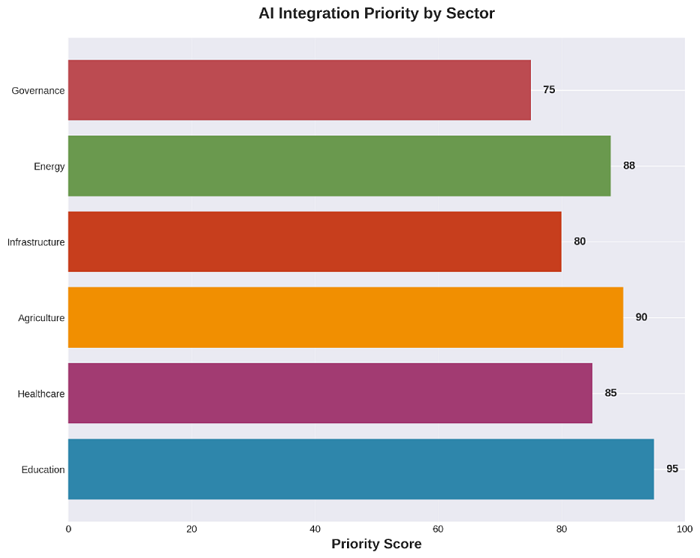
Infrastructure development is another focal point. A partnership with Yotta Data Services and darya.ai is developing Tajikistan’s first green AI data center in Darvoz, powered by renewable hydropower, aligning with the National AI Infrastructure Strategy. This facility will support AI computations while minimizing environmental impact, a model that could be exported regionally. Meanwhile, the AI Conf 2025, held in Dushanbe on October 25, 2025, gathered over 100 global leaders from more than 20 countries, showcasing Tajikistan’s ecosystem and fostering collaborations.
These processes are not without challenges. Reports highlight hurdles like infrastructure limitations, a shortage of skilled workers, and potential slowdowns from policy shifts. However, ongoing talent development programs, including AI curricula in schools and international training exchanges, aim to build a domestic workforce.
* * *
Tajikistan’s AI push is intertwined with broader Central Asian dynamics, where the region is awakening to AI’s potential amid global competition.
While Kazakhstan and Uzbekistan lead with more advanced projects—such as Kazakhstan’s AI-driven smart cities and Uzbekistan’s digital economy initiatives—Tajikistan is carving a niche through regional leadership.
In 2025, Tajikistan proposed establishing a Regional AI Center in Dushanbe, aimed at coordinating AI efforts across Kazakhstan, Kyrgyzstan, Tajikistan, Turkmenistan, and Uzbekistan. This center would facilitate joint research, data sharing, and implementation in sectors like agriculture and healthcare, accelerating initiatives such as AI-optimized water management in arid regions.
Comparatively, Kyrgyzstan is integrating AI into blockchain and energy sectors. Educational programs on AI and blockchain technologies are being developed at universities in Turkmenistan. Tajikistan’s strategy draws inspiration from these neighbors but emphasizes green AI and education, leveraging its hydropower advantage—over 90% of its energy is renewable—to support data centers that could serve the entire region.
Central Asia’s abundant critical minerals, essential for AI hardware, further amplify the region’s appeal, with Tajikistan positioning itself as a gateway for international investments in this supply chain. By hosting the Regional AI Center, Tajikistan aims to foster a collaborative ecosystem, reducing dependency on external powers like China and Russia while enhancing collective bargaining in global AI forums.
* * *
Over the next 5 years (by 2030), Tajikistan is likely to solidify its role as Central Asia’s AI hub, with the Regional AI Center operational and contributing to cross-border projects. The National Strategy’s short-term goals, including 1% GDP from AI by 2026, could scale to 3-5% by 2030 if partnerships with firms like Google DeepMind yield breakthroughs in localized AI applications. Infrastructure like the green data center and Area AI will attract startups and foreign direct investment, potentially creating thousands of jobs in tech.
Looking 10 years ahead (to 2035), Tajikistan could extend its influence beyond Central Asia, exporting AI solutions to neighboring South Asia and the Middle East. With sustained investment in education, the country might produce a skilled AI workforce rivaling regional peers, enabling advancements in predictive agriculture (to combat climate challenges) and telemedicine. However, success hinges on overcoming talent shortages and geopolitical risks; failure to do so could limit growth to niche areas. Optimistically, Tajikistan’s model of sustainable AI could inspire similar strategies in developing nations, positioning it as a UN advocate for ethical AI.
* * *
Economically, these initiatives promise transformative growth. AI integration could boost productivity in agriculture (Tajikistan’s largest sector) through precision farming, potentially increasing yields by 20-30% and reducing water waste.
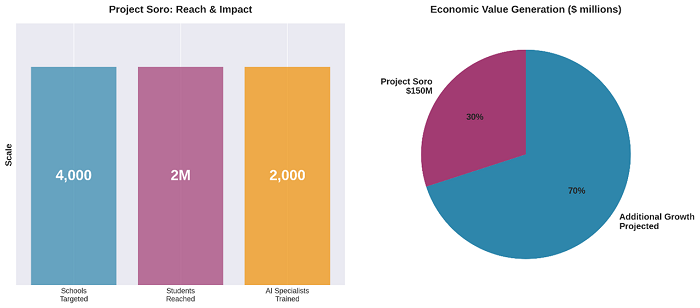
The targeted 5% GDP contribution from AI by 2040 could add billions to the economy, diversifying from remittances and hydropower exports, and fostering a tech export industry. Job creation in AI-related fields might reduce unemployment, particularly among youth, while attracting diaspora talent back home.
For citizens’ quality of life, impacts could be profound. AI-enhanced education via Project Soro will improve access to personalized learning, narrowing urban-rural divides and boosting literacy rates.
In healthcare, AI tools could enable remote diagnostics in mountainous areas, reducing mortality from preventable diseases. Overall, these advancements might elevate living standards, with improved infrastructure and services leading to higher life expectancy and economic mobility. However, equitable distribution is key; without inclusive policies, benefits may concentrate in urban centers like Dushanbe.
Tajikistan’s AI odyssey exemplifies how a resource-constrained nation can leverage strategic vision to punch above its weight. By blending national ambition with regional collaboration, it not only aims to lead Central Asia but also to influence global AI discourse, potentially redefining development paradigms for the Global South. /// nCa, 28 October 2025