


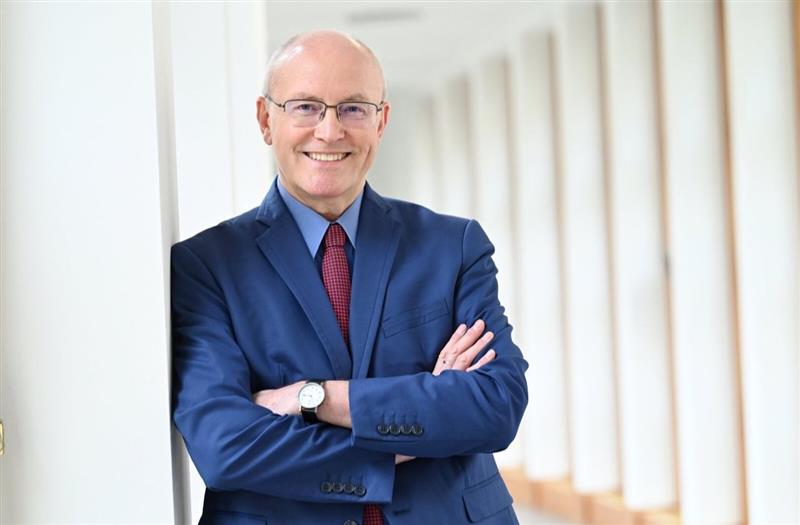
In our ongoing series of interviews with the heads of diplomatic missions in Turkmenistan, we are presenting today the exclusive interview with the Ambassador of the Federal Republic of Germany, Bernd Heinze.
nCa: Tribute to Professor Hanno Schaumburg
I will start with a respectful tribute to Professor Hanno Schaumburg, a great friend of Turkmenistan and my personal friend. We always met for lunch or dinner whenever he was in Turkmenistan. He contributed in so many different ways including the educational reforms, Margiana Cultural Exhibition, introduction of the Karakum Civilization to the western public (Mannheim), preparation of the latinized Turkmen alphabet for the Internet, advocating for the use of intellectual property for increase in the GDP of Turkmenistan, and his work in solar and renewable energy, particularly the green hydrogen energy. He passed away in August 2022 and his departure was a loss for Turkmenistan. During the last years, he traveled to Turkmenistan even when his leg was in cast because of a fracture. He was more than 75 at that time.
BH: Professor Hanno Schaumburg was indeed an extraordinary individual whose commitment to Turkmenistan went far beyond professional engagement. His contributions in education, cultural exchange, renewable energy, and digital development left a lasting legacy. His dedication—continuing his work even under difficult personal circumstances—was truly remarkable. He remains a symbol of the deep and enduring ties that can develop between Germany and Turkmenistan through mutual respect and shared vision.
nCa: Advanced engineering and Industry 4.0
Germany is a land of ideas and one of the the world’s most research-intensive nations. Advanced engineering and automotive technology are among the areas where cooperation between Germany and Turkmenistan is still in the conceptual stage. This includes precision engineering, auto-digital shift (mainly hydrogen fuel cell research), and Industry 4.0 idea of ‘smart factories.’ Do you think there is scope for joint ventures in these areas where the educated workforce and comparatively cheaper facilities of Turkmenistan could be combined with the German innovative technologies to make Turkmenistan a regional hub for products and ideas?
BH: Germany’s strength in advanced engineering, hydrogen technologies, and smart manufacturing offers significant potential for cooperation. Turkmenistan, with its young and well-educated population, could benefit from closer integration into these innovation ecosystems. Joint ventures are, in principle, both conceivable and attractive.
nCa: Chemical and pharmaceutical industries
Chemical and pharmaceutical sciences are a broad area where cooperation between Germany and Turkmenistan could be greatly beneficial. The prime areas could be the biotechnology and specialty chemicals. Do you think the products under joint Turkmen-German ventures could find a fair share in the western markets considering that they would be affordable but have the same German technology and quality behind them?
BH: There is clear potential for cooperation in biotechnology and specialty chemicals. German companies are globally competitive in these sectors due to their focus on quality, innovation, and regulatory compliance.
Products from joint ventures could indeed find a place in international markets. However, this presupposes that internationally recognized standards are met—not only in production, but also in certification, intellectual property protection, and regulatory transparency.
nCa: Renewable energy and green hydrogen
There is plenty to say about the joint work in wind and solar integration, green hydrogen economy, and waste management. In your view, what kind of projects could make the best of German technology and Turkmen resources? Do you envision that the combination of German technologies and expertise and Turkmen natural and human resources could ultimately make Turkmenistan a major supplier of energy to the world markets?
BH: The combination of Turkmenistan’s natural resources—especially solar and wind potential—and German technological expertise creates promising opportunities, particularly in green hydrogen and renewable energy integration.
nCa: Agriculture and water management
Agriculture is an area where quite a bit is being done already and there is room for plenty more. The German superiority in upstream and downstream agriculture, precision farming and telematics, water management and water saving technologies, high-protein feed and breeding, rapeseed cultivation and processing and camel health management creates vast potential. What kind of work is being done in these areas already and what are the future plans?
BH: Agriculture is already an important area of cooperation. German expertise in precision farming, water-saving technologies, and sustainable value chains could further support Turkmenistan’s agricultural development.
nCa: Transport and communications
Transport and communications are the areas of particular interest. German companies are already engaged in various degrees in the railway modernization, maritime and aerospece sector, telecommunications, and related areas. Could you please sum up the current interaction in these sectors and what could possibly the future directions?
BH: German companies have shown interest in contributing to the modernization of transport and communication infrastructure, including railways, logistics, and telecommunications.
nCa: Regional infrastructure and energy projects
Further to the last question, are there any prospects for the participation of German companies in the major projects of Turkmenistan and Central Asia such as TAPI, development of the Middle Corridor, capacity utilization of the Turkmenbashy Port, road and rail networks through Afghanistan for connecting Central Asia with South Asia, and partnership in the upstream, midstream and downstream hydrocarbon sector?
BH: Large-scale regional initiatives such as transport corridors and energy infrastructure projects offer important opportunities for cooperation. German companies could bring valuable expertise in engineering, project management, and sustainability.
nCa: Artificial intelligence and robotics
AI and Humanoid robots are emerging fields but they will fill the landscape pretty fast. Do you envision some of kind of cooperation between Turkmenistan and Germany in this field?
BH: Emerging technologies such as artificial intelligence and robotics offer exciting prospects for future cooperation. Germany has strong capabilities in applied AI and industrial automation.
Such cooperation typically begins with education, research partnerships, and pilot applications.
nCa: C5+Germany cooperation
The recently held meeting of foreign ministers in C5+Germany was a landmark event. How will these commitments turn into tangible results?
BH: The C5+Germany format is an important platform for regional dialogue and cooperation. It has the potential to translate political commitments into practical projects, particularly in areas such as energy, climate, and economic development.
For these initiatives to deliver tangible results, it will be important to align them with concrete improvements in the investment climate and to ensure consistent implementation at the working level.
nCa: Digital banking and financial markets
There is some initial work for the partnership of Germany in the digital banking and securities market of Turkmenistan. How will it take shape and can it pan out to the regional and global integration?
BH: Digitalization of financial systems is an important step toward greater economic integration. German expertise in banking technology and regulatory frameworks could support this process.
nCa: Anything else you may like to add?
BH: Thanks for creating this flexibility in the interview because so far you asked specific questions and I gave specific answers.
However, taking this opportunity, I will briefly explain the nature of the German economy, the mechanism defining the partnership features of the economy and the ways the friends and partners of German can benefit from it. This is literally part of my job as the ambassador of the Federal Republic of Germany – Bundesrepublik Deutschland.
The real strength of the German economy is its private sector. Although some giants in the German economy are well known worldwide, 99.6% of all companies in Germany are in the category of SMEs – small and medium-sized enterprises (Mittelstand). These companies are typically family-owned, have less than 500 employees and prioritize long-term stability rather than short-term profits.
The second point to note is that the German economy is export oriented, with more than 44% of companies engaged in exports. This puts Germany among the top three exporters in the world.
The third point in this context is that the private sector works hand-in-hand with the educational system in Germany. This affords the dual nature of vocational training.
I will return with more comments on the nature of German economy in a minute but here I must mention something that is so peculiar to Germany. — We have some 1500 companies that are dubbed by the media as ‘Hidden Champions.’ These are the global market leaders in their specialized niche markets but hardly anyone knows about them.
For instance, Herrenknecht AG is the uncontested global leader for the mechanized tunneling technology and yet people hardly ever hear about it. If there is a major subway or highway tunnel being built anywhere in the world, it is likely using Herrenknecht machinery.
Another example is SAACKE, a world leader in firing systems and burners used in power stations, refineries and seagoing vessels. There are hundreds more including Würth Group, Lurssen Werft, Symrise, Flexi, DSI Aerospace, Mennekes, etc.
Now, let’s get back to the nature of the economy of Germany.
While the private sector is the driving force, this strength is supported by a “social market economy” model, where the state provides a stable framework, robust infrastructure, and strong research institutions and combines them with element of the welfare state.
This explanation is not just for our Turkmen partners but for everyone else who could be looking for solid handles to partner with Germany.
Germany is scheduled to be included in the 2026 full edition of B-READY (Business Ready) framework of the World Bank’s global standard for measuring the business environment.
B-READY evaluates economies based on three pillars across 10 topics. Going into the details of B-READY here will steer us away from our focus. However, it is important to mention that regulatory framework, public services, and operational efficiency are the three main pillars of B-READY. The topics within these pillars include Business Entry, Business Location, Utility Services, Labor, Financial Services, International Trade, Taxation, Dispute Resolution, Market Competition, and Business Insolvency. There is also the requirement for digital adoption, environmental sustainability, and gender equality.
B-READY is a streamlined upgrade of what was previously known as ease of doing business. This covers the entire spectrum including but not limited to legal certainty, protection of investments, property rights, transparent procedures for licensing and procurement, predictable financial and currency conditions, determined fight against corruption, enforceable contracts, currency convertibility, reliable payment mechanisms, transparent regulation, access to infrastructure, clear rules for market access, reliable local partnerships, streamlined administrative procedures, transparent tendering procedures, fair competition, access to reliable data, clarity on regulatory requirements, confidence in long-term planning conditions, governance standards, reliable, transparent, open business environment, conducive investment climate, etc.
Whether a country is already a part of B-READY or on its way to joining it, the areas I have mentioned here are the handles that afford solid points of interaction between the economies and business entities. The more there are on both sides, the better the traction. I am talking of all kinds of formats including public-private and B2B partnership.
Let’s now look at the TFCA (Trade Facilitation in Central Asia), a project developed and implemented by GIZ at the request of the German Federal Ministry for Economic Cooperation and Development (BMZ). It aims to simplify and harmonize international trade procedures across Central Asia to reduce costs and time for businesses.
TFCA aims to increase the competitiveness of the private sector by reducing administrative barriers, increasing transparency, and adopting digital technologies in customs and transport procedures.
The current phase of TFCA will run through 2029 and its focus areas are risk management, digitalization, and public-private dialog. When we look deeper into these three categories, we find the areas I have mentioned a while ago here.
The steering committee meeting of TFCA was held in Ashgabat in March 2026. This was an important milestone in German-Turkmen trade relations.
A key outcome was the formalization of the Interdepartmental Working Group on Trade Facilitation in Turkmenistan with advisory support from GIZ. The purpose is to accelerate transactions and reduce bureaucracy.
It was also decided to expand the scope to Trans-Caspian Transport Corridor (TCTC) projects through 2029.
Now I will sum up with some general remarks.
Every economy is a self-contained ecosystem. Every country has its own chosen development path and its own set of priorities. This is part of sovereignty.
However, there is also the fact that economies need to interact with each other, in many directions and at several levels. This reinforces the need to be on the same page on the areas I have mentioned.
The conversation with our Turkmen colleagues and friends has reached the stage where each side knows what is expected of them and there is the hope that the interval between commitment and implementation will not be long.
Germany believes that the mutual economic space is earned on its own merit and there is no other way around it.
We are always here to assist and advise our Turkmen colleagues and friends. /// nCa, 6 April 2026