


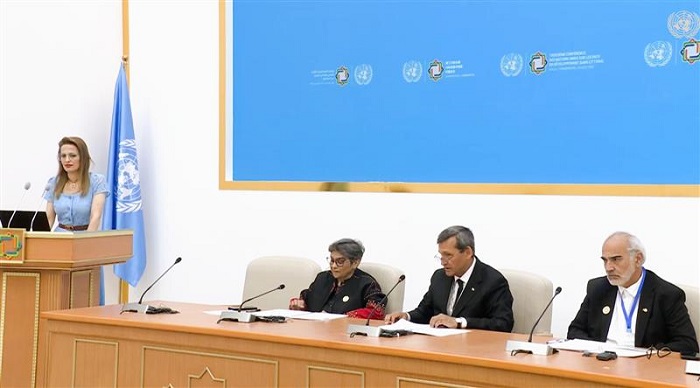
Elvira Kadyrova and Ravilya Kadyrova, Awaza, Turkmenistan
On 6 August 2025, the global community marks the first International Day of Awareness of the Special Development Needs and Challenges of Landlocked Developing Countries, established by the United Nations General Assembly resolution on July 25, 2025. This day represents a significant milestone, aimed at highlighting the unique challenges faced by LLDCs and mobilizing global efforts to address them through cooperation, investment, and innovation.
As Rashid Meredov, Deputy Chairman of the Cabinet of Ministers and Minister of Foreign Affairs of Turkmenistan, stated during a press briefing in Awaza, this day is not merely a date for commemoration, but a call to action. It is a call to deepen the understanding of the structural disadvantages faced by LLDCs and promote practical solutions to empower LLDCs to fully participate in the global economy.
LLDCs face significant barriers that limit their economic growth and transport connectivity. Meredov cited well-known statistics: these countries account for only 1% of global goods exports**, and their transport costs are, on average, 30% higher than those of coastal nations. These figures remind us journey ahead is long as systemic imbalance require systematic solutions, from access to financing and technology transfer to capacity institutional.
Turkmenistan, as a landlocked country, actively advocates for enhanced international cooperation in areas such as transit corridors, green energy, harmonization of customs procedures, and institutional strengthening.
Meredov reaffirmed the country’s readiness to collaborate with all stakeholders – from governments, international financial institutions, from civil society to the private sector to ensure that this international day serves a meaningful platform for the progress.
Rabab Fatima, Secretary-General of the Conference and Under-Secretary-General of the UN for LLDCs, highlighted that we don’t marking a date on a calendar, this day opens a new chapter for landlocked nations. This day, established by the United Nation’s General assembly, is a landmark recognition of the unique and persistent challenges, faced by LLDCs.
With a population of 600 million across four continents, LLDCs send a clear message: opportunities should not stop at the cost, limited by geography, she emphasized.
The recently adopted Awaza Programme of Action for 2024-2034 provides a clear roadmap for reducing trade costs, strengthening cross-border infrastructure, unlock digital corridors to ensure that no LLDCs left behind.
This day is not just a celebration but a platform for mobilizing partnerships and action.
Diego Pacheco Balanza, Chair of the Group of LLDCs and Permanent Representative of Bolivia to the UN, added that August 6 holds special significance for his country, coinciding with Bolivia’s Independence Day. He called on the global community to unite under the UN’s auspices to turn barriers into bridges and transform landlocked countries into land-linked ones.
The International Day of Awareness for the Special Needs and Challenges of LLDCs is not only an occasion to draw attention to their issues but also an opportunity to inspire responsibility. Turkmenistan, Bolivia, and other LLDCs emphasize that sustainable development must be inclusive and global. Connectivity, access, and opportunities are the rights of all nations, regardless of their geographical location.
As Rashid Meredov noted, diplomacy is not only about official statements and negotiations but also about cultural dialogue and human connections. This day calls on the global community to unite efforts to create a future where LLDCs are defined not by limitations but by opportunities, innovation, and resilience. ///nCa, 6 August 2025