


nCa Report
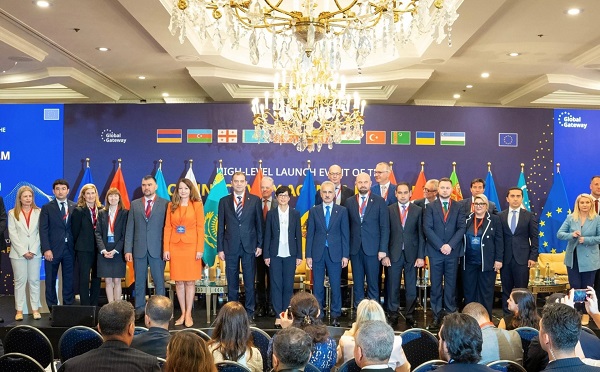
When European Commission officials welcomed transport ministers and diplomats to Brussels last Monday, the occasion was more than a routine policy gathering. The launch of the Connectivity Agenda Platform on 23 June marked a concrete step in the EU’s long-running effort to build trade routes that bypass Russia and knit together two regions that have historically remained at arm’s length.
The platform was unveiled at a high-level ministerial meeting hosted by Commissioner for Enlargement Marta Kos, Commissioner for International Partnerships Jozef Síkela, and Commissioner for Sustainable Transport Apostolos Tzitzikostas, and brought together ministers and senior representatives from EU member states, Armenia, Kazakhstan, the Kyrgyz Republic, Moldova, Tajikistan, Turkmenistan, Türkiye, Ukraine and Uzbekistan, alongside G7 partners and international financial institutions. [EU NEIGHBOURS east]
The platform operates under the EU’s Global Gateway strategy — Brussels’ answer to China’s Belt and Road Initiative — and is intended to coordinate investment and policy across transport, energy, digital infrastructure and trade facilitation. Rather than replacing existing initiatives, it builds on earlier groundwork: Kazakhstan’s deputy foreign minister, Arman Issetov, described the launch as a concrete outcome of agreements reached at a ministerial connectivity meeting held in Luxembourg in October 2025. [Qazinform]
Money on the table
The meeting produced more than declarations. The European Commission concluded statements of intent with international financial institutions expected to mobilize up to €2 billion (around $2.3 billion) for transport, border-crossing and trade-facilitation projects across the Black Sea region and the South Caucasus.
The lenders involved include heavyweight institutions: the European Investment Bank, the European Bank for Reconstruction and Development and the World Bank were all represented at the Brussels meeting. [The Times Of Central Asia/Qazinform]
Kazakhstan also announced financing deals on the sidelines. The Development Bank of Kazakhstan signed agreements worth nearly $1 billion — one with the European Investment Bank and a separate deal with a banking syndicate including Commerzbank, JPMorgan Chase and Standard Chartered, backed by guarantees from the Multilateral Investment Guarantee Agency. [The Times Of Central Asia]
The financial commitments are part of a broader EU push that has been gathering pace. At the Global Gateway Investors Forum in Brussels in January 2024, the European Commission announced a collective commitment of €10 billion toward sustainable transport connectivity for Central Asia and the Caucasus, subsequently augmented by an additional €12 billion at the inaugural EU–Central Asia Summit in Samarkand in April 2025. [The Jamestown Foundation]
The Middle Corridor: a route whose moment has come
At the heart of the platform is the Trans-Caspian Transport Corridor — widely known as the Middle Corridor — a multimodal route stretching roughly 7,000 kilometres from China through Central Asia, across the Caspian Sea, through the South Caucasus and into Europe via Türkiye. Geographically, it is the shortest land route between western China and Europe and serves as an alternative both to the northern route through Russia and to the ocean route via the Suez Canal. [Wikipedia]
The corridor’s rise has been rapid. Cargo traffic has recorded sustained growth since 2022, accelerating significantly in 2024 and 2025. The catalyst was Moscow’s invasion of Ukraine: with sanctions and reputational risks making the northern Russian route unattractive, shippers began looking for alternatives in earnest. In April 2026, participants in the corridor’s governing body approved a work plan focused on digitalization of transport processes to improve transit time and transparency. [Oxford Business Group/The Jamestown Foundation]
Bottlenecks remain, however. The Caspian Sea crossing is the corridor’s most significant structural constraint, and border procedures and inconsistent tariff structures continue to add time and cost. The new platform’s emphasis on trade facilitation and regulatory cooperation is aimed squarely at these weaknesses.
Where Turkmenistan fits
Turkmenistan’s presence in Brussels was notable. The country has traditionally kept a cautious distance from multilateral frameworks, but its participation alongside the other Central Asian states reflects a quiet but discernible shift toward western engagement.
Geography gives Ashgabat a stake in the corridor’s success. The Turkmenbashi International Seaport has expanded its cargo handling capacity to around 26 million tons a year, making it a significant node on the Caspian’s eastern shore. And Turkmenistan has been investing in its maritime credentials: in May 2026, the Baku International Sea Trade Port hosted the welcoming ceremony for the Gadamly, the first cargo vessel built in Turkmenistan — a 6,100-ton dry cargo ship capable of carrying 240 containers, which will operate regular routes between Turkmenbashi and Baku. Officials from both countries described the vessel’s launch as a step forward for the Middle Corridor. [Adb/Caspianpolicy]
European interest in Turkmenistan’s logistics potential has been direct. Earlier this year, an EU delegation led by Charlotte Adriaen, head of the EU Division for Central Asia, visited the Turkmenbashi port to discuss the effective use and development of the Trans-Caspian corridor, with particular attention paid to maintaining navigable channel depth through dredging operations. [Dredging Today]
Germany has also moved on the bilateral front. At a C5+1 meeting in Berlin in February, German logistics companies expressed willingness to invest in Turkmen ports and railways to accelerate cargo flows, with Berlin committing €2.7 million specifically for the coordination platform of the Trans-Caspian corridor. [Caspian News]
Beyond freight, Turkmenistan sits at the edge of a potentially larger strategic conversation. The long-discussed possibility of a trans-Caspian natural gas pipeline linking Turkmenistan to Azerbaijan and ultimately to European markets has gained renewed attention since Russia’s invasion of Ukraine prompted Brussels to seek alternatives to Russian energy. The platform’s inclusion of energy connectivity as a future agenda item — with dedicated meetings planned for the second half of 2026 — means that topic is unlikely to remain entirely off the table. [Hudson Institute]
For a country that exports the vast majority of its natural gas to China and has historically leaned on a narrow set of economic partners, the Connectivity Agenda Platform represents an opportunity to diversify without an irreversible commitment. Whether Ashgabat moves from participation to deeper integration will depend on how much the corridor can offer in practice — and on how seriously Brussels follows through on its investment pledges.
The Connectivity Agenda Platform will hold further meetings on energy and digital connectivity in the second half of 2026. /// nCa, 26 June 2026