


Tariq Saeedi
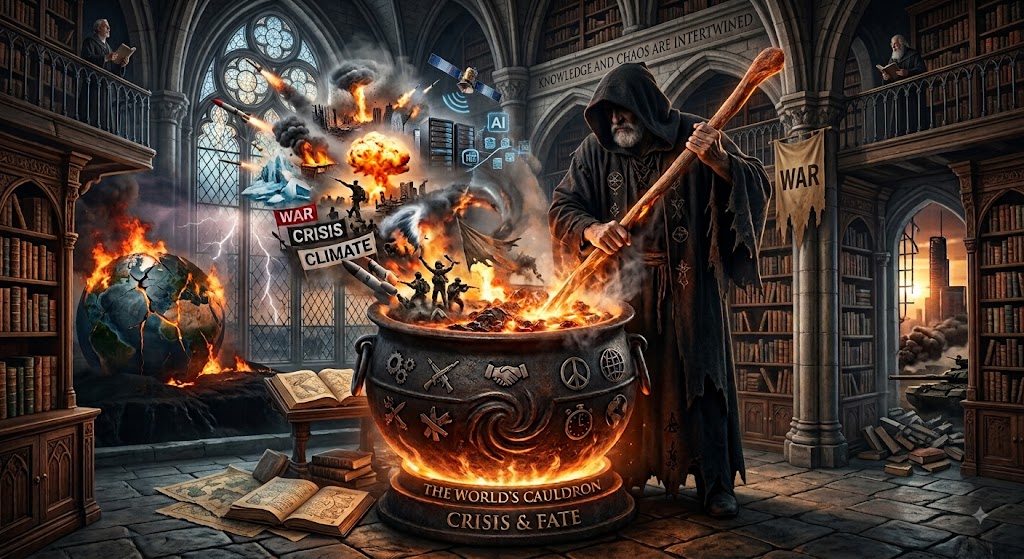
There are moments in history when events accumulate so strangely that ordinary explanations no longer suffice. We watch one development follow another with the uneasy sense that somebody, somewhere, is stirring a gigantic cauldron without knowing — or caring — what will emerge from it.
Something is deeply wrong with the way the world is being governed.
Not because humanity has become incapable of solving problems — on the contrary, never before have we possessed such scientific knowledge, technological capacity, financial resources and communications networks. We can calculate probabilities, model catastrophes, predict weather, monitor disease, detect environmental change and watch events unfold almost anywhere on the planet in real time.
And yet, when confronted with the most consequential dangers, we often behave as though tomorrow were somebody else’s problem.
Meanwhile, manageable disputes are allowed to become existential confrontations. Disputes that could be settled are prolonged; situations drifting toward accommodation are nudged back toward confrontation. Words become weapons, weapons become messages, messages become provocations — and provocations acquire a momentum of their own.
It is difficult not to wonder whether the world has developed a dangerous addiction to crisis.
The strange economics of confrontation
Prolonged confrontation is particularly irrational in an age when instability no longer stays contained within national borders.
A crisis in one region can move food prices in another. A disruption to energy supplies can alter industrial output thousands of kilometres away. A blockage in one transport corridor can ripple through supply chains on several continents. A financial shock can cross borders before governments finish convening their emergency meetings.
And yet the political imagination often remains stubbornly territorial.
Governments still calculate victory in terms of maps, leverage, prestige and short-term advantage, while the actual costs fall on people who had no part in creating the crisis.
The paradox is cruel.
Those who make the decisions are often the least exposed to their consequences. Those who send signals rarely live where the signals land. Those who speak most confidently about endurance are seldom the people whose homes, businesses and families must do the enduring.
This creates a peculiar moral asymmetry.
The longer a confrontation continues, the easier it becomes for those distant from its consequences to describe continuation as principle.
For those living with the consequences, however, principle is a much more complicated luxury.
The perpetuation of the unnecessary
There is another phenomenon that deserves more attention: crises acquiring lives of their own.
A dispute begins with identifiable grievances. Positions harden. External interests become involved. Institutions mobilise. Narratives are constructed. Commitments are made. Money is spent. Weapons, equipment, personnel and political capital become invested in the confrontation.
At some point, ending the crisis begins to threaten too many interests.
And this is when something irrational can happen.
The original question becomes almost irrelevant.
The machinery created to manage the confrontation starts creating reasons for its continuation.
Those who benefit politically, strategically, commercially or institutionally from continued tension gain an interest in keeping the temperature high. Those who have publicly committed to a course find retreat embarrassing. Those who have predicted what must happen grow reluctant to admit that circumstances have changed.
The result is a peculiar inertia: nobody needs to decide that the crisis must continue forever. It simply becomes easier to continue than to stop.
History contains many examples of this phenomenon.
What is new is the speed with which it can now happen — and the destructive power available to the participants.
The most dangerous people may be those who believe they are managing the situation
International politics rests on a comforting assumption: that great powers, with their sophisticated institutions, intelligence services and experienced diplomats, must understand the consequences of their actions.
Perhaps they do.
But understanding is not the same as control.
The modern world is an extraordinarily interconnected system, in which a decision made for one purpose can produce an entirely different consequence once it meets decisions made elsewhere.
One actor seeks deterrence.
Another interprets it as preparation for attack.
A third responds to the second.
A fourth exploits the opportunity.
Markets react.
Public opinion becomes inflamed.
Domestic political pressures intervene.
The original calculation disappears beneath layers of reaction.
At every stage, everyone may insist that they are acting rationally.
And collectively, they may be producing something utterly irrational.
This is perhaps the central danger of our age: rational actors can create irrational outcomes.
The world does not need a mad magician to produce chaos.
It merely needs enough people pursuing their own perfectly logical objectives simultaneously.
Meanwhile, the real emergencies wait patiently
The most astonishing part is what gets pushed to the margins while governments, media organisations and political elites concentrate on confrontation.
There are dangers whose clocks do not stop when diplomats argue.
The climate does not pause its trajectory because politicians are busy.
Antimicrobial resistance does not wait for a ceasefire.
Pandemics do not respect alliances.
Water scarcity does not recognise sovereignty.
Food insecurity does not care which flag flies over a border.
Artificial intelligence will not pause its development until humanity agrees on the rules governing it.
Cyber vulnerabilities do not disappear during negotiations.
Demographic change continues regardless of geopolitical rivalries.
Ecosystem degradation proceeds quietly while screens stay occupied by louder events.
These are not abstract concerns for some distant future.
Some are already affecting millions of people. Others could become crises of a scale that would make today’s geopolitical disputes look remarkably small.
And yet humanity behaves as though it has an unlimited supply of time.
We do not.
We are spending enormous intellectual energy on the wrong things
Imagine the major powers treating common threats with the same seriousness they give strategic competition.
Imagine scientists from rival countries sharing data, because a virus does not distinguish between friend and adversary.
Imagine governments treating water security as a matter of collective survival rather than a national resource question.
Imagine an international programme dedicated to preventing catastrophic food shortages caused by climate shocks, disrupted trade or conflict.
Imagine the world’s leading technology companies and governments competing not to dominate artificial intelligence, but to make it safe, accessible and beneficial.
Imagine global financial resources mobilised with the urgency normally reserved for strategic emergencies, to protect vulnerable societies from environmental collapse.
None of this is utopian.
Human beings cooperate readily once they recognise that the alternative is unacceptable.
The problem is that we tend to recognise the alternative only after disaster has arrived.
The tragedy of the invisible catastrophe
Perhaps one reason is that the most important dangers are often less dramatic than the crises that dominate our attention.
A missile is visible.
A collapsing ecosystem is not.
A dramatic speech is visible.
The gradual depletion of groundwater is not.
An explosion is visible.
The slow emergence of a pathogen resistant to existing medicines is not.
A military mobilisation can be photographed.
The cumulative effect of thousands of small environmental changes cannot easily be captured in a single photograph.
Politics gravitates toward the spectacular.
But humanity’s greatest dangers may increasingly be the opposite of spectacular.
They may arrive quietly.
They may accumulate gradually.
And by the time they become impossible to ignore, the opportunity to prevent them may have passed.
The curious pleasure of being divided
There is another uncomfortable truth.
We have become extraordinarily good at identifying what separates us and remarkably bad at recognising what unites us.
Nationality.
Ideology.
Religion.
Historical grievances.
Political systems.
Economic interests.
Civilisational narratives.
All of these differences are real. They matter. They should not be erased.
But beneath them is something more fundamental: the shared vulnerability of human beings living on one increasingly interconnected planet.
A child breathing polluted air does not know which geopolitical camp produced it.
A farmer facing a water shortage does not care which strategic doctrine caused the problem.
A family watching food prices rise gains nothing from an economist’s geopolitical explanation.
A society confronting a new disease does not have the luxury of waiting for rival governments to agree on whose fault it is.
The atmosphere has no ideology.
The oceans have no nationality.
Viruses have no passports.
And physics does not recognise spheres of influence.
Perhaps we should stop asking who is winning
One of the strangest habits of contemporary discourse is the obsession with winners and losers.
Who is gaining?
Who is losing?
Who has leverage?
Who has prevailed?
These questions have their place.
But there are circumstances in which the entire framework becomes absurd.
If a house is burning, it is useful to know who started the fire, who failed to prevent it, and who is responsible.
But if the inhabitants spend their time arguing about these questions while the fire spreads, the outcome will not be a victory for one side. — It will be a ruined house.
Humanity is beginning to encounter problems of this kind.
Some challenges are becoming too large to be solved by victory.
They can only be solved by survival.
That is a fundamentally different political philosophy.
The missing word: restraint
There is much talk today about strength. There is far less about restraint.
Yet restraint is not weakness.
A powerful state that can retaliate but chooses not to demonstrates something harder than the ability to retaliate.
A leader who can escalate but chooses to negotiate is not necessarily surrendering.
A government that accepts an imperfect settlement over a perfect catastrophe is not abandoning principle.
It is practising statecraft.
Civilisation itself may be described as the gradual construction of restraints around humanity’s capacity for destruction.
Every generation inherits those restraints — and every generation is capable of weakening them.
We should be careful about the latter.
Because technological progress has dramatically increased the consequences of political irresponsibility.
The world now possesses the means to destroy things much faster than it can rebuild them.
Perhaps the real crisis is not geopolitical
Perhaps what we are witnessing is something deeper.
Perhaps the central crisis of our time is a crisis of priorities.
We have learned how to produce more, communicate faster, travel farther and calculate better.
But have we learned how to decide what matters?
We can place machines on other planets while millions of people remain vulnerable to entirely earthly problems.
We can develop extraordinarily sophisticated weapons while struggling to establish basic mechanisms for preventing their use.
We can build financial systems capable of moving trillions of dollars in seconds while struggling to mobilise comparatively modest resources against preventable human suffering.
We can predict increasingly complicated futures while remaining politically addicted to the immediate.
This is not a failure of intelligence. — It is a failure of judgement.
The world does not need another grand strategy
Perhaps what is required is something simpler.
A hierarchy of priorities.
Some problems are serious.
Some are urgent.
Some are existential.
They should not be treated alike.
If humanity faces dangers that could fundamentally alter the conditions under which civilisation operates, they deserve attention commensurate with their scale.
Not after every political dispute has been settled.
Not after every strategic contest has been won.
Not after every government has extracted maximum advantage.
Now.
The world needs mechanisms through which rivals can cooperate without first becoming friends.
It needs scientific collaboration that survives political disagreement.
It needs channels of communication that remain open when official relations deteriorate.
It needs leaders capable of distinguishing between national interest and national vanity.
It needs an international culture in which de-escalation is not interpreted as defeat.
And above all, it needs the humility to recognise that nobody has complete control over the consequences of what they set in motion.
Before the magician stirs the pot again
The image that best captures our present predicament is a magician stirring a gigantic pot.
Into it go grievances, ambitions, fears, weapons, sanctions, elections, propaganda, economic pressures, historical memories and technological capabilities.
The magician announces that he knows what he is doing.
The audience applauds.
But nobody can quite see what is happening at the bottom of the pot.
Every now and then, something terrible emerges.
Everyone is shocked.
Everyone condemns it.
Everyone searches for someone to blame.
And then, remarkably, the stirring continues.
Perhaps it is time to put down the spoon.
Not because disagreements have disappeared.
Not because justice no longer matters.
Not because nations should abandon their interests.
But because there are dangers that transcend every individual dispute.
The planet grows more interconnected while politics grows more fragmented. Our capacity to destroy is increasing faster than our capacity to restrain ourselves. Our common vulnerabilities are multiplying while our political imagination stays trapped in the logic of rivalry.
This is a dangerous combination.
The great irony is that humanity may eventually discover that the most consequential contest of the twenty-first century was never between one bloc, ideology or power and another.
It was between our ability to cooperate and our willingness to postpone cooperation until cooperation became impossible.
There is still time.
But time is precisely the resource we are spending most carelessly.
And somewhere, someone is still stirring the pot. /// nCa, 12 August 2026