


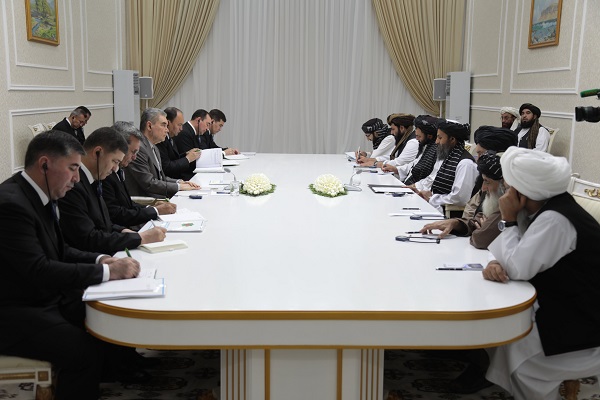
On Monday, 10 August 2026, National Leader of the Turkmen people Gurbanguly Berdimuhamedov and Afghanistan’s Deputy Prime Minister for Economic Affairs Abdul Ghani Baradar held talks in narrow and expanded formats in Herat province, Afghanistan.
According to Turkmenistan’s state news agency TDH, the visit focused on reviewing progress on the Turkmenistan-Afghanistan-Pakistan-India (TAPI) gas pipeline project.
Narrow format talks
During the meeting, Abdul Ghani Baradar said the good-neighborly relations between Afghanistan and Turkmenistan were rooted in the shared historical ties of the two peoples, as well as their common cultural and spiritual values. He expressed appreciation for the regular humanitarian assistance provided by Turkmenistan to the Afghan people.
Arkadag Berdimuhamedov, in turn, said Turkmenistan, drawing on its status of permanent neutrality, recognized by the United Nations three times, consistently advocates peace and sustainable development both in the region and globally.
He reaffirmed Turkmenistan’s readiness to further expand cooperation with Afghanistan.
Expanded talks focus on TAPI
The TAPI gas pipeline and other infrastructure projects were at the center of the expanded talks, which brought together official delegations from the two countries.
Baradar said Afghanistan viewed the TAPI pipeline, the Turkmenistan-Afghanistan-Pakistan power transmission project and the optical-fiber communications line not only from an economic perspective, but also as important steps toward expanding bilateral cooperation.
According to him, implementation of these projects would improve access to energy for the Afghan population, create new jobs and provide Afghan investors with favorable conditions for using natural gas to generate electricity.
Afghanistan’s Deputy Prime Minister for Economic Affairs also stressed the need to establish a joint mechanism to ensure regular coordination between the relevant agencies of the two countries and further advance work on TAPI.
Arkadag Berdimuhamedov described the gas sector as one of the key areas of the bilateral partnership. He highlighted the strategic role of Herat province as an important transit hub.
The supply of energy resources and the development of transit opportunities, he said, provide a foundation for long-term energy cooperation and support economic development across the wider region.
He also highlighted the importance of the TAPI gas pipeline, the Turkmenistan-Afghanistan-Pakistan (TAP) power transmission line and the optical-fiber communications project, all of which were initiated by Turkmenistan. The latter is intended to expand digital cooperation and establish electronic information links between the countries.
The talks noted that supplies of natural gas and electricity from Turkmenistan to Afghanistan could create significant opportunities to accelerate the development of major industrial zones in Herat province. This, in turn, would help create new jobs and support economic and social well-being in neighboring Afghanistan.
Addressing joint projects and stressing the importance of strengthening the legal framework for bilateral cooperation, Berdimuhamedov proposed establishing a Turkmen-Afghan Commission on Economic Cooperation.
According to TDH, around 300 pieces of specialized equipment are currently involved in construction of the Serhetabat-Herat section of the TAPI pipeline, known as ‘Arkadagyň ak ýoly.’
A 123-kilometer section of the transnational gas pipeline has already been laid, while construction is continuing on a further 30 kilometers. Completed sections are undergoing hydrostatic pressure testing. More than 120 workers and specialists are involved in the project.
The talks concluded with the signing of a Memorandum of Understanding between Turkmenistan’s state concern Türkmengaz and Afghanistan’s state-owned Afghan Gas Corporation.
Under the memorandum, the sides agreed to work jointly on developing gas-related infrastructure in Herat province and supplying Turkmen natural gas to industrial facilities, power plants and households.
Connectivity and the Lapis Lazuli Corridor
The talks also covered cooperation in transport and logistics. The sides highlighted the role of the Turkmenbashi International Seaport in unlocking the region’s transport potential, as well as the importance of the Lapis Lazuli international transport corridor linking Afghanistan, Turkmenistan, Azerbaijan, Georgia and Türkiye.
The agreement establishing the Lapis Lazuli corridor was signed in Ashgabat in 2017.
As noted by TDH, Berdimuhamedov has put forward a number of proposals aimed at revitalizing the corridor and improving its efficiency. These include establishing a unified logistics center, developing infrastructure at cargo departure and receiving points—including seaports, railway stations and road terminals—introducing a unified freight-pricing policy along the entire route, streamlining customs procedures through a “single window” system, and developing a digital atlas of the Lapis Lazuli Corridor.
The multimodal corridor provides the participating countries with a platform to strengthen trade and transport links across a broad geoeconomic area spanning Central and South Asia and the Caspian, Black and Mediterranean Sea regions, while helping unlock their economic potential.
Education and skills development
The sides also discussed cultural and humanitarian cooperation.
In this context, they considered increasing the number of Afghan students studying in Turkmenistan and training qualified specialists in various fields, particularly in the gas sector, who could work on the TAPI project.
***
Later on the same day, Gurbanguly Berdimuhamedov returned to Ashgabat after completing his visit to Afghanistan.///nCa, 11 August 2026