


[Final Version]
The state visit of President Serdar Berdimuhamedov of Turkmenistan to Azerbaijan has emerged as a landmark event in the modern history of relations between the two Caspian neighbors, producing a broad package of agreements, new transport and maritime initiatives, and a strong reaffirmation of the strategic partnership between Ashgabat and Baku.
Hosted by President Ilham Aliyev in Baku, the visit underscored the growing importance of Turkmenistan-Azerbaijan cooperation at a time when the Caspian region is assuming an increasingly significant role in Eurasian transport, energy and trade networks.
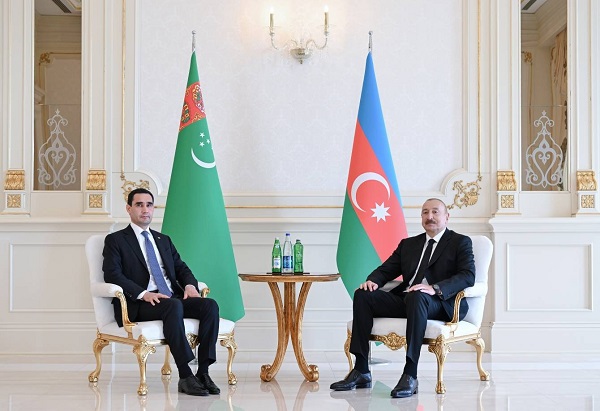
High-Level Political Dialogue
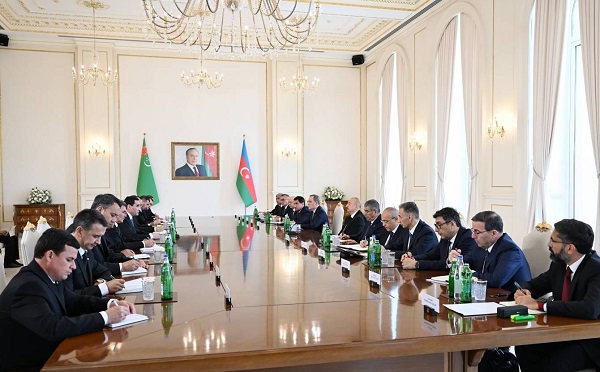
Following an official welcoming ceremony in Baku, Presidents Berdimuhamedov and Aliyev held one-on-one and expanded-format talks covering political relations, trade, transport, energy, customs cooperation, humanitarian ties and regional developments.
The two leaders signed a Joint Statement that reaffirmed the friendly and brotherly nature of bilateral relations and expressed their commitment to expanding cooperation across multiple sectors.
President Berdimuhamedov also paid tribute to Azerbaijan’s National Leader Heydar Aliyev and visited Victory Park, gestures that Azerbaijani media described as reflecting the special character of relations between the two countries.
Broad Package of Agreements
While initial reports focused on a limited number of memoranda, subsequent Azerbaijani coverage revealed that the visit produced a considerably broader package of agreements and cooperation documents.
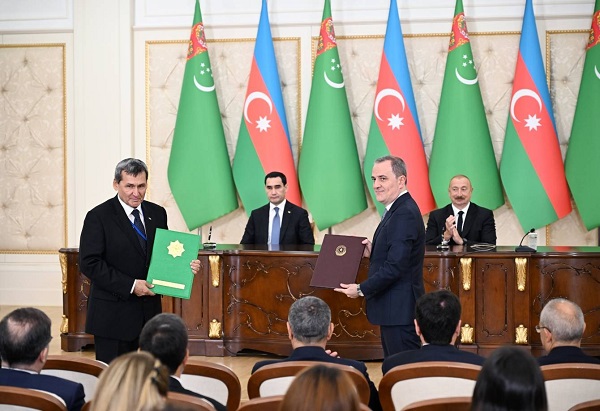
The signed documents covered:
- Customs information exchange and customs statistics;
- Foreign ministry cooperation for 2026-2029;
- Economic and trade cooperation;
- Industrial cooperation for 2026-2028;
- Energy cooperation;
- Agricultural cooperation;
- Cooperation between central banking and financial institutions;
- Food safety;
- Healthcare;
- Labor and social protection;
- Sports and youth affairs.
The diversity of the agreements demonstrates that Turkmenistan and Azerbaijan are moving beyond sector-specific engagement toward a more institutionalized strategic partnership encompassing both economic and social spheres.
Dostlug Tanker: Symbol of a New Era
The most visible outcome of the visit was the presentation of the newly built oil tanker Dostlug (“Friendship”) to Turkmenistan.
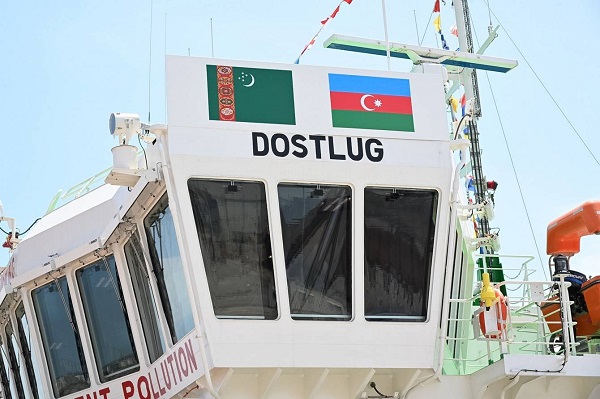
The ceremony was conducted online with the participation of both presidents and attracted considerable attention in Azerbaijani media.
Constructed at the Baku Shipyard, the vessel represents a practical contribution to the modernization of Turkmenistan’s maritime fleet while simultaneously showcasing Azerbaijan’s growing shipbuilding capabilities.
The name Dostlug carries particular significance.
It is the same name as the offshore hydrocarbon structure jointly developed by Azerbaijan and Turkmenistan in the Caspian Sea. The field became a symbol of reconciliation and cooperation after years during which differing interpretations of maritime boundaries had complicated development of certain Caspian resources.
Today, the word “Dostlug” has become a powerful symbol of the transformation of Azerbaijani-Turkmen relations from coexistence to active strategic cooperation.
Caspian Maritime Cooperation Expands
The arrival of a Turkmen vessel in Azerbaijan during the visit further highlighted the growing maritime interaction between the two countries.
Azerbaijani observers noted that shipping cooperation is becoming one of the key pillars of bilateral relations. The ports of Turkmenbashi and Baku are increasingly important components of trans-Caspian freight routes linking Central Asia with the South Caucasus, Türkiye and Europe.
The expansion of maritime cooperation is expected to contribute directly to increasing cargo flows across the Caspian Sea and improving the efficiency of regional logistics chains.
The Middle Corridor Dimension
A major theme in Azerbaijani analysis of the visit has been the strategic significance of the Middle Corridor, also known as the Trans-Caspian International Transport Route.
Both Azerbaijan and Turkmenistan occupy pivotal positions on this route, which connects China and Central Asia with European markets through the Caspian Sea, the South Caucasus and Türkiye.
The agreements signed during the visit, particularly those related to customs modernization, trade facilitation and transport cooperation, are expected to strengthen the competitiveness of this corridor.
As global trade patterns continue to evolve, the two countries increasingly view themselves as key partners in the development of an alternative Eurasian transport architecture.
Energy Cooperation Remains Central
Although no major new energy agreement was announced during the visit, Azerbaijani media emphasized that energy remains one of the strongest foundations of bilateral relations.
Particular attention was given to the jointly developed Dostlug field in the Caspian Sea, which is widely regarded as a model of successful cooperation between the two countries.
Analysts in Azerbaijan have also linked the strengthening relationship to broader discussions about future trans-Caspian energy connectivity and the possibility of expanding routes through which Turkmen energy resources could reach international markets.
In this context, the visit reinforced the perception that Turkmenistan and Azerbaijan are becoming increasingly important partners in the evolving energy geography of the Caspian region.
From Good Neighbors to Strategic Partners
The significance of the visit extends beyond the documents signed in Baku.
Over recent years, contacts between the two countries have intensified steadily through presidential meetings, parliamentary exchanges, ministerial consultations, transport initiatives, cultural programs and economic cooperation projects.
The state visit demonstrated that both governments are now seeking to institutionalize this momentum and transform it into a long-term strategic partnership.
The combination of political trust, expanding trade, growing maritime cooperation, customs integration and shared interest in regional connectivity has created a strong foundation for future collaboration.
Looking Ahead
The outcomes of President Serdar Berdimuhamedov’s state visit indicate that Turkmenistan and Azerbaijan are entering a new phase of relations characterized by practical integration rather than symbolic cooperation alone.
The Joint Statement, the extensive package of agreements, the transfer of the Dostlug tanker, and the emphasis on transport and maritime connectivity collectively point toward a partnership that is becoming increasingly consequential for the wider Caspian and Eurasian regions.
For both countries, the visit marks not merely another diplomatic exchange but a strategic investment in a more interconnected Caspian space and a stronger role in the emerging architecture of Eurasian trade, transport and energy cooperation. /// nCa, 23 June 2026