


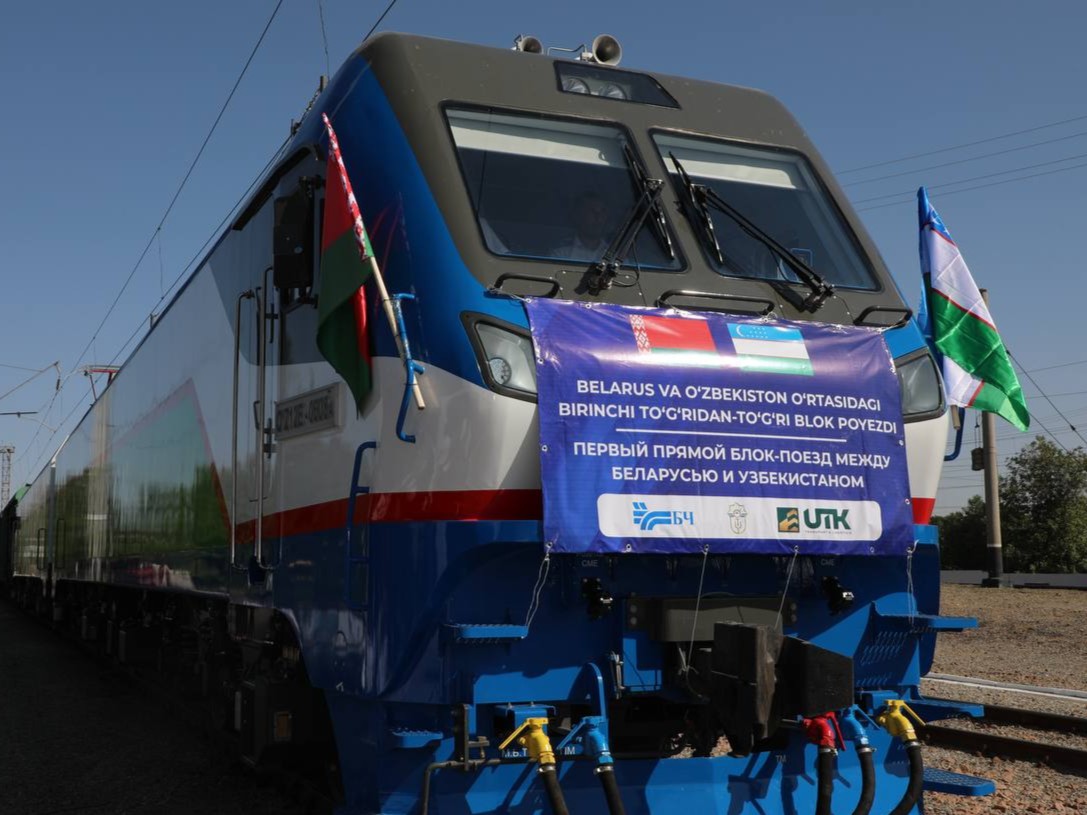
A new block train service linking Belarus with Central Asia is demonstrating how dedicated rail operations can significantly reduce transit times while lowering logistics costs for regional exporters.
On 5 August 2026, the first Slavic Caravan freight train arrived at Chukursay station in Tashkent after completing the more than 4,000-kilometre journey from Belarus in less than six days. The train crossed Russia and Kazakhstan before reaching Uzbekistan, carrying 3,800 tonnes of Belarusian exports, including timber products, chemicals and food cargo.
While the inaugural train was making its way across the vast Kazakh steppe, a second block train departed from Orsha-Vostochnaya station in Belarus, signalling that the project is moving rapidly from a pilot initiative to a regular transport service.
Operated by Belarusian Railways in cooperation with the railway administrations of Russia, Kazakhstan and Uzbekistan, the second train is transporting more than 4,000 tonnes of Belarusian exports from multiple regions of the country. Its cargo includes processed timber products and higher-value food commodities.
The second departure also marks an expansion of the corridor’s geographical reach. While Uzbekistan remains the primary destination, part of the cargo will continue by rail to Kyrgyzstan and Tajikistan, extending the corridor from Eastern Europe to four Central Asian markets.
The development reflects growing demand for direct rail services between Belarus and Central Asia as trade volumes continue to increase.
The most significant improvement delivered by the new service is transit time.
Conventional wagonload shipments on the same corridor can require up to two months because of marshalling operations, border procedures and fragmented train movements. The Slavic Caravan, by contrast, reaches Uzbekistan in less than a week.
This performance is made possible by operating as a dedicated block train. The consist moves as a single unit throughout the journey without intermediate sorting or re-marshalling, reducing operational delays at major rail hubs. Customs procedures are also simplified across Belarus, Russia and Kazakhstan through the common framework of the Eurasian Economic Union (EAEU), further improving border-crossing efficiency.
Besides faster delivery, rail offers a clear economic advantage. Transporting a standard 20-foot container by rail costs at least one and a half times less than road freight. For exporters moving large production volumes over long distances, these savings can substantially improve competitiveness.
The service is designed to accommodate exporters from a broad range of industries, including woodworking, chemicals, food processing, construction materials and machinery manufacturing.
Backhaul operations are equally important for maintaining commercial viability. Return trains are expected to carry textiles, processed food and fresh fruit from Central Asia, although seasonal harvests and refrigerated logistics capacity will influence traffic volumes for perishable cargo.
Infrastructure alone does not generate freight demand. Sustainable rail services require growing trade flows capable of filling trains in both directions.
Current trade statistics suggest that this condition is increasingly being met.
Belarus–Uzbekistan trade reached approximately US$855 million in 2025, with both governments targeting US$2 billion by 2030.
Trade with Tajikistan climbed to a record US$222.8 million, making Belarus one of the country’s ten largest trading partners.
Meanwhile, Belarus and Kyrgyzstan recorded bilateral trade worth US$206.5 million in 2025 and have adopted a roadmap aimed at increasing annual trade to US$500 million by the end of the decade.
Commercial infrastructure is expanding alongside these figures. Belarus already operates a trading house in Bishkek and plans to open three more retail outlets, while Uzbekistan inaugurated its own trade house in Minsk in July.
These platforms will require reliable freight capacity. Logistics costs typically account for between 10% and 40% of a product’s final retail price, meaning that more efficient transport can directly improve price competitiveness.
Industrial cooperation is also creating regular freight flows. One example is the supply of radiators from Kyrgyzstan to Belarus for installation in tractors, combine harvesters and heavy trucks manufactured by Belarusian producers.
The launch of the Slavic Caravan illustrates a broader shift in Eurasian rail logistics. Rather than relying on fragmented wagonload traffic, operators are increasingly deploying scheduled block trains to provide predictable transit times, lower operating costs and greater supply chain reliability.
As trade between Belarus and Central Asia expands, the corridor is well positioned to become a regular freight artery connecting Eastern Europe with Kazakhstan, Uzbekistan, Kyrgyzstan and Tajikistan.
In an environment where manufacturers increasingly evaluate logistics providers on speed, reliability and cost efficiency, services such as the Slavic Caravan are likely to become an important component of regional supply chains rather than a niche transport solution. ///nCa, 7 August 2026