


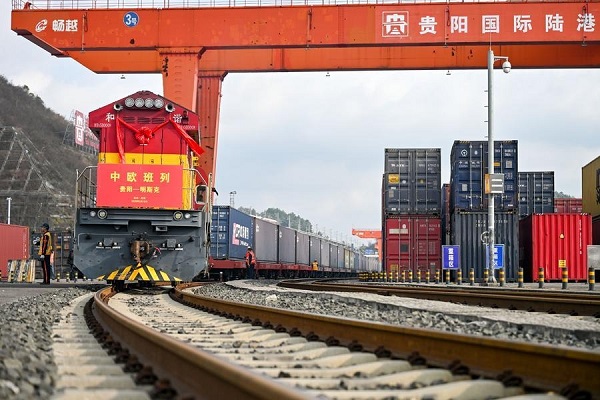
Freight train traffic through Alashankou, also known as Alataw Pass, a key rail gateway in northwest China’s Xinjiang Uygur Autonomous Region, has surpassed 3,000 trips so far this year, reaching the milestone 19 days earlier than in 2025. This reflects steadily rising demand for reliable overland trade routes to Europe and Central Asia, reports Xinhua.
A China-Europe freight train loaded with machinery, auto parts, and electronic products departed Alataw Pass Station at 4 p.m. on Thursday bound for Malaszewicze in Poland. This service pushed the cumulative total of China-Europe (Central Asia) freight trains handled at the port beyond the 3,000 mark, according to China Railway Urumqi Group Co., Ltd.
The accelerated pace highlights the expanding role of Xinjiang’s rail ports in China’s westbound logistics network. Exporters are increasingly turning to these overland corridors to deliver manufactured goods to markets across Central Asia and Europe.
Since the beginning of the year, Alataw Pass has handled an average of more than 20 China-Europe (Central Asia) freight trains per day, with peaks reaching 35 trains daily. The port has also seen ongoing improvements in handling capacity and operational efficiency.
China’s latest national railway operating plan, rolled out in the second quarter, introduced new Central Asia-bound services originating from Beijing, Tianjin, and Zhangjiakou in Hebei Province that transit through Alataw Pass. This expands the network of routes utilizing the border port.
Customs authorities have implemented measures to shorten cargo dwell times, including faster clearance procedures for inbound grain under conditional release arrangements and additional night-shift inspections based on demand from companies. These steps have lowered storage costs and improved goods flow while maintaining necessary quarantine oversight, according to an official with Alataw Pass Customs.
Alataw Pass currently supports 128 China-Europe (Central Asia) freight train routes, linking China to 21 countries, including Germany and Poland. More than 200 types of goods — ranging from auto parts and electronics to daily necessities — pass through the port.
Growing strategic importance of Central Asia
Central Asia’s role in China’s overland trade is becoming increasingly vital. The region serves not only as a key transit corridor for goods heading to Europe but also as a growing market in its own right and a critical partner for energy, resources, and infrastructure cooperation under the Belt and Road Initiative.
Robust growth in rail services underscores how stable, efficient connections to Central Asia help diversify trade routes away from maritime chokepoints, enhance supply chain resilience, and support deeper economic integration across Eurasia.
As both trade volumes and infrastructure mature, Alataw Pass and similar western gateways are poised to play an even more prominent role in China’s connectivity with this strategically important region. /// nCa, 11 May 2026