


Elvira Kadyrova and Tamir Shakirov
One of the best ways to understand a country is to ask a deceptively simple question:
How easily can an ordinary person get from one place to another?
Mobility is often discussed in terms of highways, railways and airports.
But for ordinary people, mobility is much more personal.
It is the journey to work.
The trip to the market.
The taxi to a restaurant.
The bus to school.
The family journey to another city.
The ability to own and maintain a car.
The ability to travel beyond one’s immediate neighbourhood.
In the early 1990s, Turkmenistan inherited a transport system designed largely around Soviet-era patterns of movement. Private vehicle ownership was much less widespread, the range of vehicles available was narrower and the modern automotive service ecosystem that consumers know today was only beginning to emerge.
Three and a half decades later, the experience is different.
Modern cars of many types share the roads with buses and taxis. Modernized highways connect cities and regions. New bus fleets have appeared. The taxi has become an ordinary component of urban mobility with several taxi services for urban and inter-city travel.
And perhaps most visibly, the car has become part of everyday consumer choice.
Hyundai operates a service and maintenance centre in Turkmenistan.
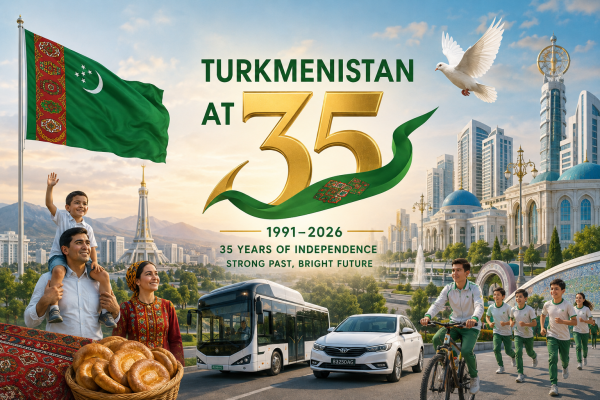
The country’s bus fleet has also been modernized, particularly in Ashgabat. The city’s characteristic white buses have become part of the capital’s everyday visual landscape. Predominant are Hyundai and Yutong buses.
But infrastructure is perhaps the more important part of the story.
The 600-kilometre Ashgabat–Turkmenabat highway, completed in stages, has substantially modernised road travel between the capital and the eastern region of the country. Other major road projects have improved connections between regional centres.
The significance of such projects is not simply that a road becomes wider or smoother.
It is that distance becomes easier to overcome.
And this is where mobility intersects with quality of life.
A road is ultimately useful because somebody uses it.
A family can travel.
Goods can reach shops.
A worker can commute.
A business can operate across regions.
A person can visit relatives.
A tourist can move more easily between destinations.
Even the availability of vehicle servicing and spare parts matters. A modern automotive market requires mechanics, service centres, tire suppliers, parts dealers, washing facilities and other supporting businesses.
Mobility therefore creates its own ecosystem.
There is another development worth noticing: the growing presence of environmentally cleaner vehicles.
Turkmenistan has increasingly promoted electric and hybrid vehicles, particularly in Arkadag City, where electric taxis and other electric vehicles have become more visible.
That is interesting because it shows that the country’s mobility story is not simply about catching up with the automobile culture of the past.
It is beginning to engage with the automobile culture of the future.
But perhaps the simplest measure is the experience of a young person.
A young Turkmen today grows up in a country where travelling from Ashgabat to another region by modern road is normal; where taxis can be summoned or hired; where modern buses are part of urban life; where cars come in different types and where vehicle ownership is a normal aspiration.
That was not the experience of the early independence years.
And yet we rarely think of mobility as a quality-of-life indicator.
We should.
Because mobility is ultimately about freedom of movement.
The shorter the psychological and practical distance between home, work, school, shopping, relatives and leisure, the larger the world becomes.
Thirty-five years ago, distance was more often an obstacle.
Today, for many people, it is simply a journey.
And that is another quiet measure of how everyday life has changed. /// nCa, 21 September 2026