


nCa Context
In foreign policy summits and corporate boardrooms alike, conversations surrounding the clean energy transition frequently focus on headline metrics: megawatt-hours, carbon taxes, subsidy structures, and supply chain resilience.
Yet behind nearly every trade-off in transport logistics, defense readiness, manufacturing efficiency, and infrastructure investments lies a single physical parameter: energy density.
For non-energy executives and diplomatic officers, understanding energy density does not require an advanced degree in chemical engineering. Rather, it requires viewing it as a core currency of operational mobility and space constraints.
Understanding this metric illuminates why replacing fossil fuels is complex, where technological breakthroughs will alter trade routes, and why certain industrial sectors face stubborn decarbonization bottlenecks.
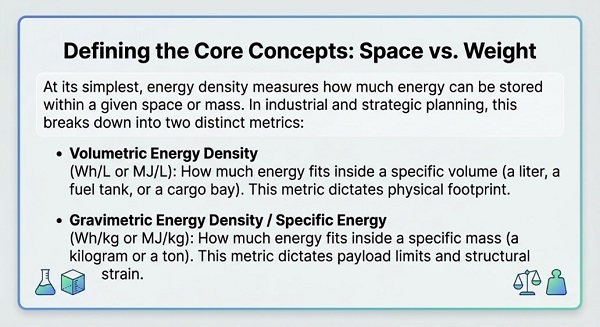
Defining the Core Concepts: Space vs. Weight
| Energy Source | Gravimetric Density (Wh/kg) | Primary Constraint Solved | Strategic Realities |
| Uranium-235 (Fission) | ~24,000,000,000 | Mass & Volume | Massive output; requires heavy safety containment & strict governance. |
| Diesel / Jet Fuel | ~12,000 – 12,700 | Mass & Volume | Global benchmark; enables high-payload long-haul transport. |
| Compressed Hydrogen | ~33,000 (Mass) / Low (Volume) | Mass (Poor Volume) | Extremely light per kg, but bulky; requires heavy high-pressure tanks. |
| Advanced Li-ion Battery | ~200 – 350 | Local Emissions | Highly efficient; heavy and bulky compared to liquid fuels. |
To contextualize these numbers: a standard jet airliner running on conventional kerosene carries fuel with an energy density roughly 35 to 40 times higher by weight than today’s best commercial lithium-ion batteries.
The Bottleneck Effect: Why “Green” Isn’t Just an On/Off Switch
The stark contrast in energy density explains why the energy transition moves at different speeds across different economic sectors.
The Mass Paradox in Aviation and Maritime Shipping
In passenger cars, a lower gravimetric energy density is manageable: adding weight increases road friction and battery footprint, but the vehicle still functions effectively for standard distances.
In long-haul aviation or ocean freight, however, energy density becomes an absolute operational ceiling. A commercial aircraft powered entirely by current lithium-ion battery technology would be too heavy to take off with any passengers or cargo. Because every additional kilogram of battery requires more energy just to lift itself, the physics of gravimetric density currently limits electric flight to short-haul regional aircraft or small drones.
Grid Storage vs. Mobile Storage
Energy density also dictates industrial infrastructure priorities:
- For stationary grid storage (e.g., backing up a solar farm), volumetric and gravimetric energy density are low priorities. Land footprint is rarely an absolute constraint, meaning lower-density, lower-cost chemistries like Lithium Iron Phosphate ($\text{LFP}$) or flow batteries are ideal.
- For mobile applications (e.g., defense vehicles, heavy machinery, aviation), maximum density per unit of mass and volume is paramount.
Policy and Strategic Implications for Diplomats and Business Leaders
For decision-makers navigating cross-border trade, regional stability, and supply chain investments, energy density shapes macro-level strategy in three critical ways:
- Explaining the Persistence of Hydrocarbons: Diplomats negotiating international climate agreements must recognize that reliance on liquid fossil fuels is rarely driven by stubbornness alone; it is often driven by payload physics. Identifying alternative fuels with comparable energy density—such as Sustainable Aviation Fuels ($\text{SAF}$), synthetic e-fuels, or green ammonia—is essential for decarbonizing heavy transport.
- Evaluating Technological Claims: When evaluating investments or industrial policy claims regarding “breakthrough” battery chemistries, diplomats and executives should ask: Is the gain in volumetric density, gravimetric density, or both? A battery that doubles volumetric density without reducing weight helps smartphone design, but it will not revolutionize transoceanic shipping.
- Critical Mineral Geopolitics: Pushing the limits of energy density requires precise materials science. Higher density in batteries typically requires scarce or geopolitically concentrated elements like nickel, cobalt, and high-purity lithium. Tracking energy density trends helps anticipate which raw material supply chains will become foreign policy flashpoints over the coming decades.
Strategic Summary
Energy density is the fundamental metric governing how humanity packages, moves, and consumes power. For leaders outside the energy sector, evaluating projects through the dual lenses of weight (gravimetric) and space (volumetric) provides an instant clarity filter. It separates realistic industrial transitions from speculative timelines, guiding sound policy and long-term capital allocation. /// nCa, 6 November 2026