


Liliya Zhirnova
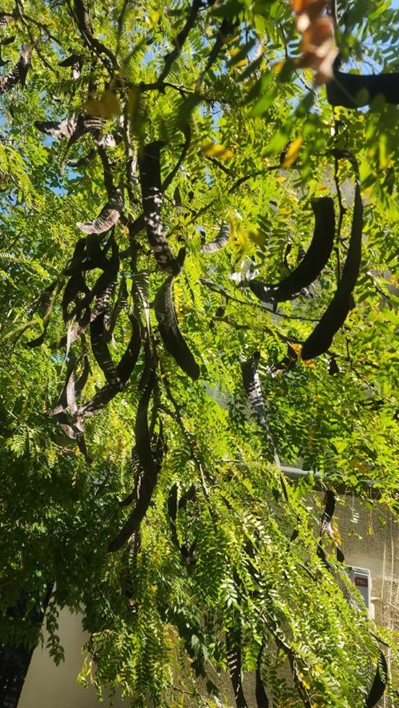
To the casual pedestrian strolling along the green avenues and parks of Ashgabat, the Honey Locust (Gleditsia triacanthos) is often recognized simply by its characteristic foliage and long, dark seed pods hanging high in the canopy.
Providing a distinct “dappled” shade—allowing soft sunlight to filter through rather than casting a dense block of darkness—it is easy to mistake this urban staple as merely decorative.
However, beneath its light canopy and distinctive dark legumes lies a remarkably hardy, multi-purpose species with deep ecological value, rich nutritional potential, and strong agricultural utility.
A Familiar Silhouette Across Regions
The tree shares a strong visual family resemblance with South Asia’s prominent Siris or Srinh tree (Albizia lebbeck), widely known throughout the Punjab region. Both belong to the legume family (Fabaceae) and feature delicate, bipinnate (fern-like) leaves.
Yet while the Punjabi Srinh produces light, papery, straw-colored pods that rattle loudly in the warm winds, the Honey Locust of Central Asia drops thick, dark brown to blackish pods that curve and twist as they mature. This resilience to extreme temperature fluctuations—from scorching summer heat to freezing winter drafts—makes the Honey Locust uniquely suited for urban greening across continental zones.
Pods, Sugar, and Forage: Nature’s Energy Packets
Despite its modest appearance, every component of the Honey Locust serves a functional purpose:
Natural Sweetener and Culinary Uses
The name “Honey Locust” is not symbolic—it refers directly to the sticky, sweet pulp surrounding the seeds inside fresh pods.
- High Sugar Content: Freshly ripened pulp can contain 20% to 30% natural sugars, yielding a sweet, slightly tangy flavor. Historically, indigenous populations and frontier settlers harvested the raw pulp or boiled it down into syrups and traditional sweeteners.
- Coffee Substitute & Protein: The hard seeds nestled inside the pods contain substantial protein (ranging from 10% to 24%). When dried and roasted, these seeds have long been ground as a rich, caffeine-free coffee alternative.
High-Calorie Animal Feed (Silvopasture Systems)
As autumn turns to winter, the tree naturally drops its calorie-dense pods continuously over several months.
- Winter Livestock Fodder: In agricultural and agroforestry systems, these fallen pods serve as essential forage for cattle, sheep, and goats during months when grazing grass is scarce.
- Dual-Benefit Canopy: Because the leaves let sunlight reach the ground, pasture grass thrives directly beneath the canopy. Farmers frequently plant Honey Locusts in grazing zones to combine natural livestock shade with seasonal fodder.
Environmental Anchor and Durable Timber
Beyond its yield, the tree plays a vital structural role in land management and forestry:
- Deep Soil Stabilization: The tree develops a robust taproot network. This deep structure anchors sandy or loose soils against wind erosion without competing aggressively with shallow surface vegetation for upper-soil moisture.
- Urban & Rural Windbreaks: Exceptionally tolerant of highly alkaline soils, drought, and heavy urban microclimates, it serves as a reliable green belt tree for arid cities and shelterbelts.
- Rot-Resistant Wood: The timber produced by the Honey Locust is exceptionally dense, strong, and resistant to decay—even when set directly into damp soil. For generations, it has been a prized material for fence posts, railway ties, tool handles, and heavy construction.
Pharmacological & Bioactive Value
In traditional ethnobotanical practices, extracts prepared from the bark, pods, and roots were utilized in natural remedies for digestive issues and respiratory ailments. Modern laboratory research has further validated this interest, identifying active compounds (such as specific galactomannans and antioxidant flavonoids) in Gleditsia species that exhibit notable anti-inflammatory and cellular protective properties.
Summary Overview
| Feature | Characteristics & Applications |
| Botanical Name | Gleditsia triacanthos (Fabaceae family) |
| Key Visual Identifiers | Long, dark, twisted seed pods; fine, fern-like compound foliage |
| Nutritional Uses | Pod pulp (20–30% sugar); roasted seeds as protein-rich coffee alternative |
| Agricultural Value | Ideal for silvopasture; high-calorie livestock fodder dropping through autumn/winter |
| Ecological Role | Deep-root soil stabilization, drought resilience, and municipal windbreaks |
| Wood Properties | Heavy, shock-resistant, and highly rot-resistant timber |
The Honey Locust is far more than an ordinary street tree casting a light shadow. It represents a tough, resource-rich species that continues to quietly support urban ecosystems, agricultural landscapes, and green belts across the region. /// nCa, 6 November 2026