


Tariq Saeedi
There is a growing tendency today to speak about trade corridors as instruments of strategy, influence, and competition. Maps are drawn with arrows pointing around rivals, past adversaries, and away from inconvenient neighbors. Connectivity is increasingly discussed in the language of exclusion.
History offers a different lesson.
What we now call the “Great Silk Road” was one of the most successful systems of connectivity in human history precisely because it was open, decentralized, and available to all who wished to participate. It was not conceived as a geopolitical project. It had no founding charter, no single architect, and no rigid institutional structure. In fact, the people using these routes across antiquity and the Middle Ages had no idea they were travelling on something later generations would romanticize as the “Silk Road.”
The name itself came much later. It was coined only in 1877 by the German geographer Ferdinand von Richthofen, who used the term Die Seidenstrasse to describe the flourishing trade in Chinese silk between East Asia and Europe. By then, the routes had already existed for centuries.
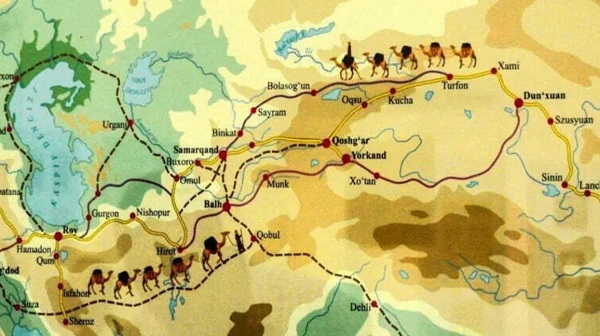
For the merchants, nomads, pilgrims, and travelers of their own time, this was not a single grand highway stretching from China to Europe. It was a vast and constantly shifting web of local paths, caravan trails, mountain crossings, desert passages, river links, and maritime routes.
Trade happened step by step, city by city, oasis by oasis.
Yet together these fragmented routes formed something extraordinary: a living continental network that connected civilizations without requiring uniformity among them.
A caravan from Venice could trade in Central Asia. Arab merchants could buy silk and paper originating in China. Indian traders sold spices, dyes, and textiles across the region. Turkic nomads exchanged horses and livestock for manufactured goods. Persian cities became intellectual and commercial crossroads. Scholars, monks, craftsmen, and travelers moved alongside merchants. Religions, languages, sciences, and artistic traditions travelled with them.
No one asked whether the participants belonged to the “right” bloc or sphere of influence. No empire attempted to define the routes exclusively in ideological terms. The system worked because participation itself created mutual benefit.
Profit certainly mattered.
Trade has always followed incentives. But the deeper strength of the Silk Road lay in its inclusiveness. Every society connected to it found some reason to sustain it.
This is the lesson modern corridor projects may need to revisit.
Today, many connectivity initiatives are framed less as bridges and more as strategic counters — alternatives to one country, bypasses around another, or mechanisms for reducing dependence on someone else. Such thinking may produce temporary alignments, but it rarely creates durable networks of shared interest.
The historical Silk Road functioned differently. It was resilient because it was not linear, centralized, or exclusive. When one route became unstable, trade shifted elsewhere. When empires weakened, commerce adapted through alternate paths. The system survived because it possessed flexibility and redundancy rather than rigid control.
Modern planners often prefer clean lines on maps. History, however, suggests that enduring connectivity resembles an ecosystem more than an engineered pipeline.
This distinction matters.
A corridor designed only for transit remains a logistical project.
A corridor that allows broad participation can evolve into an economic and civilizational space.
The old Silk Road also reminds us that connectivity is never merely about moving goods. Along those routes travelled mathematics, astronomy, medicine, architecture, cuisine, music, religious thought, and technologies such as paper-making. Ideas moved as naturally as commodities.
Today’s infrastructure discussions understandably focus on ports, railways, customs procedures, and energy flows. These are essential. But history suggests that trade routes become transformative only when they also encourage human interaction, cultural exchange, tourism, education, and intellectual openness.
The enduring appeal of the Silk Road lies not in nostalgia, but in the model it represents. It was not perfect, peaceful, or politically unified. Yet it demonstrated that connectivity becomes most powerful when multiple civilizations see themselves reflected within it.
That may be the central lesson for the corridors now criss-crossing Eurasia and beyond.
The Great Silk Road was never truly great because it connected East and West. — It became great because it connected everyone willing to participate. /// nCa, 8 May 2026