


A Six-Country Platform and the Emerging Architecture of a Connected Eurasia
Tariq Saeedi and Raviliya Kadyrova
AVAZA, Turkmenistan — The Consultative Meeting of the Heads of State of Central Asia and Azerbaijan held in Avaza on 8 October 2026 may eventually be remembered less for the individual declarations made at the meeting than for what the expanded format makes possible.
Formally, this was the Eighth Consultative Meeting of the heads of state. Politically and structurally, however, it was the first full-fledged meeting of the expanded six-country format, following the decision taken in Tashkent in November 2025 to admit Azerbaijan as a full participant.
That distinction matters.
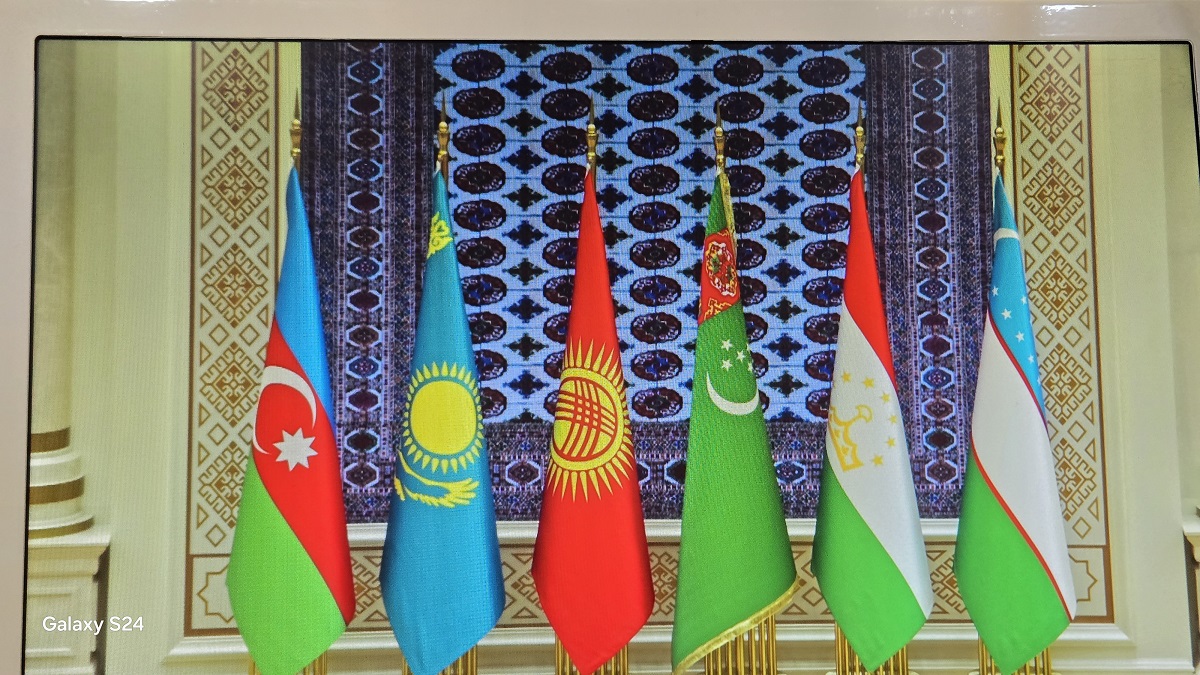
For the first time, the five Central Asian states — Kazakhstan, Kyrgyzstan, Tajikistan, Turkmenistan and Uzbekistan — and Azerbaijan met in a fully established consultative framework that brings together the heart of Central Asia, the Caspian Sea and the South Caucasus. The significance of the arrangement is therefore greater than the addition of one more participant to an existing regional meeting.
It creates a wider geographical and economic space in which decisions taken in one part of the region can increasingly be connected with opportunities and requirements in another.
The meeting in Avaza, hosted and moderated by President of Turkmenistan Serdar Berdimuhamedov, therefore deserves to be viewed not simply as another item on the regional diplomatic calendar, but as a step in the gradual construction of a more closely connected Eurasian space.
From regional consultation to practical connectivity
The Central Asian consultative process has already demonstrated its usefulness as a mechanism for political dialogue. The official Turkmen account of the Avaza meeting noted that the format had proved to be a viable, useful and effective platform for interaction, enabling the participating states to respond more quickly to regional developments while taking the interests of their partners into account.
The inclusion of Azerbaijan gives that mechanism a new practical dimension.
Azerbaijan brings the western shore of the Caspian into the same political conversation as the Central Asian states on its eastern side. This does not eliminate national interests or differences among the six countries. Nor does it create a supranational organization. The value lies elsewhere: it creates a regular political space in which issues that previously had to be coordinated through several separate channels can increasingly be discussed together.
Transport is perhaps the clearest example.
Central Asia’s economies need efficient access to external markets. Azerbaijan needs reliable cargo flows across the Caspian and onward connections to Central Asia. Turkmenistan has its own ports, transport infrastructure and transit ambitions. Kazakhstan and Uzbekistan are developing their own east-west and north-south routes, while Kyrgyzstan and Tajikistan bring their own geographical and economic requirements to the regional equation.
When these interests are considered together, a transport corridor ceases to be simply a line on a map. It becomes an interconnected system of railways, ports, highways, logistics centres, customs procedures, digital systems, warehouses, energy supplies, investment and industrial production.
The same logic applies to energy.
Central Asia possesses substantial energy resources and considerable potential for renewable generation. Azerbaijan has developed infrastructure connecting the Caspian region with markets farther west. Cooperation in conventional energy, electricity, renewables and transmission can therefore be considered within a broader regional framework rather than as a collection of unrelated bilateral projects.
President Ilham Aliyev’s address at Avaza illustrated this wider perspective. He pointed to growing trade and investment between Azerbaijan and Central Asian states, joint investment funds with Kazakhstan, Uzbekistan and Kyrgyzstan, increasing cargo traffic along the Middle Corridor, the Digital Silk Way project and cooperation in energy and renewable energy. He argued that the countries should seek opportunities to invest together, produce together and reach foreign markets together.
The Eurasian significance
The importance of this emerging six-country space extends beyond the immediate region.
Viewed geographically, Central Asia and Azerbaijan occupy a position between some of the world’s major economic centres. To the east lies China; to the west lie the Caucasus, Türkiye and Europe; to the north is Russia; and to the south lie Iran, Afghanistan, Pakistan and the wider South Asian region.
This does not mean that the six states can, by themselves, redesign the Eurasian transport or economic system. Such a conclusion would be premature.
What they can do is make the space between these larger economic centres more coherent.
That distinction is important.
A functioning regional network does not necessarily require every country to participate in every project. It requires enough compatibility between national systems for goods, energy, information, investment and people to move more efficiently across borders.
In that sense, the Central Asia–Azerbaijan format can become an accelerator.
If customs procedures become more compatible, transit times can fall. If railway systems and ports are better coordinated, cargo can move more predictably. If digital systems are interoperable, logistics can become more transparent. If energy infrastructure is connected, markets can become more flexible. If investment mechanisms are coordinated, projects that are too large or complex for one country can become possible through partnership.
And if political dialogue remains sufficiently strong, disagreements can be addressed before they become obstacles to economic cooperation.
The potential benefit could ultimately reach far beyond the six countries themselves — from European markets to China and from Russia to South Asia.
This is why the geographical importance of the Avaza format should not be reduced to the frequently used description of the countries as a “bridge” between East and West. A bridge is passive infrastructure. What is emerging here has the potential to become a more active network of networks, in which the countries themselves increasingly participate in the movement, processing, financing and production of goods and energy.
Four interconnected pillars
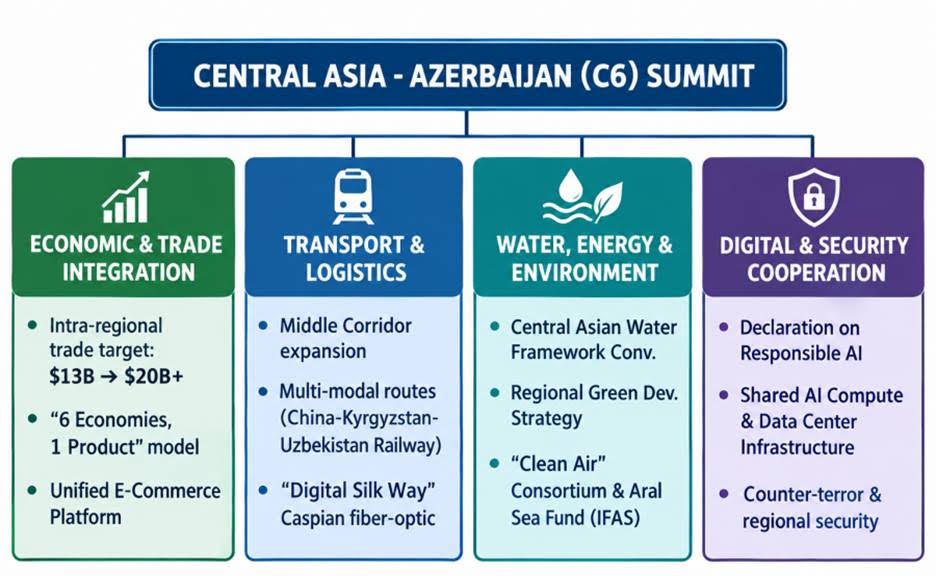
The emerging architecture can be viewed through four broad and mutually dependent pillars: economic and trade integration; transport and logistics; water, energy and the environment; and digital and security cooperation.
These pillars should not be treated as four separate agendas.
Trade depends upon transport. Transport depends upon energy and infrastructure. Agriculture and industrial development depend upon water. Digital systems increasingly determine how transport, customs, finance and energy networks operate. Security and political stability underpin all of them.
The accompanying visualization prepared for this report illustrates this interconnected character.
The practical challenge now is to move from broad convergence to implementation.
That process will necessarily be uneven. Some projects will advance faster than others. National priorities will remain important, and not every proposal will be equally attractive to every participant. Infrastructure projects also require financing, technical feasibility, regulatory compatibility and, above all, sustained political commitment.
But the existence of a regular six-country political mechanism can reduce one of the chronic problems of regional development: the fragmentation of otherwise complementary initiatives.
A platform rather than a bloc
There is another feature of the Avaza meeting that deserves emphasis.
The emerging Central Asia–Azerbaijan format does not need to become a closed political bloc in order to become useful. Its strength may instead lie in remaining open, pragmatic and project-oriented.
The countries can cooperate where their interests converge while maintaining their individual foreign-policy choices and relationships with other partners.
This is particularly relevant in Eurasia, where virtually every major infrastructure, energy or trade project intersects with several different geographical and political spaces.
A regional framework that seeks coordination rather than exclusivity may therefore prove more sustainable.
The Avaza meeting also demonstrated the breadth of the agenda. Political and diplomatic cooperation was accompanied by discussion of trade and economic relations, energy, transport and logistics, environmental issues, water resources and humanitarian cooperation. These areas had already been incorporated into the draft agenda prepared by Turkmenistan before the summit.
The result is a framework in which infrastructure and diplomacy increasingly reinforce one another.
From declarations to an operating mechanism
The most important test of the expanded format will now begin after the summit.
The leaders have signed a Joint Statement of the Eighth Consultative Meeting and a Decision on the Regulatory Documents of the Consultative Meeting. The six presidents — Ilham Aliyev, Kassym-Jomart Tokayev, Sadyr Zhaparov, Emomali Rahmon, Serdar Berdimuhamedov and Shavkat Mirziyoyev — participated in the signing ceremony in Awaza.
These documents are important because they provide both a political statement of common direction and a formal framework for the functioning of the consultative mechanism.
A detailed list of the documents adopted or signed at the conclusion of the summit will be provided near the end of this report series, after the texts and their implications have been examined.
That sequencing is deliberate. The purpose of this opening part is to establish the larger picture before examining individual speeches, decisions and sectoral initiatives.
The speeches as an accompanying record
nCa has already published a separate synthesis of the speeches delivered at the summit. That analysis should be regarded as an accompanying part of this report, rather than repeated here.
The speech synthesis provides a comparative view of the positions expressed by the participating leaders and helps identify areas of convergence, distinctive national priorities and the direction in which the expanded format may develop.
Read nCa’s synthesis of the summit speeches
The present series will approach the summit differently. It will examine the meeting as a developing regional process: its political significance, its economic and connectivity implications, the individual contributions of the participating states, the practical initiatives and documents emerging from the meeting, and finally the opening and closing interventions of the host.
President Serdar Berdimuhamedov’s role is particularly important in that respect. As host and moderator, he opened the summit and delivered the closing remarks. Those interventions will be examined separately in the later parts of the series, after the positions of the other participating leaders and the principal outcomes have been considered.
Only then will it be possible to return to the host’s overall message and assess what the Avaza meeting, taken as a whole, may mean for the next stage of regional cooperation.
The ultimate question is therefore not simply whether the six countries have expressed a common vision.
It is whether they can increasingly act as a coordinated regional space while remaining six sovereign states.
If they can, the significance of the Avaza format will extend well beyond the Caspian coast. It could help make Central Asia and Azerbaijan not merely a geographical intersection between larger markets, but an increasingly functional part of the Eurasian economic and connectivity system — one capable of linking interests from Europe to China and from Russia to South Asia.
That is the larger context in which the decisions taken at Avaza should now be examined. /// nCa, 8 October 2026