


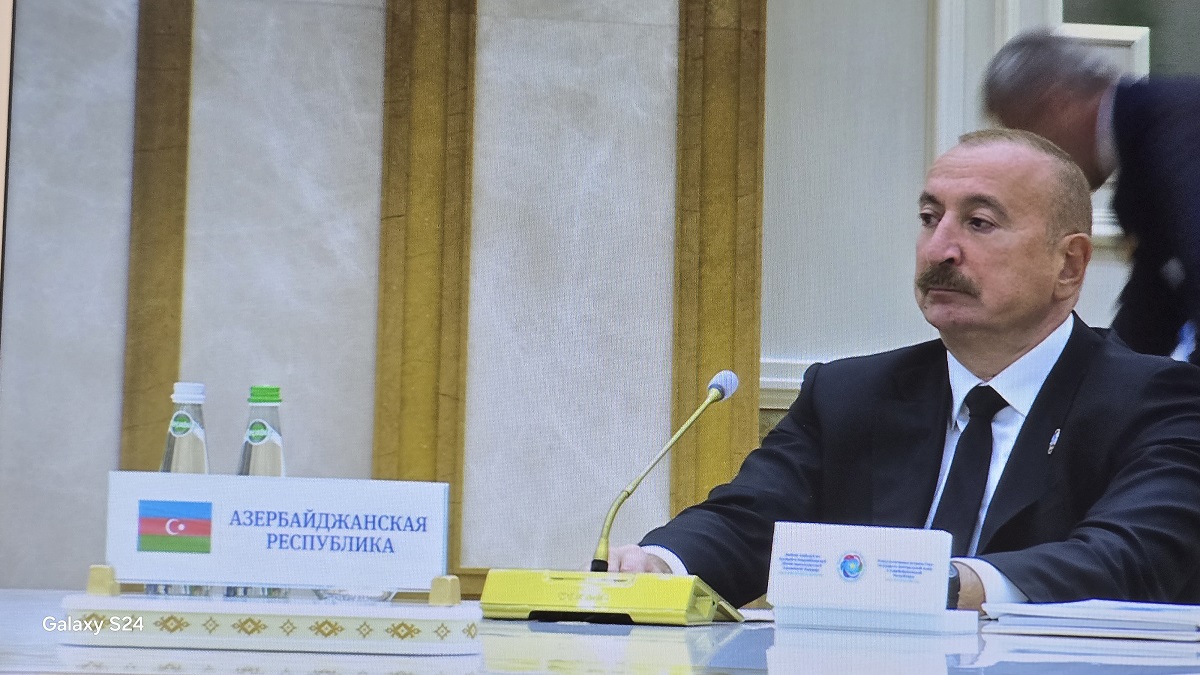
Azerbaijan Enters the Consultative Format as a Full Participant
AWAZA, Turkmenistan — The Consultative Meeting of the Heads of State of Central Asia and Azerbaijan held in Awaza on 8 October 2026 marked a significant change in the geometry of the regional dialogue.
For Azerbaijan, this was the first participation in the Consultative Meeting as a full-fledged participant. Azerbaijan’s accession was formally agreed at the Consultative Meeting in Tashkent in November 2025, following an initiative advanced by Gurbanguly Berdimuhamedov, Chairman of the Halk Maslahaty of Turkmenistan, at the informal meeting in Awaza in August 2025.
The significance of that decision became visible in full at the Awaza summit.
Technically, the traditional five-country Central Asian format has now become a C6 mechanism: Kazakhstan, Kyrgyzstan, Tajikistan, Turkmenistan and Uzbekistan, joined by Azerbaijan. The official name of the event, however, was more precise and was also reflected in the summit branding: the Consultative Meeting of the Heads of State of Central Asia and Azerbaijan.
The distinction is useful. This is not the creation of a new organization or a formal political bloc. It is an expanded consultative mechanism in which six sovereign states can coordinate positions and pursue practical cooperation where their interests converge.
For Azerbaijan, President Ilham Aliyev’s participation therefore had both a regional and bilateral dimension.
A first summit, but not a first political connection
Aliyev arrived in Turkmenistan on a working visit on the morning of 8 October and proceeded to the Awaza Complex, where he was received by President Serdar Berdimuhamedov before the leaders posed for a joint photograph.
The Azerbaijani president’s address made clear that Baku views its admission to the format as the institutional expression of a relationship with Central Asia that has already been developing rapidly.
He began by thanking President Serdar Berdimuhamedov for the invitation and hospitality and by expressing his pleasure at returning to Turkmenistan and Awaza.
He then returned to the November 2025 decision that admitted Azerbaijan as a full participant, thanking the other participating presidents for their unanimous support. Particular recognition was given to Turkmenistan and to Gurbanguly Berdimuhamedov, who, according to Aliyev, had advanced the initiative at Awaza in August 2025.
For Azerbaijan, therefore, participation in the C6 is not being presented as an isolated diplomatic development. It is part of a broader process of deepening relations with the Central Asian states.
Azerbaijan–Turkmenistan: a bilateral relationship within the wider regional framework
The bilateral relationship with Turkmenistan occupied a prominent place in Aliyev’s remarks.
The Azerbaijani president noted that five high-level visits between the two countries had taken place since 2025, describing this as evidence of the intensity of political dialogue and the two sides’ intention to strengthen bilateral relations.
He singled out one particularly symbolic project: the construction of a mosque in Fuzuli initiated by Gurbanguly Berdimuhamedov. Aliyev recalled that the two leaders had jointly attended the foundation-laying ceremony and described the project as a manifestation of friendship and spiritual affinity between the two peoples.
He also referred to assistance provided by Central Asian countries in the reconstruction of Azerbaijan’s liberated territories. Uzbekistan has built a school named after Mirzo Ulugbek in Fuzuli; Kazakhstan has established the Kurmangazy Children’s Creativity Center there; and Kyrgyzstan has built a school named after Manas in Aghdam.
These references were important because they placed Azerbaijan’s relationship with Central Asia in a broader human and political context rather than restricting it to trade and transit.
Aliyev–Berdimuhamedov meeting: the bilateral agenda
After the summit, President Ilham Aliyev held a separate meeting with President Serdar Berdimuhamedov in Turkmenbashi.
The two presidents recalled their respective visits to Azerbaijan and Turkmenistan, including visits involving Gurbanguly Berdimuhamedov and visits to Garabagh, and emphasized the contribution of these high-level contacts to bilateral relations.
The Azerbaijani presidential administration reported that the two sides discussed prospects for expanding cooperation in the political, economic, transport, transit, logistics, cultural and humanitarian spheres, together with issues concerning the Caspian Sea and cooperation within international organizations.
They also emphasized the importance of the Awaza consultative meeting in strengthening Azerbaijan’s partnership with the Central Asian states and expanding regional cooperation.
Aliyev praised the organization of the event and again expressed appreciation for the unanimous support given to Azerbaijan’s accession to the consultative format.
The two presidents subsequently exchanged views on prospects for bilateral cooperation and other matters of mutual interest.
The meeting is particularly relevant to the wider summit narrative because it illustrates how the multilateral C6 framework and the Azerbaijan–Turkmenistan bilateral relationship can operate alongside one another rather than compete with one another.
A wider economic relationship with Central Asia
In his summit address, Aliyev devoted considerable attention to the economic relationship between Azerbaijan and Central Asia.
He said Azerbaijan’s cooperation with the Central Asian countries had expanded substantially in recent years, pointing to stronger political contacts, more frequent high-level visits, growing trade, increasing investment and joint projects.
According to figures cited in his speech, Azerbaijan’s trade with the Central Asian countries increased by more than 50 percent in 2025. He also stated that more than 400 companies with Central Asian capital were operating in Azerbaijan.
The Azerbaijani president highlighted another instrument of economic cooperation: joint investment funds established with Kazakhstan, Uzbekistan and Kyrgyzstan. He noted that each has capital amounting to hundreds of millions of dollars.
His message was that these mechanisms should move beyond their existence as financial structures and be used more actively for joint projects, new manufacturing facilities and industrial cooperation.
The emphasis was therefore not simply on increasing bilateral trade.
The larger proposition was to invest together, produce together and enter external markets together.
That represents a potentially important shift in the way regional economic cooperation is conceived. Instead of treating the six economies primarily as buyers and sellers, the approach seeks to connect production, investment and external market access.
Transport: the Caspian as a connector
Transport was the most developed element of Aliyev’s economic message.
He described the Caspian Sea as increasingly important to connectivity among the countries and stressed the importance of infrastructure on both shores of the sea.
Azerbaijan, he said, had invested heavily in its transport infrastructure, including seaports, airports, railways and highways. Cargo transit across the Caspian was increasing, while the common objective should be to make the routes more efficient and competitive.
This connects directly with the wider C6 discussion about the Middle Corridor.
Aliyev stated that transit cargo on the Middle Corridor increased by more than 10 percent in 2025 and by almost another 20 percent during the first eight months of 2026.
He also referred to the Digital Silk Way project and work on laying fibre-optic cables along the seabed of the Caspian Sea.
The combination is significant.
The emerging connectivity architecture is no longer being defined exclusively in terms of railways, roads and ports. Digital infrastructure is increasingly being treated as part of the same connectivity system.
For the Central Asian states, Azerbaijan consequently offers not simply a western endpoint for a transport route, but a wider connection into the South Caucasus and onward international markets.
Energy: from transit to regional integration
Energy formed the second major infrastructure component of Aliyev’s address.
He stated that Azerbaijan plays an important role in transporting Central Asian energy resources to international markets, specifically noting that oil from Turkmenistan and Kazakhstan is transported through Azerbaijan and that volumes are increasing.
At the same time, he pointed to expanding cooperation in renewable energy.
Azerbaijan is working with Kazakhstan and Uzbekistan on the establishment of a green energy corridor, adding a new dimension to the region’s traditional energy relationships.
The significance of this approach is that the C6 framework can potentially connect conventional energy flows with emerging renewable-energy networks rather than treating them as entirely separate agendas.
The political foundation
Aliyev concluded his speech by widening the argument beyond individual economic and infrastructure projects.
He said the geopolitical significance of the cooperation format went beyond joint projects in energy and transport. Peace, security, and political and economic stability, in his formulation, constitute the foundation upon which the achievements of the six countries rest.
This was a relatively concise conclusion, but it provided the political frame for the economic proposals developed earlier in his address.
The message was essentially that connectivity cannot be separated from stability.
For Azerbaijan, therefore, the new C6 format is being approached simultaneously as a mechanism for political dialogue and as a platform for practical cooperation in trade, investment, transport, digital connectivity and energy.
The Aliyev Position: A Snapshot
Taken as a whole, President Aliyev’s address can be read through several interconnected propositions.
First, Azerbaijan sees its full participation in the consultative mechanism as the institutionalization of a relationship with Central Asia that has already been expanding.
Second, Baku places particular importance on economic cooperation moving beyond trade towards joint investment, manufacturing and access to external markets.
Third, the Caspian is treated as a central connecting space rather than a dividing body of water, with transport infrastructure on both shores forming part of a larger Eurasian network.
Fourth, the Middle Corridor and the Digital Silk Way are presented as mutually reinforcing components of physical and digital connectivity.
Fifth, energy cooperation is evolving from the movement of hydrocarbons towards wider cooperation involving renewable energy and a proposed green energy corridor with Kazakhstan and Uzbekistan.
Finally, Azerbaijan’s position links all of these areas to the broader political requirements of peace, security and stability.
This combination gives Azerbaijan’s first full participation in the consultative format a distinctly practical character. The emphasis was not on creating another institutional layer in the regional system, but on using the expanded format to connect initiatives that already exist or are being developed.
The full speech
President Ilham Aliyev’s complete address is available on the official website of the President of the Republic of Azerbaijan.
Full Speech of President Aliyev
https://president.az/en/articles/view/73715?utm_source=chatgpt.com
The visit continues
President Aliyev’s programme in Turkmenistan is not yet necessarily complete.
The Turkmen Ministry of Foreign Affairs stated upon his arrival that his visit would include participation not only in the Consultative Meeting of the Heads of State of Central Asia and Azerbaijan, but also in the first Caspian Environmental Summit and the meeting of the CIS Council of Heads of State, with bilateral high-level meetings also planned.
For the moment, however, the central fact is established: Azerbaijan has entered the traditional Central Asian consultative mechanism as a full participant, and its first summit-level contribution in Awaza has placed connectivity, investment, production, energy and regional stability at the centre of its position.
The C6 has therefore moved from a concept discussed in 2025 to an operating political format in 2026. /// nCa, 8 October 2026