


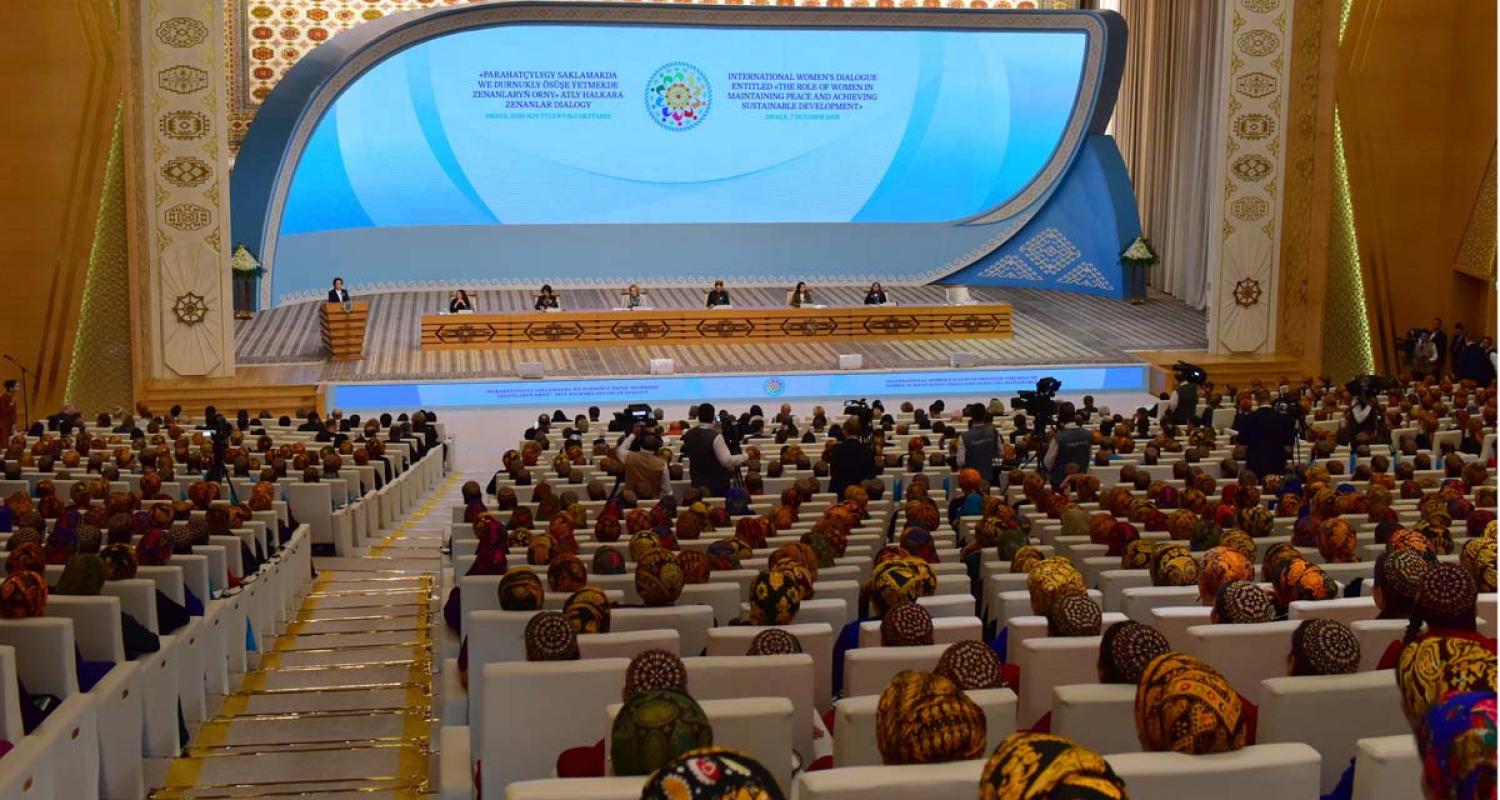
AVAZA, Turkmenistan – Valentina Matviyenko’s visit to Turkmenistan for the events in Avaza has unfolded across several different layers of regional diplomacy, bringing together Russian-Turkmen relations, parliamentary cooperation, healthcare, humanitarian issues and the international discussion on the role of women in peace and sustainable development.
The Chairwoman of the Federation Council of the Russian Federal Assembly and Chairwoman of the Council of the CIS Interparliamentary Assembly arrived in Avaza to participate in the International Women’s Dialogue “The Role of Women in Maintaining Peace and Achieving Sustainable Development.” But her programme quickly demonstrated that the visit was considerably broader than participation in a single forum.
On October 6, she was received in Avaza by Gurbanguly Berdimuhamedov, the National Leader of the Turkmen people and Chairman of the Halk Maslahaty. Their meeting focused on the state of Russian-Turkmen relations and the implementation of agreements reached at the highest levels. Matviyenko described bilateral relations as developing consistently across a broad range of areas and noted the contribution of high-level political contacts to taking cooperation to a new stage.
The meeting also touched directly on the purpose of her visit. Matviyenko praised the organisation of the International Women’s Dialogue and said it reflected the importance accorded to the role of women in society. She specifically recognised the contribution of Oguljahan Atabayeva, Vice President of the Gurbanguly Berdimuhamedov Charitable Foundation for Assistance to Children in Need of Guardianship, to the preparation and organisation of international women’s forums.
The following day, Matviyenko met Dunyagozel Gulmanova, Chairwoman of the Mejlis of Turkmenistan. Their discussion highlighted the steady development of bilateral interparliamentary relations and Matviyenko’s role in strengthening contacts between the legislators of the two countries, as well as in advancing the parliamentary women’s agenda.
The parliamentary dimension is particularly significant. The two sides support cooperation between interparliamentary friendship groups, specialised committees, young parliamentarians and women parliamentarians. Such contacts are increasingly becoming a practical layer of diplomacy alongside traditional government-to-government relations.
Matviyenko’s engagement was not confined to parliament.
At the International Women’s Dialogue, she addressed the broader question of women’s contribution to peace and sustainable development, participating alongside parliamentarians, international organisations and representatives of governments from the region and beyond. The dialogue itself examined women’s role in peacebuilding, the Sustainable Development Goals, international law and the Women, Peace and Security agenda.
She also took part in the second international conference on Universal Health Coverage and the Sustainable Development Goals, another event held in Avaza during the same period. In her address, Matviyenko linked health policy with interparliamentary cooperation, stressing the importance of children’s health, health legislation and scientific and research cooperation within the CIS.
That combination is worth noting. The same senior parliamentarian was participating in discussions about international peace and women’s role in sustainable development, while also engaging with questions of healthcare legislation, children’s health and scientific cooperation. These are not separate policy worlds: they intersect around the quality of governance and the wellbeing of populations.
There was also a strong humanitarian dimension to the Avaza programme. The International Women’s Dialogue brought together political and parliamentary figures with representatives of international organisations and humanitarian institutions. Turkmenistan’s Gurbanguly Berdimuhamedov Charitable Foundation, whose work with children was highlighted during the health conference as well, formed part of that wider humanitarian setting.
Taken together, Matviyenko’s engagements during the Avaza meetings present an interesting picture of how contemporary parliamentary diplomacy can operate. A senior political figure can move in a single visit from high-level bilateral relations to interparliamentary contacts, from health legislation to scientific cooperation, and from humanitarian issues to questions of peace and women’s participation in public life.
There is also a quieter observation to be made about gender parity.
Matviyenko’s significance in these meetings does not derive from the fact that she is a woman. She occupies one of the highest political and parliamentary positions in Russia and is an experienced participant in international diplomacy. Her record and institutional position are the reasons for the weight attached to her interventions.
Yet her presence in Avaza is also a useful illustration of how women’s participation in senior public life has changed the character of international dialogue. She was not present in a symbolic capacity. She was simultaneously engaged as a national political leader, parliamentarian, CIS parliamentary figure and participant in discussions on health, peace and sustainable development.
The distinction matters. Women’s empowerment is most meaningful when accomplished women are present at the table because of their competence, authority and experience—and when their presence becomes normal rather than exceptional.
In that sense, Matviyenko’s Avaza programme offered its own quiet illustration of the theme being discussed at the International Women’s Dialogue.
The visit also underlined the unusually broad character of the Avaza programme itself. What might otherwise have been a sequence of separate conferences and meetings became, in practice, a dense network of political, parliamentary, humanitarian and policy contacts.
For Turkmenistan and Russia, the immediate result is a further layer of parliamentary and institutional engagement. For the wider CIS, Matviyenko’s multiple roles demonstrate how parliamentary diplomacy is increasingly intersecting with questions traditionally handled through government ministries: health, social policy, humanitarian cooperation, sustainable development and women’s participation.
And for Avaza, her programme offered another indication that the current gathering is functioning as more than a series of individual events. It is becoming a meeting point where several strands of regional diplomacy converge. /// nCa, 8 October 2026