


nCa Context
From One to All: The Changing Language of Modern Diplomacy
When we think about global politics, we often picture massive rooms like the United Nations, where nearly every country in the world gathers to debate and vote. For a long time, this was the gold standard of global problem-solving.
However, as the world becomes more complex, the ways countries talk to one another are changing. To describe these changes, political scientists and diplomats use a specific set of terms ending in “-lateral” (from the Latin word for “side”).
Beyond bilateral and multilateral, there are other forms of -lateralism. Here is a guide to the actual terms used in modern diplomacy today—written in plain language.
The Core Terms We Already Know
To understand the newer terms, it helps to anchor them against the two traditional pillars of foreign policy:
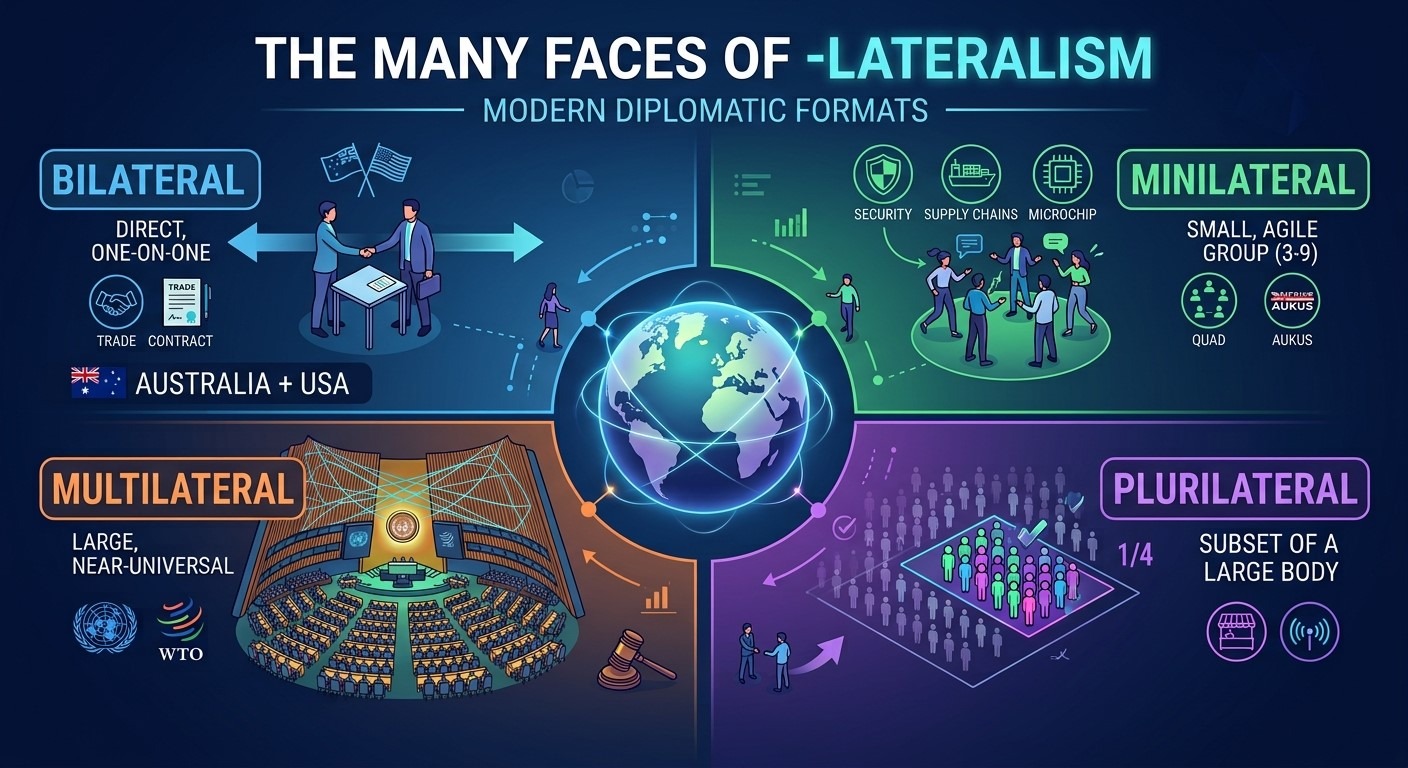
- Bilateralism (Two Sides): This is direct, one-on-one diplomacy. When Australia and the United States sign a trade deal, or when two leaders sit down in a private room to resolve a border dispute, they are working bilaterally. It is highly focused but limited to just two actors.
- Multilateralism (Many Sides): This involves large, formal groupings of countries working under shared rules. The ultimate example is the United Nations (UN) or the World Trade Organization (WTO). Multilateralism is powerful because it creates global laws, but it is notoriously slow because getting nearly 200 countries to agree on anything is incredibly difficult.
Do “Microlateral” and “Nanolateral” Exist?
The short answer is no. In formal political science, international law, or diplomatic history, “microlateral” and “nanolateral” are not recognized terms.
If you happen to see them in an online article or a speech, they are being used casually as metaphors. A commentator might invent the word “microlateral” to describe an incredibly small, hyper-local agreement between two tiny island states, but it is not an official concept.
However, a very similar prefix does officially exist—and it has completely changed modern diplomacy.
The Rise of “Minilateralism”
Coined in the late 2000s, minilateralism describes diplomacy involving a small, targeted group of countries (usually between 3 and 9 members).
Minilateralism was born out of frustration with large multilateral bodies. When the UN or WTO stalls because countries cannot agree, a small handful of like-minded nations will form a “minilateral” group to get things done quickly. These groups do not try to fix every global issue; instead, they focus on one highly specific problem, such as maritime security or supply chains.
Because they are small, they are agile, fast, and informal.
Famous Examples of Minilateral Groups:
- The Quad: A diplomatic partnership between Australia, India, Japan, and the United States focused on security and cooperation in the Indo-Pacific region.
- AUKUS: A security partnership between Australia, the United Kingdom, and the United States.
- The G7: A group of seven of the world’s most advanced economies that meet regularly to coordinate global economic policy.
Other Real “Lateral” Terms
Beyond minilateralism, there are two other legitimate concepts you might encounter in global governance:
1. Plurilateralism (A Club Within a Club)
This term is most common in international trade. Imagine a massive club with 160 members (like the WTO). It is impossible to get all 160 members to agree to a new rule on digital trade. Under a plurilateral agreement, a smaller subset of those members (say, 40 countries) will agree to the new rules among themselves. The rest of the club members do not have to sign it, but they cannot stop the smaller group from moving forward.
2. Omnilateralism (All Sides, Including Us)
This is a newer, more philosophical concept. Traditional diplomacy only happens between nation-states (governments). Omnilateralism argues that modern problems—like climate change, global pandemics, and artificial intelligence—cannot be solved by governments alone. It describes a framework where governments, private corporations, non-profit organizations, and civil society all have an official seat at the table to solve universal threats to humanity.
Summary: The Diplomatic Spectrum
| Term | Number of Players | The Main Advantage | The Main Disadvantage |
| Bilateral | Exactly 2 | Highly customized and direct | Ignores the wider global context |
| Minilateral | Small group (3–9) | Fast, flexible, and action-oriented | Excludes other countries, causing resentment |
| Plurilateral | Subset of a larger body | Allows willing countries to progress faster | Can fragment global trade rules |
| Multilateral | Large / Near-universal | Creates legitimate, global laws | Very slow and prone to political gridlock |
Ultimately, modern diplomacy is no longer about choosing just one method. A nation like Australia will use bilateral talks for immediate neighbors, minilateral groups like the Quad for regional security, and the multilateral UN for global international law. /// nCa, 22 September 2026 (photo – AI-generated image)