


nCa Report
Iran serves as a critical transit hub connecting the Middle East, Central Asia, South Asia, the Caucasus, and Europe through a network of land, rail, and sea routes. Its strategic location facilitates the efficient movement of goods, supporting regional trade and economic integration.
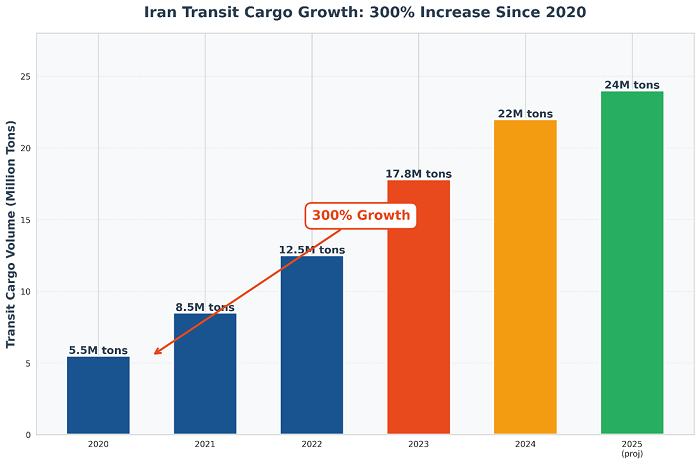
Over the last three years (2023-2025), Iran’s transit infrastructure has seen significant growth in cargo volumes, driven by initiatives like the International North-South Transport Corridor (INSTC) and enhanced rail connections.
Total transit cargo through Iran reached approximately 20.3 million tons in the 11 months ending February 2025, with projections for continued expansion.
In 2024, transit volumes exceeded 22 million tons, marking a 300% increase from 2020 levels. This growth underscores Iran’s role in enabling seamless trade flows amid global supply chain demands.
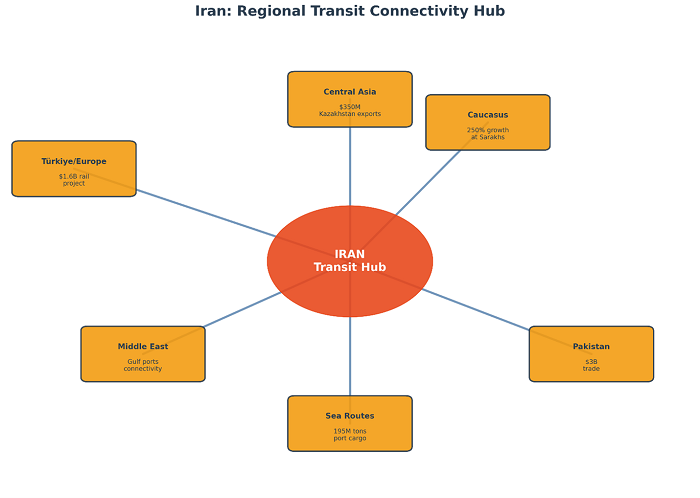
Transit Between Middle East and Central Asia
Iran acts as a vital land bridge for trade between the Middle East (including countries like Saudi Arabia, UAE, and Iraq) and Central Asia (such as Kazakhstan, Uzbekistan, and Turkmenistan). Routes through Iran offer shorter and more cost-effective alternatives to longer sea or northern paths, particularly via the INSTC, which connects Persian Gulf ports to Caspian Sea crossings.
Key data on cargo volumes:
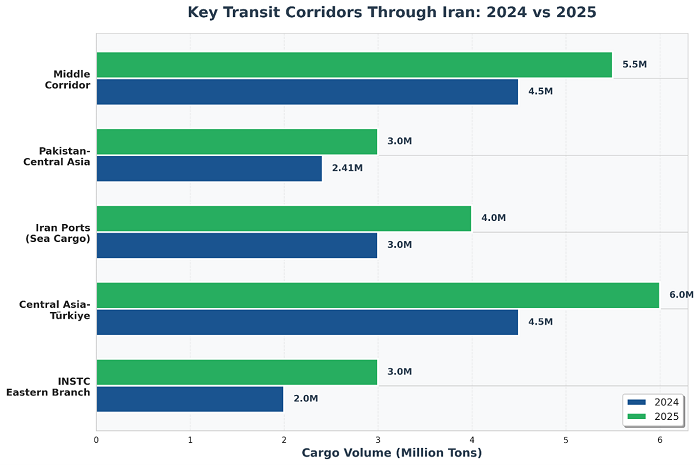
- In 2024, approximately 2 million tons of cargo moved along the INSTC eastern branch, with potential for further growth.
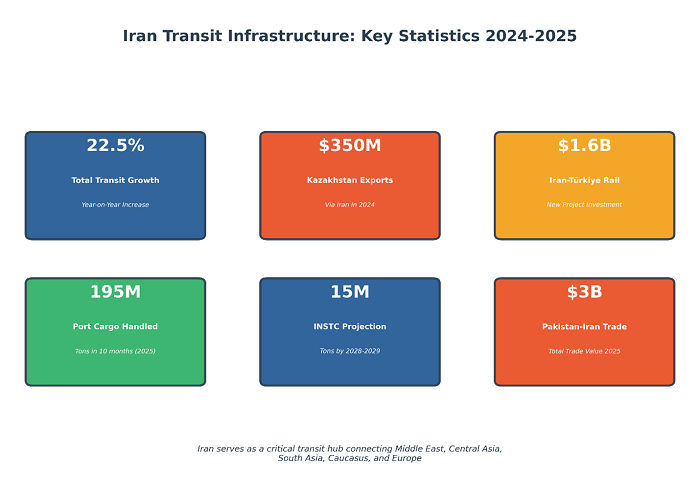
- Kazakhstan’s exports via Iran totaled about $350 million in 2024 and $120 million from January to May 2025.
- Iran-Turkmenistan trade reached $340 million in 2024, with targets for expansion.
- Overall, transit cargo through Iran increased by 22.5% in the Iranian year ending March 2025 compared to the previous year.
These volumes highlight Iran’s efficiency in handling diverse cargo, supporting economic ties between oil-rich Middle Eastern states and resource-exporting Central Asian nations.
Central Asia and Turkiye (and Onward to Europe)
Trade routes from Central Asia to Turkiye often transit through Iran, leveraging rail and road networks for onward connections to Europe. This corridor enhances access to European markets, reducing dependency on longer routes via Russia or the Caspian Sea.
Notable developments and volumes:
- Trade across routes through Turkmenistan and Iran has increased up to 30 times since 2023.
- In 2025, Iran and Turkey agreed to build a $1.6 billion rail link to boost trade corridors between Asia and Europe.
- Bilateral trade between Turkey and Iran aims to reach $30 billion annually.
- Approximately 60% of Central Asian transit cargo moves via rail, with overall Eurasian freight exceeding 260 million tons in 2023.
Iran’s transit routes provide safe, cost-effective options, with cargo volumes projected to increase 1.5 times over the next five years, potentially topping 95 million tons along Central Asia’s main corridors.
Central Asia and Armenia (and Georgia)
Iran facilitates transit from Central Asia to the Caucasus region, including Armenia and Georgia, via land borders and the Caspian Sea. These routes support the Middle Corridor, offering alternatives to traditional paths and enhancing regional connectivity.
Volume insights:
- Cargo entering Iran for transit through Sarakhs (border with Turkmenistan) increased by 250% in the first nine months of 2025.
- Around 18-20 million tons of cargo pass through Georgia annually, with potential impacts from competing routes.
- The Middle Corridor, involving Iran, is forecasted to triple freight volumes to 11 million tons by 2030.
- In 2025, Azerbaijan lifted restrictions on cargo transit to Armenia, signaling improved regional flows.
These developments emphasize Iran’s role in building redundancy and reducing transit times for Central Asian goods reaching the Caucasus.
Central Asia and Sea Cargo Through Iranian Ports
Iranian ports like Bandar Abbas and Chabahar serve as gateways for Central Asian sea cargo, enabling access to global maritime routes. This is particularly important for landlocked Central Asian countries, facilitating exports and imports via the Persian Gulf.
Key volumes:
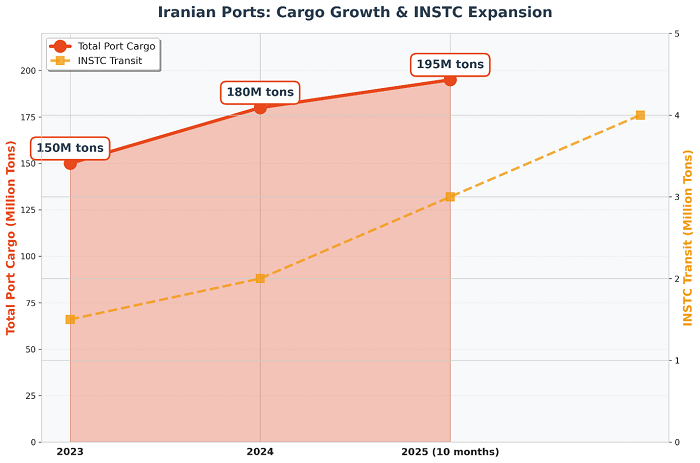
- In the 10 months from March 2024, 195 million tons of cargo were handled at Iranian ports.
- INSTC trade volumes could reach 15 million tons by 2028-2029, with 2 million tons in 2024.
- Iran aims to boost Caspian Sea transit to 35 million tons.
- Kazakhstan plans a dedicated logistics terminal at an Iranian port, supporting Middle Corridor growth.
Iran’s ports have shown resilience, with container shipping maintaining operations despite challenges.
| Year | Total Port Cargo Handled (Million Tons) | Estimated Central Asia-Related Transit (Million Tons) |
| 2023 | ~150 (approximated from growth trends) | ~1-2 (INSTC and Caspian routes) |
| 2024 | ~180 | ~2 |
| 2025 | 195 (10 months) | Projected 3+ |
Pakistan and Central Asia
Transit through Iran connects Pakistan with Central Asia, bypassing longer routes and supporting trade in goods like rice, textiles, and energy resources.
Data points:
- Pakistan-Central Asia trade (including Afghanistan) reached $2.41 billion in FY2025.
- Pakistan-Iran trade hit $3 billion in 2025, with targets for $10 billion.
- Shifts in Afghan trade to Iran and Central Asia amid Pakistan tensions, with 1.95 million tons exported to Afghanistan via Iran in 10 months.
This route enhances connectivity, with increasing volumes driven by free trade agreements.
Pakistan and Turkiye (and Onward to Europe)
Iran enables efficient transit for Pakistan-Turkey trade, with rail corridors linking to Europe. The Islamabad-Tehran-Istanbul (ITI) corridor is key for this flow.
Volumes and updates:
- Pakistan-Turkey exports were $37.9 million in October 2025.
- Pakistan-Iran trade surged to $2.7 billion in 2023 and $3 billion in mid-2025.
- ITI freight train service resumed in December 2025.
- Turkey-Iran trade targets $30 billion.
These links facilitate onward European access, boosting overall trade efficiency.
Role in Food Security and Medical Supplies
Detailed breakdowns of transit cargo by type are limited in public data, but agricultural and food products are significant in regional trade flows through Iran. For instance, cereals account for about 7.3% of Iran’s overall imports, and Iran imports over 25 million tons of crop and livestock products annually. In transit contexts, grain cargo represents a notable portion, such as 52% of traffic at Kazakhstan’s Aktau port (connected to Iran). Iran’s agricultural exports grew by 22% in value in early 2024, reaching $7.6 billion in the Iranian year 1403, indicating food items likely comprise 5-10% of transit volumes based on trade patterns.
For medicines and medical supplies, transit data is scarce, but Iran exports $100 million worth of medicines in 10 months. Regional shortages highlight the importance of stable transit routes, with Iran’s pharmaceutical sector producing 99% of its domestic needs. Disruptions could affect supplies to neighboring regions, underscoring Iran’s transit role in health security.
In summary, Iran’s transit infrastructure is indispensable for regional connectivity, with growing volumes supporting economic stability and essential goods flow.
Detailed list of sources consulted for the preparation of this report:
General Transit Volumes and Growth in Iran
- Iran Reports New Record In Cargo Transit – Details on 20.3 million tons of transit cargo in 2025.
- Over 545m tons of cargo transported across Iran in 11 months – Road network cargo data for 2024-2025.
- Iran sees increase in transit via country – 42% increase in transit from March to October 2024.
- Iran Logistics Market 2033 – Market size and growth projections, including 2024 figures.
- Cargo transit traffic through Iran expands – 22.5% increase in transit for 2024-2025 Iranian year.
- Iran’s Transit Boom Shocks Competitors – Transit times and volumes from Central Asia to Iranian ports in 2025.
INSTC and Middle East-Central Asia Routes
- How Iran Lost the Competition For New Transit Corridors – Transit volume of 17.8 million tons in recent Iranian year.
- The International North-South Transport Corridor – Overview of INSTC routes and connections to Gulf and Central Asia.
- The North–South Transport Corridor and Energy-Related Exports – 26.9 million tons of INSTC freight in 2024.
- International North–South Transport Corridor – Multi-mode network details and freight movement.
- Russia, Iran INSTC Trade Volumes Could Reach 15 Million Tonnes – 2 million tons in 2024, projections to 15 million by 2028-2029.
- INSTC Eastern Corridor: India’s Gateway to Central Asia – Cargo movements via Mundra to Central Asia through Iran in 2025.
Central Asia to Turkiye/Europe and Caucasus Routes
- Central Asian states registering impressive trade gains – 60% rail transit and projections to 95 million tons over five years.
- Turkey in the Middle Corridor: Hub between Europe and Asia – Middle Corridor freight transport details.
- The race for Central Asia’s transport routes – Shifting transit hubs in Central Asia and Caucasus.
- Georgia Evaluates Competition with Armenia over the Middle Corridor – 18-20 million tons annual cargo through Georgia.
- Iran Proposes Establishing Iran-Azerbaijan-Georgia Transit Corridor – TRACECA framework proposals in 2025.
- How Will Central Asia Benefit from the Extension of Trans-Caspian Routes – 4.5 million tons via Middle Corridor in 2024.
- Tentative Armenia-Azerbaijan Plan Could Boost the Middle Corridor – Freight volume tripling projections to 2030.
- Iran Container Transit 2025: Key Routes & Solutions for Global Trade – Gulf-Central Asia corridor for landlocked countries.
Sea Cargo Through Iranian Ports
- Kazakhstan reaffirms plan for dedicated logistics terminal at Iran’s ports – Multimodal terminals and Middle Corridor volumes in 2025.
- Iranian container shipping shows defiance amid 2025 sanctions surge – Container volumes at Bandar Abbas and other ports.
- Iran Cargo Shipping Market (2025-2031) – Historical and forecast volumes by port developments.
- Intermodal Logistics Networks Linking the Persian Gulf with Central Asia – 19% year-on-year growth in 2024.
Pakistan-Central Asia and Pakistan-Turkiye/Europe Routes
- Pakistan’s Trade With Afghanistan, Central Asia Climbs To $2.5 Billion – $2.41 billion trade in FY2025.
- Iran benefits from Afghanistan-Pakistan border clashes, trade surges – Trade shifts to Iran routes in 2025.
- Herat Boosts Exports via Iran and Central Asia as Pakistan Routes Close – Transit pathways through Iran.
- Istanbul–Tehran–Islamabad railway – ITI corridor for freight between South Asia, West Asia, and Europe.
- Iran and Turkey are building a new USD 1.6 billion railway corridor – 1,500 tons initial cargo in 2025.
- Iran, Turkey agree to build $1.6 billion trade rail link – Strategic corridor between Asia and Europe.
- Iran, Pakistan, Turkey to relaunch container train service in December – ITI resumption in 2025.
- Afghanistan shifts trade to Iran route to avoid Pakistan closures – Discounts at Chabahar and growth in Central Asia routes.
Food Security and Medical Supplies
- The Effects of the Re-imposition of US Sanctions on Food Security in Iran – Food insecurity percentages and import impacts.
- Drop in animal feed imports fuel fears over Iran’s food security – 60% decrease in soybean meal imports in 2025.
- Iran’s Agricultural Exports: Expanding Footprint in the Middle East – $7.6 billion agricultural exports in 2024-2025 Iranian year.
- Analyzing the international trade-related food miles in Iran – Food transport distances and volumes.
- Potential escalation in Israel-Iran conflict poses risks to food security – Agricultural transit vessels in 2025.
- Iran drug stocks under two months, 800 medicines at risk – Medicine shortages and import volumes in 2025.
- Iran sanctions: What impact are they having on medicines? – Exemptions and supply challenges.
- “Maximum Pressure”: US Economic Sanctions Harm Iranians’ Right to Health – Access to essential medicines.
- Iran medical suppliers warn of worsening drug shortages – Vital medicine supplies at risk in 2025.
- Iran and Strait of Hormuz Crisis – Impact on Pharmaceutical Supply Chain – Pharmaceutical production and transit values.
These sources were selected based on their relevance to the data points in the report, such as cargo volumes, percentage estimates for food items (derived from agricultural trade patterns), and medical transit figures. Some data was cross-verified across multiple sources for accuracy. /// nCa, 6 January 2026