


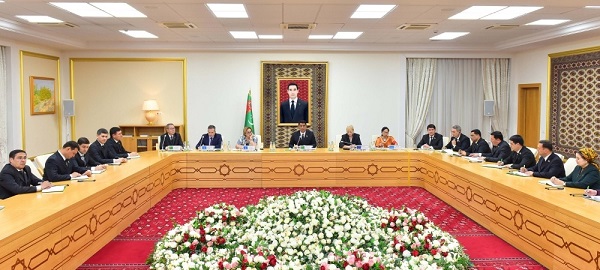
On 14 May 2026, the Mejlis of Turkmenistan hosted a conference titled “The Constitution – A Legal Guarantee for State Development and Social Prosperity,” held in honor of the Day of the Constitution and the National Flag of Turkmenistan in a hybrid format.
The forum served as a platform for exchanging advanced legal practices and showcasing positive initiatives aimed at strengthening peace, security, and sustainable development. Participants included heads of UN structural agencies in Turkmenistan, the Ambassador of the European Union to Turkmenistan, representatives from the parliaments of Central Asian countries and Azerbaijan.
Speakers emphasized that Turkmenistan, committed to its legal status of permanent neutrality, consistently proposes regional and global initiatives to ensure universal security and promote mutually beneficial multilateral cooperation. They also highlighted the country’s concrete steps toward unifying international efforts to uphold the role of international law.
Key Discussion Points
Narine Sahakyan, the UN Development Programme (UNDP) Resident Representative in Turkmenistan, noted that the provisions of the Constitution—which establish Turkmenistan as a democratic, law-based, and secular state—hold particular significance for the UN and the international community at large. The Constitution identifies the individual as the highest value of society and the state, making the protection of human rights and freedoms the paramount duty of state authorities.
Special attention was given to the initiative proposed by President Serdar Berdimuhamedov during the plenary session of the 80th UN General Assembly: declaring 2028 the “Year of International Law.” Turkmenistan continues to consistently advocate for the central role of the UN and the priority of universally recognized norms of international law, principles which are deeply embedded in the nation’s constitutional framework.
Beata Peksa, the EU Ambassador to Turkmenistan, noted that within the European Union, constitutions are viewed not merely as legal documents, but as unshakeable principles of justice, stability, and human dignity, serving as a living link between the state and its citizens. She remarked that a constitution is more than a collection of laws—it represents the spirit of the people, guaranteeing rights, strengthening stability, and fostering progress. The European Union remains a reliable partner for Turkmenistan in its efforts to strengthen the rule of law, protect human rights, and modernize the judicial system.
M. Kuliev, Chairman of the Mejlis Committee on International and Inter-parliamentary Relations, emphasized the new historical stage in relations with Central Asian countries and Azerbaijan. He noted that inter-parliamentary cooperation strengthens democratic values and regional stability.
Nurlan Beknazarov, Chairman of the Committee on Constitutional Legislation, Judicial System, and Law Enforcement Agencies of the Senate of the Parliament of Kazakhstan, highlighted the symbolic timing of the conference. He pointed out that Kazakhstan is also currently undergoing a major phase of political, institutional, and economic modernization aimed at creating a more sustainable, balanced, and open model of state development. The primary goal of these reforms is to further strengthen the country’s statehood, independence, and sovereignty—objectives that have gained particular significance in the modern era. Speaking on bilateral ties, he stressed that Turkmenistan remains a good neighbor and a vital political and economic partner. The two nations are united by shared historical roots, centuries-old traditions of good-neighborliness, cultural proximity, and a unique geostrategic position. Regular contacts at the inter-parliamentary level confirm the strategic nature of Kazakh-Turkmen relations.
Marat Bashimov, a member of the Committee on Legislation and Judicial-Legal Reform of the Mazhilis of the Parliament of Kazakhstan, noted that Kazakhstan was among the first nations to implement reforms regarding the protection of digital rights. He emphasized that rights in this field are highly developed within the country, leading to a series of amendments and additions to the Constitution of Kazakhstan to address these modern challenges.
Ali Muhammad oglu Huseynli, Chairman of the Committee on Legal Policy and State Building of the Milli Majlis of Azerbaijan, discussed the constitutional status granted to the European Convention on Human Rights in Azerbaijan. He underscored the historical importance of restoring the Constitution’s jurisdiction over the country’s entire territory in 2020. Furthermore, the speaker highlighted the ongoing peaceful agenda between Azerbaijan and Armenia, noting that sustainable peace—achieved through the opening of transport and communication routes—will contribute to the realization of social and economic rights in the region and support long-term stability.
Elvira Surabaldieva, Chairperson of the Committee on International Affairs, Defense, Security, and Migration of the Jogorku Kenesh of the Kyrgyz Republic, recalled the pivotal role of Kyrgyzstan’s first Constitution (1993) in establishing sovereignty and democracy. She noted that in subsequent years, the Basic Law has undergone several amendments to refine the public administration system and further develop democratic processes, with the current version adopted via referendum in 2021. Surabaldieva emphasized that inter-parliamentary cooperation between Kyrgyzstan and Turkmenistan is a crucial mechanism for strengthening bilateral relations and political dialogue. She expressed the Kyrgyz side’s readiness to expand contacts between parliamentary friendship groups and specialized committees to launch new joint initiatives.
Lakshmi Bhawani, Deputy Representative of the UN Children’s Fund (UNICEF) in Turkmenistan, characterized the Constitution as the bedrock for protecting children’s rights. She highlighted the significance of the National Action Plan for 2023–2028 and urged that investments in children be viewed as essential contributions to the country’s future. Currently, this National Action Plan serves as a vital platform for inter-agency coordination to enhance child welfare. Bhawani reaffirmed that UNICEF supports the Government of Turkmenistan in building an inclusive and prosperous future, rooted in constitutional guarantees, international obligations, and national development priorities.
Yagmyr Nuryev, Director of the Institute of State, Law, and Democracy of Turkmenistan, characterized the Constitution as the legal foundation for peace and harmony. He noted that the harmonization of the national legal system with international law, along with Turkmenistan’s international initiatives based on the modern concept of neutrality, are aimed at strengthening global trust and ensuring favorable conditions for sustainable development worldwide.
Armands Pupols, Political Affairs and Human Rights Officer at the UN Regional Centre for Preventive Diplomacy for Central Asia (UNRCCA), highlighted the preventive function of the Constitution in mitigating conflict risks. By clearly defining the branches of power, protecting fundamental rights, establishing accountability mechanisms, and enshrining peaceful, legal processes for political transition and dispute resolution, the Constitution serves as a vital tool for maintaining regional stability.
Sapargul Utemuratova, a member of the Committee on Entrepreneurship Development and Competition of the Legislative Chamber of the Oliy Majlis of Uzbekistan, presented the results of the 2023 constitutional reform. She explained that the new Constitution of Uzbekistan formalizes the principles of a social state, where the individual—along with their life, freedom, honor, and dignity—is recognized as the highest value. Special emphasis is now placed on social guarantees and the support of families, youth, and vulnerable populations.
Ilhom Ikrom Kamolzoda, Chairman of the Committee on State Building and Local Self-Government of the Majlisi Namoyandagon of the Majlisi Oli of Tajikistan, emphasized the Constitution’s role as a tool for achieving the UN Sustainable Development Goals (SDGs), particularly in health and education. In a broader context, he noted that the Constitution serves as the vital link between international development targets and national policy. An analysis of constitutional provisions across CIS states suggests that the Constitution plays a far more significant role than simply being the state’s Basic Law; in the modern world, it is the primary mechanism for implementing the SDGs, as it is through constitutional norms that state policy directions and human rights guarantees are codified.
Mahmadali Vatanzoda, Chairman of the Committee on Constitutional Foundations, Rights and Freedoms of Man and Citizen, and Legality of the Majlisi Milli of Tajikistan, pointed out that more than one-third of the articles in Tajikistan’s Constitution are dedicated to human rights. He stated that human rights represent the largest institution of constitutional law, designed to ensure a dignified life and provide the necessary conditions for free labor and personal development. /// nCa, 15 May 2026